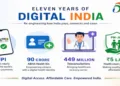
India’s ambitious effort to build a nationwide digital health ecosystem has reached a significant milestone, with the Ayushman Bharat Digital Mission (ABDM) emerging as one of the largest digital health networks in the world. The mission, launched to create a seamless and interoperable digital healthcare infrastructure, has now generated more than 93.95 crore Ayushman Bharat Health Account (ABHA) numbers and linked over 105 crore digital health records.
The achievement was highlighted during the third meeting of the Mission Steering Group (MSG), chaired by Union Minister for Health and Family Welfare Jagat Prakash Nadda. The meeting reviewed the progress made under the mission and discussed the roadmap for expanding the reach and impact of digital healthcare services across the country.
Addressing the gathering, Nadda emphasised that India has successfully established a robust digital health infrastructure over the last few years. However, he stressed that the next phase of the mission must focus on maximising adoption and utilisation so that citizens, healthcare providers and institutions can fully benefit from the digital ecosystem that has been created.
According to the Health Minister, digital public infrastructure has become a powerful tool for improving access to healthcare, enhancing continuity of treatment and empowering citizens through secure access to their health records. He noted that technology must continue to serve as a key enabler in India’s journey towards Universal Health Coverage while ensuring healthcare remains inclusive, accessible and citizen-friendly.
What is the Ayushman Bharat digital mission?
The Ayushman Bharat Digital Mission was launched by the Government of India as a key component of the country’s broader digital transformation agenda. The mission aims to create an integrated digital healthcare ecosystem that connects patients, healthcare providers, hospitals, laboratories, pharmacies and government health programmes through a common digital framework.
At the heart of the mission is the concept of interoperability. Traditionally, health records in India have been scattered across hospitals, clinics and diagnostic centres, making it difficult for patients to access their complete medical history. ABDM seeks to address this challenge by creating a digital architecture that enables health information to be securely shared across healthcare providers with the consent of patients.
The mission functions as a Digital Public Infrastructure for healthcare, similar to how Aadhaar transformed identity verification and how UPI revolutionised digital payments. By establishing common digital standards and platforms, ABDM aims to simplify healthcare delivery and improve patient experiences across the country.
The significance of ABHA IDs
One of the most important components of the Ayushman Bharat Digital Mission is the Ayushman Bharat Health Account, commonly known as ABHA.
The ABHA number serves as a unique digital health identifier for every individual. It allows citizens to create and maintain a longitudinal health record that can be accessed across different healthcare providers with their consent.
The generation of more than 93.95 crore ABHA IDs represents a remarkable achievement in India’s healthcare digitisation journey. It means that a substantial portion of the country’s population is now connected to the national digital health ecosystem.
For patients, ABHA IDs eliminate the need to repeatedly carry physical documents and medical records. Health information can be securely stored and accessed digitally, improving continuity of care and enabling better clinical decision-making.
The widespread adoption of ABHA IDs also lays the foundation for a future where healthcare becomes more personalised, efficient and data-driven.
Over 105 crore digital health records linked
Beyond the creation of ABHA IDs, the mission has also made significant progress in linking digital health records.
According to the Ministry of Health and Family Welfare, more than 105 crore digital health records have been connected to the ABDM ecosystem. These records include information related to consultations, diagnoses, prescriptions, laboratory reports and other healthcare interactions.
The ability to maintain comprehensive digital health records offers several benefits. Patients can access their medical history from different healthcare providers through a single platform. Doctors can make more informed decisions based on complete health information rather than fragmented records. Healthcare providers can avoid duplication of tests and procedures, improving efficiency and reducing costs.
The linking of over 105 crore records demonstrates the growing acceptance of digital healthcare systems among healthcare institutions and citizens alike.
Building a National Digital Health Network
A key objective of the Ayushman Bharat Digital Mission is to create a nationwide network of healthcare facilities and professionals.
The mission has already registered more than 5.33 lakh health facilities and nearly 9.85 lakh healthcare professionals on national digital health registries. These registries serve as trusted databases that help patients identify verified healthcare providers and institutions.
The participation of such a large number of hospitals, clinics, diagnostic centres and healthcare professionals indicates the scale at which the digital health ecosystem is expanding.
The registries also contribute to transparency and accountability by creating standardized records of healthcare institutions and practitioners across the country.
As more facilities and professionals join the platform, citizens gain greater access to trusted healthcare services through digital channels.
Transforming Patient Experience Through Technology
One of the most visible outcomes of ABDM has been the improvement in patient convenience.
The Health Ministry reported that nearly 24 crore Scan & Register tokens have been generated under the mission. This feature allows patients to quickly register for outpatient department (OPD) services using digital tools, reducing waiting times and simplifying hospital visits.
Traditionally, patients often spent considerable time completing registration procedures and managing paperwork. Digital registration systems help streamline these processes, making healthcare access faster and more efficient.
The Scan & Register feature also supports seamless sharing of health information between healthcare providers with patient consent, reducing administrative burdens and improving continuity of care.
Such innovations demonstrate how digital tools can improve everyday healthcare experiences for millions of citizens.
The expansion of ABDM is also evident in the growing number of healthcare institutions adopting digital health solutions.
According to official figures, more than 2.72 lakh healthcare facilities have adopted ABDM-enabled software. These software solutions facilitate digital record management, interoperability and secure data exchange.
The adoption of standardized digital platforms is critical for ensuring that healthcare information can move seamlessly across institutions while maintaining privacy and security.
Healthcare providers benefit from improved record management and operational efficiency, while patients gain access to more integrated healthcare services.
The growing adoption of ABDM-enabled software suggests that digital healthcare is increasingly becoming part of routine medical practice across India.
Integration with Major Health Schemes
One of the defining strengths of the Ayushman Bharat Digital Mission is its integration with several flagship government healthcare programmes.
During the Mission Steering Group meeting, members reviewed progress in integrating ABDM with schemes such as Ayushman Bharat Pradhan Mantri Jan Arogya Yojana (PM-JAY), the Central Government Health Scheme (CGHS), Employees’ State Insurance Corporation (ESIC) and Nikshay, India’s programme for tuberculosis elimination.
These integrations are helping create a more unified healthcare ecosystem where beneficiaries can access services through interconnected digital platforms.
For example, patients covered under PM-JAY can benefit from streamlined healthcare delivery and improved record management. Similarly, integration with programmes such as CGHS and ESIC enhances service delivery for government employees and workers.
By bringing multiple health programmes onto a common digital framework, ABDM is helping reduce fragmentation and improve coordination across the healthcare system.
The expansion of ABDM has been supported by active participation from states and Union Territories.
Members of the Mission Steering Group appreciated the progress achieved through initiatives such as Model Districts, Model Facilities and Aarogya Setu 2.0. These initiatives have played a significant role in accelerating digital health adoption at the grassroots level.
The meeting was attended by Tripura Chief Minister Manik Saha, Madhya Pradesh Deputy Chief Minister Rajendra Shukla and several Union Ministers of State, reflecting the collaborative approach being adopted to strengthen the mission.
State governments are playing a crucial role in implementing digital health initiatives, promoting awareness and encouraging healthcare providers to adopt ABDM standards.
The success of the mission ultimately depends on effective coordination between the Centre, states and healthcare institutions.
Strengthening Governance and Interoperability
As the digital health ecosystem expands, governance and interoperability have become increasingly important.
The Mission Steering Group discussed measures to accelerate nationwide adoption of ABDM by promoting nationally notified digital health standards and strengthening governance mechanisms.
Interoperability remains one of the core principles of the mission. It ensures that healthcare information can be exchanged seamlessly between different systems, institutions and service providers.
Without interoperability, digital healthcare platforms risk becoming isolated systems that cannot communicate effectively with one another. ABDM seeks to avoid this challenge by establishing common standards and protocols for data exchange.
The focus on governance is equally important, particularly in areas such as data security, privacy protection and consent management.
Artificial Intelligence and the Future of Digital Healthcare
Looking ahead, members of the Mission Steering Group discussed the role of emerging technologies in shaping the future of healthcare.
Artificial Intelligence (AI), advanced analytics and other digital technologies are expected to play an increasingly important role in improving diagnosis, treatment planning, disease surveillance and healthcare management.
The future roadmap for ABDM includes leveraging these technologies while strengthening institutional capacities and enhancing collaboration with states and Union Territories.
AI-driven healthcare solutions have the potential to improve efficiency, support clinical decision-making and expand access to healthcare services, particularly in underserved regions.
However, the successful integration of such technologies will depend on the strength of the underlying digital health infrastructure, a foundation that ABDM is currently helping to build.
Concluding the Mission Steering Group meeting, Jagat Prakash Nadda emphasized that strengthening the healthcare sector is essential for achieving the vision of Viksit Bharat by 2047.
He described ABDM as a critical pillar in this journey, capable of transforming the way healthcare services are delivered, accessed and managed across the country.
The minister noted that while significant progress has been made in creating digital infrastructure, the focus must now shift towards increasing adoption and ensuring that digital tools are effectively utilized by citizens and healthcare providers.
He expressed confidence that continued collaboration among the Centre, states, Union Territories, healthcare institutions and technology partners would help create a resilient, inclusive and future-ready healthcare ecosystem.
Building the World’s Largest Citizen-Centric Health Network
The Ayushman Bharat Digital Mission represents one of India’s most ambitious public digital infrastructure initiatives. With more than 93.95 crore ABHA IDs generated, over 105 crore health records linked, 5.33 lakh healthcare facilities registered and nearly 9.85 lakh healthcare professionals onboarded, the mission has already achieved a scale unmatched by many countries.
More importantly, it is laying the foundation for a healthcare system where citizens can access their medical records securely, receive seamless care across institutions and benefit from technology-enabled healthcare services.
As India moves towards Universal Health Coverage and the goal of Viksit Bharat 2047, the Ayushman Bharat Digital Mission is increasingly emerging as the digital backbone of the country’s healthcare transformation. The challenge ahead is no longer building the infrastructure, but ensuring that every citizen, healthcare provider and institution fully utilizes it to create a healthier, more connected and digitally empowered India.