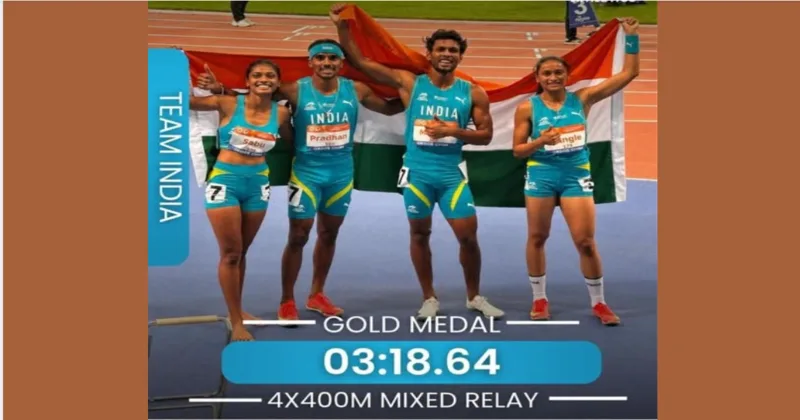
In the fading light of a dramatic evening of July 10 in Ordos, China, Indian athletics wrote a new chapter in its growing legacy. As the anchor leg of the mixed 4x400m relay unfolded, the Indian quartet found itself staring at silver.
Then stepped forward Shravani Sachin Sangle, a 20-year-old rising star whose breathtaking final surge turned certain heartbreak into pure gold.
India clocked a winning time of 3:18.64, edging past hosts China (3:18.74) by a razor-thin 0.10 seconds in one of the most thrilling finishes of the championships.
Shravani’s sensational anchor leg, overtaking the Chinese runner in the dying metres after making up a massive deficit, sealed India’s first-ever gold in the event and capped a superb opening day for the 53-member Indian contingent.
The Race That Had Everyone on Their Feet
The Indian team of Astik Pradhan, Sandra Mol Sabu, Setu Mishra, and Shravani Sachin Sangle had been in the mix throughout, but as the baton changed for the final time, China held a visible lead.
The home crowd roared in anticipation of a host nation victory.
What followed was pure theatre. Shravani received the baton slightly behind (about 20+ metres gap) and immediately began eating into the deficit with controlled aggression.
She ran with remarkable composure through the first 300 metres of her leg, closing the gap steadily without overexerting early. Then, in the final straight, she unleashed everything.
With the finish line in sight and the Chinese anchor fading under pressure, Shravani accelerated past her rival in the last 15 metres. The crowd fell into a stunned silence before erupting, this time with a mix of disbelief and appreciation for sporting excellence.
India had snatched victory from the jaws of defeat in the most spectacular fashion.
Who is Shravani Sachin Sangle?
Born on November 16, 2005, Shravani Sachin Sangle is a talented young athlete from Maharashtra who specialises in the 400 metres and 400m hurdles.
Her personal bests stand at 54.42 seconds in the flat 400m and an impressive 58.79 seconds in the hurdles (achieved in May 2026).
A product of dedicated domestic training, Shravani has steadily climbed the ranks in Indian athletics.
Her background in hurdles gives her exceptional strength, rhythm, and a powerful finishing kick, attributes that proved decisive in Ordos.
At just 20 years old, this performance marks her as one of the brightest prospects in Indian track and field, capable of delivering under the brightest lights and highest pressure.
Her anchor leg was not just about raw speed; it was a masterclass in race intelligence, mental fortitude, and tactical execution.
GOLD FOR INDIA! 🥇
The quartet of Astik Pradhan, Sandra Mol Sabu, Setu Mishra & Shravani Sachin strikes Gold in the 4x400m Mixed Relay at the Asian U23 Athletics Championships! ⚡#IndianAthletics #AFI pic.twitter.com/yjzEabl32M
— Athletics Federation of India (@afiindia) July 9, 2026
Race Tactics: A Masterful Come-From-Behind Strategy
India’s triumph was no accident. The team, guided by smart coaching decisions, employed a calculated “build and strike” approach perfectly suited for a high-stakes mixed relay.
Running Order Breakdown:
Astik Pradhan (Lead-off, Male): Tasked with providing a strong, competitive start. He secured a solid position and ensured clean handoffs while staying in touch with the leaders.
Sandra Mol Sabu (Second Leg, Female): Maintained rhythm and position through what is often the most volatile leg in mixed relays. She kept India within striking distance without burning unnecessary energy.
Setu Mishra (Third Leg, Male): The crucial bridge. In his first major international assignment, the young talent from Bihar ran aggressively to position Shravani for a shot at glory. India entered the final handoff trailing but very much alive.
Shravani’s Anchor Masterclass: This was the tactical masterstroke. Rather than panicking and going out too hard, Shravani paced her effort intelligently. She gradually reeled in the leader before exploding in the final stretch.
Her hurdles background likely helped with efficient stride mechanics and finishing power.
The ability to overcome a significant deficit on the anchor leg against a home favourite demonstrated exceptional race temperament and confidence in her closing speed.
China, as expected from the hosts, likely pushed hard early to build a buffer. While this worked for three legs, it left their anchor vulnerable to a fresher, faster-finishing opponent.
India’s strategy of conserving for the end proved superior in this high-pressure environment. Perfect handoffs throughout the race further minimised time losses and kept the team in contention.
The overall time of 3:18.64 (roughly 49.66s average per leg) shows there is still room for improvement, particularly in even pacing across all four runners, but the tactical execution was near flawless for the conditions.
A Well-Rounded Day 1 Haul for India
Shravani’s golden moment was the glittering highlight, but it was far from India’s only success on opening day.
The young squad showed impressive depth across multiple disciplines, collecting five medals in total: 1 Gold, 1 Silver, and 3 Bronzes.
In the Men’s Discus Throw, Bhartpreet Singh opened India’s account with a bronze medal throw of 52.91m. China dominated the event, with Li Zhixin winning gold (60.79m) and Jiang Zehao taking silver (59.60m).
The Men’s 5000m delivered a strong 2-3 finish for India’s distance runners. Shivaji Parashuram Madappagoudra claimed silver in a competitive 14:08.19, while Vinod Singh powered to bronze with 14:23.57. Japan’s Rui Suzuki took the gold in 14:01.24.
In the Women’s 3000m Steeplechase, Prachi Ankush Devkar finished strongly to secure bronze in 10:32.69 seconds. China completed a 1-2 here, led by Yang Yiting in 10:14.68, with Liu Yuxin taking silver in 10:25.51.
These results reflect not only individual brilliance but also the growing depth in Indian athletics at the U23 level.
With 53 athletes representing the country, the performance bodes well for the rest of the championships.
How the Chinese media is covering Home Team’s loss:
Chinese mainstream media, including Xinhua and CCTV, reported the mixed 4x400m relay result factually and briefly, noting that the home team earned silver with a time of 3:18.74, just 0.10 seconds behind India’s winning 3:18.64.
The Chinese media coverage downplays the dramatic Indian comeback and instead highlights China’s dominant overall performance on Day 1, collecting 7 golds, 4 silvers, and 2 bronzes (13 medals total) to top the standings.
Outlets focused primarily on Chinese victories in throws (hammer and discus), steeplechase, and jumps, framing the relay silver as part of a successful opening day for the hosts rather than an analytical look at the 4X400m Mixed Relay race sudden and significant upset. There is little analysis of the race tactics or specific praise for Shravani Sangle’s anchor leg.
Historical Significance for India and Looking Ahead
This mixed relay gold holds special importance as it is India’s first in the event at this championship level. Coming against the powerful Chinese team on their home soil adds extra lustre to the achievement.
For a young squad, starting the campaign with five medals and a dramatic gold creates tremendous momentum and confidence.
Shravani’s heroics will undoubtedly inspire the next generation of Indian athletes, especially young girls dreaming of track and field glory. Her story, from consistent domestic performer to continental champion in a single unforgettable sprint, captures the magic of sport.
As the championships continue in Ordos, India will look to build on this strong foundation. With several strong performers already showing podium potential and more events to come, the Indian contingent has every reason to aim higher.
For now, though, the spotlight rightly belongs to Shravani Sachin Sangle and her teammates. In a single race, they delivered drama, courage, tactical intelligence, and history. Indian athletics is on the rise, and moments like this are proof that the future is bright.