AYODHYA: Uttar Pradesh Chief Minister Yogi Adityanath on July 10 launched a blistering attack on the Congress and the Samajwadi Party during his visit to Ayodhya, accusing them of undermining the city’s religious heritage and obstructing the construction of the Ram Temple. Referring to a past controversy over namaz being offered at Hanumangarhi, the Chief Minister questioned if the Congress and Samajwadi Party have the guts to hold the recitation of Hanuman Chalisa inside Delhi’s Jama Masjid, asserting that his government had restored Ayodhya’s cultural identity and transformed it into a global centre of faith and development.
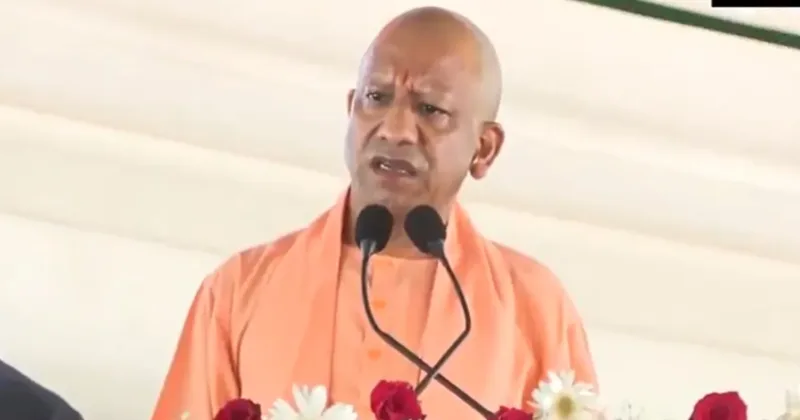
Addressing a public gathering, Yogi alleged that the Congress and the Samajwadi Party had “committed the sin” of allowing namaz to be offered on the steps of the revered Hanumangarhi Mandir. “Can anyone recite the Hanuman Chalisa inside Jama Masjid? Can the Congress or the Samajwadi Party make that happen? Then who was responsible for getting namaz offered on the steps of Hanumangarhi?” he asked, using the comparison to target the Opposition’s stance on religious issues.
#WATCH | “Can the Samajwadi Party and the Congress ever have the Hanuman Chalisa recited at the Jama Masjid?
Why was the sin of offering namaz on the sacred steps of Shri Hanumangarhi in Ayodhya Ji allowed to happen?”
— UP CM Yogi Adityanath pic.twitter.com/6JzQ3ZwSeP
— Organiser Weekly (@eOrganiser) July 10, 2026
The Chief Minister’s remarks came amid the ongoing political controversy surrounding the alleged theft of donations from the Ram Mandir, an issue that has intensified political exchanges in Uttar Pradesh. While the Opposition has sought accountability over the alleged embezzlement, Yogi hit back at the previous governments’ for neglecting Ayodhya and came down heavily on them for opposing key religious and development initiatives.
Highlighting the transformation of the temple town since 2017, CM Yogi said Ayodhya had regained its status as India’s cultural capital under the BJP government. He credited the blessings of Bhagwan Ram and Bhagwan Hanuman for the city’s rapid development and pointed to major infrastructure projects, including the Maharishi Valmiki International Airport, expanded road connectivity, renovated ghats and tourism facilities, as evidence of the state’s commitment to the holy city.
The Chief Minister also accused the Samajwadi Party of opposing the airport project and misleading the public over its development. He said that the airport, now connected to major cities across the country, symbolised the new Ayodhya that had emerged under the double-engine government.
Yogi further alleged that the Congress and the Samajwadi Party had repeatedly attempted to stall the construction of the Ram Temple, questioned the existence of Bhagwan Ram, and were responsible for creating an identity crisis for Ayodhya. He also referred to the firing on Ram devotees during earlier agitations, saying that despite repeated obstacles, “no one could stop the construction of the grand Ram Temple.”
The Chief Minister contrasted the BJP government’s initiatives with those of previous administrations, citing the naming of a night shelter after Nishadraj Guha and the installation of a grand statue depicting the meeting between Bhagwan Ram and Nishadraj at Shringverpur. He accused earlier governments of encouraging encroachments in the name of Waqf rather than preserving India’s civilisational heritage.
Calling Ayodhya the capital of the Solar Dynasty (Suryavansh), Yogi highlighted ongoing efforts to develop the city as a Solar City. He said projects such as the redevelopment of Suraj Kund, the beautification of Guptar Ghat and the transformation of riverfront infrastructure reflected the government’s commitment to preserving the city’s spiritual and cultural legacy alongside modern development.
Concluding his address, Yogi said Ayodhya’s transformation demonstrated what could be achieved through clear intent and decisive governance. “When the intention is pure, work progresses on its own. When policy is clear, the divine also lends support. Today, that is visible in Ayodhya,” he said.
Bhadarsa to Be Renamed Bharatpur-Bharatkund, Nagar Panchayat to Be Named After Maa Jwala Ji
Uttar Pradesh Chief Minister Yogi Adityanath on Thursday announced that Bhadarsa in Ayodhya district will be renamed Bharatpur-Bharatkund to honour Bharat, the younger brother of Bhagwan Ram. The announcement was made during a public programme in Ayodhya, where the Chief Minister also declared that the Khirauni Suchitaganj Nagar Panchayat would be named after Maa Jwala Ji.
Addressing the gathering, Yogi Adityanath said the decision to rename Bhadarsa was aimed at recognising the historical and cultural significance associated with Bharat, a revered figure in the Ramayana known for his devotion and sacrifice.
“From now on, Bhadarsa will be known as Bharatpur-Bharatkund, to honour Bharat, the younger brother of Bhagwan Ram,” the Chief Minister said.
Bhadarsa municipality in Ayodhya will be renamed as Bharat Nagar; a new municipal area to be named after Maa Jwala: UP CM Yogi Adityanath pic.twitter.com/7a1dXjgymC
— Press Trust of India (@PTI_News) July 10, 2026
During his speech, Yogi also praised the people of Ayodhya for their resilience and determination, saying these qualities had shaped the region’s identity over the years.
“Your enthusiasm and your spirit of fighting through difficult circumstances are what define Ayodhya,” he said.
The Chief Minister paid tribute to the late Munna Singh Chauhan, recalling his contribution to public life and stating that his legacy continues through Dr Amit Singh Chauhan. Referring to earlier demands raised by local representatives, Yogi noted that Khirauni Suchitaganj had already been upgraded from a gram panchayat to a nagar panchayat.
He added that a fresh request had been made to name the civic body after Maa Jwala Ji, which the state government has accepted.
“Earlier, there was a request to upgrade Khirauni Suchitaganj from a gram panchayat to a nagar panchayat, and that was done. Now, the request is to name it after Maa Jwala Ji, and I say that it will indeed be named after Maa Jwala Ji. From now on, this nagar panchayat will be known by the name of Maa Jwala Ji,” Yogi said.
The Chief Minister also referred to recent developments involving the chairperson of Bhadarsa while explaining the decision to rename the town, stating that “Bhadarsa will no longer be known by that name.”
The announcements come as the Uttar Pradesh government continues to emphasise the cultural and religious heritage of Ayodhya through various development and renaming initiatives. The proposed name Bharatpur-Bharatkund is intended to highlight the region’s association with Bharat, who, according to Hindu tradition, spent time at Bharat Kund while awaiting Bhagwan Ram’s return from exile.