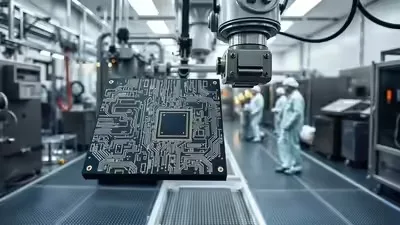
Gujarat is set to take a major step in India’s semiconductor journey with the establishment of a dedicated research and training hub at the Indian Institute of Technology (IIT) Gandhinagar. Backed by an investment of Rs 190 crore, the Silicon and Advanced Semiconductor Manufacturing Research and Training Hub (SAMARTH) aims to become a national centre for semiconductor research, innovation and workforce development, helping India build the skilled talent required for its rapidly expanding chip manufacturing sector.
The SAMARTH facility is being jointly funded by the Union Ministry of Electronics and Information Technology (MeitY), the Gujarat government’s Department of Science and Technology and IIT Gandhinagar. The centre is expected to become operational soon and is being positioned as a key pillar in India’s efforts to achieve self-reliance in semiconductor manufacturing.
The initiative comes at a crucial time when India is investing heavily in semiconductor fabrication, assembly, testing and packaging facilities. Policymakers have repeatedly stressed that the success of these investments will depend not only on infrastructure and incentives but also on the availability of a highly skilled workforce. SAMARTH has been conceived to address this requirement by creating a steady pipeline of trained professionals equipped to work in modern semiconductor facilities.
IIT Gandhinagar has already begun the process of procuring specialised equipment and appointing consultants for the construction of the facility and related infrastructure, indicating that work on the ambitious project is progressing rapidly.
Bridging the Gap Between Academia and Industry
A central objective of the SAMARTH hub is to bridge the long-standing gap between academic education and the practical requirements of the semiconductor industry. While engineering institutions across India produce thousands of graduates every year, industry leaders have often pointed to the need for specialised training in semiconductor fabrication, chip design and advanced manufacturing processes.
The new centre will focus on providing hands-on, industry-oriented training that will enable engineering students to become “fab-ready” and capable of working in semiconductor fabrication facilities from day one. Alongside students, faculty members and industry professionals will also benefit from structured upskilling programmes designed to keep pace with technological advancements in the sector.
Officials believe that such industry-focused training will play a critical role in ensuring that India has the human capital needed to support its long-term semiconductor ambitions.
Advanced Research Facilities at the Core
Beyond workforce development, the centre is expected to emerge as a major hub for semiconductor research and innovation. The facility will house state-of-the-art laboratories dedicated to nano-fabrication, CMOS process training, semiconductor process and device design, device modelling, integrated circuit design and prototyping.
A dedicated device process characterisation laboratory will also be established to support testing, inspection and quality assessment of semiconductor devices and manufacturing processes. These facilities are expected to provide researchers, students and industry professionals with access to sophisticated infrastructure that is typically available only in leading global semiconductor research centres.
The government expects that the availability of such facilities will accelerate indigenous research and contribute to the development of technologies that can strengthen India’s position in the global semiconductor value chain.
Training More Than 10,000 Individuals
One of the most ambitious aspects of the project is its large-scale training target. Over the next five years, the SAMARTH centre aims to train more than 10,000 individuals across different educational and professional categories.
The programme is expected to benefit over 5,600 undergraduate, postgraduate and doctoral students while also providing training to around 1,500 vocational and technical education trainees. Another 1,000 participants are expected to undergo specialised certificate programmes, while 230 faculty members and an equal number of industry professionals will receive advanced training and upskilling opportunities.
The initiative also seeks to create awareness about semiconductor technologies among younger students. More than 2,700 school and college students are expected to participate in summer schools, workshops and exposure programmes that introduce them to semiconductor manufacturing, chip design and related career opportunities.
Officials say such outreach efforts are important for cultivating long-term interest in the sector and encouraging more students to pursue careers in advanced electronics and semiconductor technologies.
Expanding Opportunities Across Gujarat
The benefits of the centre will not be limited to IIT Gandhinagar alone. To widen participation, the institute is preparing to sign Memorandums of Understanding (MoUs) with engineering colleges across Gujarat. Through these partnerships, students from institutions throughout the state will be able to access training programmes and specialised facilities at the centre.
The plan is expected to create a broader ecosystem for semiconductor education and workforce development, ensuring that opportunities are available to students from diverse academic backgrounds. Participants from partner institutions will be able to enrol in training programmes at nominal fees, making advanced semiconductor education more accessible.
Officials believe this collaborative model will help create a statewide network of skilled talent capable of supporting future semiconductor projects and attracting additional investments into Gujarat.
Industry-Oriented Courses and Skill Development
In addition to its regular training programmes, the SAMARTH centre will offer specialised short-term certificate courses, summer schools and outreach initiatives focused on semiconductor technologies. These programmes are expected to cover a wide range of subjects, including semiconductor manufacturing processes, integrated circuit design, electronic systems and emerging technologies shaping the future of the industry.
Industry participation will be a key feature of these programmes, ensuring that students and professionals receive exposure to real-world challenges and current industry practices. By aligning training modules with industry requirements, the centre aims to improve employability and create a workforce capable of contributing immediately to semiconductor manufacturing operations.
The emphasis on practical learning reflects a broader shift in India’s approach to technical education, where employability and industry relevance are increasingly becoming central priorities.
Research Collaborations with Global Partners
The SAMARTH hub is also expected to establish collaborations with national and international institutions involved in semiconductor research and workforce development. Such partnerships will facilitate joint research projects, knowledge exchange and training programmes that expose Indian researchers and students to global best practices.
Experts believe that international collaborations will be essential for India as it seeks to develop capabilities in an industry dominated by a handful of technologically advanced nations. Access to global expertise and research networks can accelerate innovation while helping domestic institutions remain aligned with evolving industry standards.
The centre is therefore expected to serve not only as a training facility but also as a platform for building long-term partnerships that support India’s semiconductor aspirations.
Gujarat’s Growing Role in India’s Chip Ecosystem
The establishment of SAMARTH further reinforces Gujarat’s emergence as a key destination in India’s semiconductor landscape. The state has attracted significant investments under the Centre’s semiconductor promotion initiatives and has positioned itself as a preferred location for chip manufacturing and electronics production projects.
Industry observers note that infrastructure, policy support and talent development are the three pillars of a successful semiconductor ecosystem. While Gujarat has already made substantial progress in attracting investments and creating industrial infrastructure, the launch of the SAMARTH hub addresses the equally important challenge of workforce development.
By combining research, training and industry engagement under one roof, the facility is expected to strengthen the state’s competitiveness and support the growth of a comprehensive semiconductor ecosystem.
Aligning with India’s Semiconductor Vision
The project is closely aligned with the Centre’s broader vision of creating a complete semiconductor ecosystem rather than isolated manufacturing units. Prime Minister Narendra Modi has repeatedly emphasised that India’s semiconductor ambitions extend across the entire value chain, including design, manufacturing, equipment production, logistics and supply chains.
“Our goal is not limited to setting up just one factory, but to build an entire ecosystem. India is now focusing on the entire semiconductor value chain, from design engineers to machine manufacturers and logistics. The announcement of the India Semiconductor Mission 2.0 is a major step in this direction. As production increases, the demand for materials and components within India will also rise, creating the biggest opportunity for domestic industries,” the Prime Minister had said.
His remarks reflect the broader strategy underpinning initiatives such as SAMARTH, which seek to create the research capabilities, skilled manpower and innovation ecosystem necessary to support India’s semiconductor manufacturing ambitions.