“For clear, straightforward, impartial views on subjects of national and international importance and for imbibing unadulterated patriotism, it is useful to read ORGANISER (Weekly). It will fulfil the expectations for correct guidance in all current affairs”
– Sri Guruji Golwalkar, the Second Sarsanghchalak of Rashtriya Swayamsevak Sangh, on the significance of Organiser Weekly
It is not a big deal for a media publication to survive for eight decades, however the story of Organiser Weekly is something to reckon with. Why the journey of 80 years is different for Organiser is because it was born with the contributions that were made by ordinary shareholders at a time when the national scene was in flux. Liberal Capitalism and Communism defined the dominant ideological debate, while cultural nationalist thought was dismissed as a non-entity. The Organiser chose to speak about the civilisational ethos of Hindu culture, identity, and change, with continuity in the ancient nation that was aspiring to tread on the path to become a modern state. Hence, the idea was conceived to celebrate not merely as an event but the legacy of collective resolve to spread the message of ‘unadulterated’ commitment to national reconstruction.
The editorial legacy was started with the veteran A R Nair, who had an exposure to national and international media. On July 3, 1947, the issue was published with the reclamation of ‘Tejomaya Hindu Rashtra’. The Organiser was immediately faced with a ban and censorship due to the Nehru Government’s illiberal attitude. Organiser fought the first battle for free speech under the leadership of K R Malkani. Under his stewardship, Organiser attained new heights by consistently pursuing national integration, security, and cultural unity. He groomed people like Lal Krishna Advani and introduced the entertainment segment to Organiser without compromising ideological dimensions. Hollywood movies and international context began to take up space in film reviews. The atrocities against Hindus in West and East Pakistan, the original idea of granting citizenship to persecuted refugees, and a strong stance on Jammu-Kashmir and the North-Eastern parts of Bharat remained the hallmarks of the publication.
The Motherland, a daily publication, carved out a unique position during the difficult period before the emergency as a sister concern of Organiser. It gave indications about the forthcoming onslaught on constitutional democracy and hence faced the wrath of the Indira Gandhi Government. Even after the excesses of the state machinery, complete confiscation of the machinery, freezing of accounts, and burning of archives, Organiser revived the legacy after the draconian emergency. From the Ekatama Yatra to the Ram Janmabhoomi movement, the nationalist weekly remained the sole torchbearer that highlighted the need for cultural liberation in the English-language media space. Whether on corruption, transparency, accountability in governance, or the Swadeshi model of development, Organiser maintained consistency in providing the Bharatiya perspective.
When nobody was ready to talk about the real nature of red terrorism in the form of Communism or Naxalism, the weekly called out the violent nature and urban character of the phenomenon. Stalwarts like Deendayal ji, H V Seshadri Ji, Dattopant Thengadi, and M G Vaidya articulated their views on burning national issues from time to time. Gurudatt Ji, Pandit Satavalekar, TVR Shenoy, M V Kamat, Muzaffar Hussain, and Jay Dubhashi provided substance, a national paradigm, and a global context to the national challenges. While adapting to new technology, Organiser kept the nature of Bharatiya society and the preservation of cultural ethos at the centre.
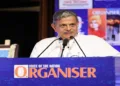
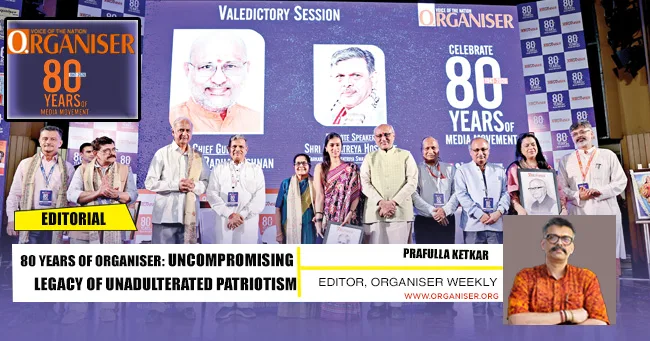
The combination of liberal and communist assaults on nationalist voices continued with the colonised mindset. The fundamental flaw in the Nehruvian ‘idea of India’ was based on the premise that Bharat is a nation in the making, rather than a state in the making. This resulted in the negation of heritage and values. Aping the Western model as a sign of modernity and continuing with British colonial structures and traditions became symbols of progressiveness. Decolonisation of the Bharatiya mind has been the core mission of Organiser Weekly. Hence, both the Hon Vice President, Shri C P Radhakrishnan ji, and Mananiya Sarkaryavah of RSS Shri Dattatreya Hosabale ji, have proclaimed the Organiser as the Voice of the Nation’s Soul.
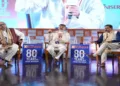
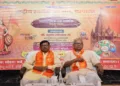
The 80th Foundation Day was an attempt to bring together the extended family of the Organiser, including former editors, their family members, and all those who have contributed to this difficult yet glorious journey. It was a reminder of the legacy that needs to be celebrated and the responsibility that must be carried forward with changing times. The technology and digitalisation of news media have completely changed consumption patterns. Readers are now more viewers and listeners. Organiser is also adapting to this trend through a dynamic website, social media handles and video content, without compromising the publication’s original spirit. Hence, when no media house dared to give voice to the suppressed voices in West Bengal under the Mamata Banerjee-led TMC government, Organiser video-recorded their statements and pursued their cases without disclosing their identity. Victims of ‘Love Jihad’ find Organiser a reliable platform to speak about their ordeal. The cultural continuum that connects the north and south, east and west of Bharat is explained and projected through various celebrations. Bharat is known for its industrial clusters. The Organiser brings out the success stories of wealth creation from such centres. The change-makers in society are regularly featured in the content. Holistic healthcare and affordable education are now annual features of Organiser events, where all the stakeholders come together and deliberate on issues. These efforts are nothing but the continuation of the legacy of being a responsible media house that seeks to contribute to national reconstruction.
The celebration of 80 years of Organiser on July 3, 2026 was a get-together to cherish and record history, to realise the responsibility of the present, and to shape the future course. It was a continuation of the uncompromising legacy of unadulterated patriotism.