Two ordinary frictions of Indian life: moving money and reaching a doctor, sat at the heart of a deeper problem, where an economy and a health system that was running on the paper. A little over a decade after the Digital India programme was launched on July 1, 2015, both frictions have been re-engineered from the ground up. What emerges is not convenience but a quiet redistribution of dignity and the numbers behind it are now among the largest of the development visible anywhere on earth.
The payment rail that carries half the world
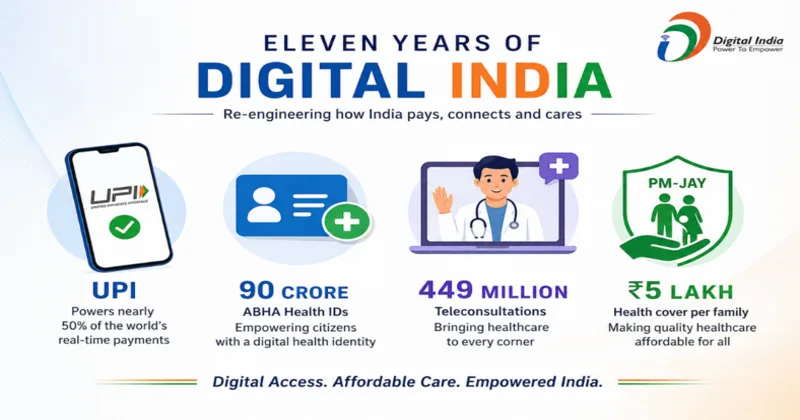
Rolled out in 2016, UPI today processes close to 49 per cent of the world’s real-time payment transaction volume, means every second real-time digital payment on the planet is settled through an Indian system. This is not a rounded-up boast. The International Monetary Fund, in June 2025, recognised UPI as the world’s largest retail fast-payment service by volume and a comparison of transaction counts placed India at 129.3 billion transactions in a single month, ahead of Brazil, Thailand, China and South Korea combined.
The genius architecture behind the UPI is that it asks almost nothing of the user. A street vendor with a basic smartphone and a printed QR code participates in the same rail as a corporate treasury. That inclusivity rests on interlocking pillars of digital public infrastructure. Banks are connected through a unified framework where every account is digitally identifiable. Aadhaar supplies trusted identity for both sender and receiver. Cheap mobile data, expanding 5G and optical fibre pushed deep into rural blocks provide the connectivity, while affordable handsets serve as the gateway. To widen the last mile, the Payments Infrastructure Development Fund has deployed roughly 5.45 crore digital acceptance points in tier-3 to tier-6 towns as of October 2025 and an estimated 56.86 crore QR codes have reached 6.5 crore merchants.
The reach now extends beyond India’s borders. Greece became the tenth country to enable UPI on June 30, 2026, following a live rollout in Nice, France, letting Indian travellers pay by familiar apps instead of absorbing the two-to-five per cent fees that traditional cross-border cards impose. A homegrown protocol has become an instrument of both convenience and soft power. The scale of what runs on this rail is easy to underestimate: from a predominantly cash economy just over a decade ago, digital payments have become the default mode of transaction for hundreds of millions of Indians in cities and villages alike, driving not only convenience but transparency and financial inclusion that formal banking alone never delivered.
UPI has expanded its global footprint with its launch in Greece, enabling instant remittance services abroad.
The system continues to reduce transaction costs and enhance speed and convenience in cross-border payments, reinforcing India’s leadership in digital public… pic.twitter.com/URnBZ5n7F5
— MyGovIndia (@mygovindia) July 3, 2026
When the middleman disappears, the artisan earns more
Digital markets are not only about speed, they are about who keeps the money. For generations, weavers and craftspeople reached buyers only through a chain of intermediaries, each layer shaving the artisan’s margin while inflating the shelf price. India handmade, a Ministry of Textiles initiative built by the Digital India Corporation bridges that chain. It connects artisans, weavers, self-help groups, producer companies and rural enterprises directly to customers across the country and it credits the entire sale amount straight into the artisan’s bank account with no deduction.
The platform has onboarded over 3,900 artisans and weavers, it also lists more than 21,000 handcrafted and handloom products, many sold by first-time digital sellers who were guided through simplified registration, multilingual support, AI-assisted listings, integrated order management, secure payments and free logistics. The Dastkar Bamboo Producer Company, selling bamboo and cane craft on the platform for three years, has used it to reach markets far beyond its region, translating into steadier incomes for artisan families and a lifeline for traditional crafts that once struggled to find buyers. The double outcome is that producers earn more even as the same handmade goods become cheaper for the customer, because the intermediary’s cut has simply vanished.
A health record for nine in ten Indians
If the digital market rewired how India transacts, the digital health stack has rewired how India heals. At its foundation sits the Ayushman Bharat Digital Mission, launched in September 2021, which assigns every resident a 14-digit Ayushman Bharat Health Account or ABHA. In July 2026 the mission crossed 90 crore ABHA accounts, a leap from 14.7 crore in 2021, 50.6 crore in 2023 and 84.5 crore in 2025. Women make up nearly 49.75 per cent of holders, a signal of genuinely broad-based adoption rather than skew toward the connected few.
The ABHA number is more than an ID, it is the key to a portable and consent-based medical history. Under it over 82 crore health records have been linked and the surrounding registries have matured into a working ecosystem. Roughly 4.51 lakh registered health facilities and 7.61 lakh healthcare professionals, with more than 2.5 lakh facilities running ABDM-enabled software so that a doctor can securely retrieve a patient’s prescriptions, lab reports and discharge summaries. Uttar Pradesh alone has generated more than 14.3 crore ABHA registrations, while states like Bihar have pioneered scan and share OPD registration that turns an hour-long queue into a few seconds at a counter. The interoperability runs on international FHIR standards, the same logic that lets any bank talk to any other bank through UPI — here applied to hospitals, labs and pharmacies.
Availability of doctor a phone call away
Digital identity means little without access to care and this is where e-Sanjeevani has changed the arithmetic of distance. The national telemedicine platform, now assisted by AI-based clinical decision support, has enabled over 449 million teleconsultations through more than 2,20,000 registered providers. For a farmer in a hill district or a mother who cannot lose a day’s wage travelling to a town hospital, a specialist consultation now begins at the nearest Ayushman Arogya Mandir. There are over 1,85,940 of these health and wellness centres operating as of May 2026, the primary-care tier that Ayushman Bharat was designed to build, transforming old sub-centres into functioning first points of contact.
Insurance cover scheme that ends the poverty trap
Access without affordability still bankrupts families and before 2018 more than six crore Indians were pushed into poverty every year by out-of-pocket medical bills. The Pradhan Mantri Jan Arogya Yojana attacks exactly that. It offers cashless cover of Rs 5 lakh per family per year for secondary and tertiary hospitalisation across a network of empanelled public and private hospitals, now numbering over 32,000. Since its launch the scheme has authorised over 11.69 crore hospital admissions worth about Rs 1.73 lakh crore and more than 43.52 crore Ayushman cards have been issued.
In September 2024 the cover was extended to every citizen aged 70 and above regardless of income through the Ayushman Vay Vandana Card, adding an estimated 4.5 crore senior citizens to the pool. The impact has been documented by The Lancet mentions a 36 per cent rise in early cancer detection and treatment over six years, with beneficiaries seeing a 90 per cent improvement in timely treatment against 30 per cent for non-enrolees. The Union Budget 2026-27 raised the PM-JAY allocation to Rs 9,500 crore and lifted overall health spending to Rs 1,06,530 crore, a ten per cent increase.
World watching over the first thousand days
The two threads, market and health converge most movingly at the Anganwadi centre, where the Poshan Tracker has replaced the eleven manual registers an Anganwadi worker once juggled. As of May 2026, the platform has over 13.30 lakh registered workers serving 8.93 crore beneficiaries having pregnant women, lactating mothers, children under six and adolescent girls with 99.89 per cent Aadhaar verification. Daily transactions have climbed from about one crore in 2021 to over 22 crores in 2026, running across all 36 states and Union Territories. The system geo-tags centres, time-stamps records, uses face recognition for ration distribution and maintains a live monthly database on nutrition indicators for over 77 million children, feeding real-time dashboards and heat maps that let policymakers act on evidence rather than estimate. For a beneficiary like Priyanka Mathur a local resident of Varanasi says she was able to track thoroughly pregnancy, antenatal care, counselling, immunisation and take-home ration arrive on schedule all through apps.
What ties the QR code, the artisan’s platform, the ABHA number and the nutrition tracker together is a single design philosophy to build open, interoperable public rails, then let citizens, merchants, doctors and workers ride them. This is Antyodaya rendered in software, the last person in the queue reached not by a one-off scheme but by infrastructure that treats inclusion as the default setting. India did not import this model, it built it and is now exporting it, from UPI’s arrival in Greece to global interest in its digital health architecture. As Digital India completes eleven years, its true accomplishment is not any single record-breaking statistic but the compounding of countless ordinary moments, payment that clears instantly, crafts that sells at a fair price, health record that follows a patient, child whose growth is finally being watched. A billion small transformations, adding up to one very large one and every one of them measured in a life made a little more secure.