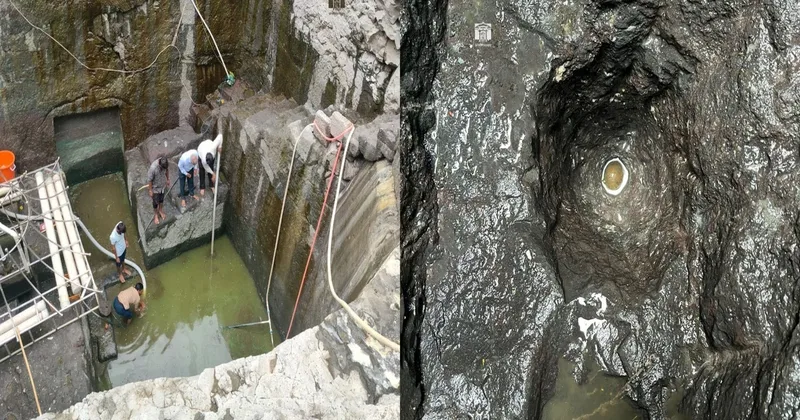
Nashik: A centuries-old stone Shivling has been discovered at the bottom of the historic Amrit Kund within the revered Trimbakeshwar Mandir complex in Maharashtra’s Nashik district during an ongoing conservation project undertaken by the Archaeological Survey of India (ASI). The remarkable discovery was made after the ASI drained the water from the sacred reservoir and removed decades of accumulated silt as part of restoration work aimed at preserving the heritage structure.
🚨 HUGE! Shivling DISCOVERED after many years in the historic Amrit Kund at Trimbakeshwar Temple in Nashik.
ASI drained the water during conservation work, revealing it at the bottom of the 65-foot-deep reservoir.
Water from this Peshwa-era kund is used for puja-abhishek. pic.twitter.com/w1UYtsMnMS
— Megh Updates 🚨™ (@MeghUpdates) June 29, 2026
The Amrit Kund, also known as Amritavarshini Kund, is a 65-foot-deep stone reservoir located inside the Trimbakeshwar Mandir premises. Built during the Peshwa era, the kund has remained filled with water for generations, concealing the Shivling at its base from public view. As conservation teams carefully emptied the reservoir and carried out desilting operations, the ancient Shivling gradually emerged from beneath thick layers of sediment, surprising archaeologists, temple authorities and devotees alike.
According to ASI officials, the restoration work is part of a larger conservation initiative to preserve one of Maharashtra’s most important Mandir complexes ahead of the upcoming Simhastha Kumbh Mela. Over the years, large amounts of silt and debris had accumulated at the bottom of the kund, making cleaning and structural assessment necessary. The discovery of the Shivling underscores the importance of archaeological conservation, as such efforts often reveal hidden architectural and religious features that have remained buried for decades or even centuries.
The Trimbakeshwar Mandir, dedicated to Bhagwan Shiva, is one of the twelve Jyotirlingas and is among Hinduism’s holiest pilgrimage sites. Every year, lakhs of devotees visit the Mandir to offer prayers and perform sacred rituals. The Amrit Kund holds special religious significance because its water is traditionally used for the daily puja and abhishek of the Trimbakeshwar Jyotirlinga. Unlike the nearby Kusavarta Kund, which is regarded as the symbolic origin of the Godavari River, the Amrit Kund primarily serves the Mandir’s ritualistic requirements.
While the Shivling has now become visible due to the temporary draining of the reservoir, experts believe it had remained submerged for a very long time, hidden beneath water and layers of silt. Archaeologists are expected to conduct a detailed examination of the structure to determine its age, craftsmanship and historical context. Although no official dating has yet been announced, historians believe it is at least as old as the Peshwa-era reconstruction of the temple in the 18th century and could possibly predate it, depending on further archaeological findings.
Mandir authorities have welcomed the discovery, describing it as both spiritually significant and historically valuable. The revelation has generated immense curiosity among devotees, many of whom consider the emergence of the Shivling to be a rare and auspicious event. However, officials have clarified that the Amrit Kund will remain under ASI supervision until the conservation work is completed, after which the reservoir will be refilled and normal ritual practices resumed.
The discovery serves as a reminder of India’s vast Mandir heritage, where centuries-old structures continue to reveal hidden relics through scientific conservation. It also highlights the crucial role played by the ASI in preserving ancient monuments while uncovering forgotten aspects of the country’s rich religious and cultural history. The newly revealed Shivling at the bottom of the historic Amrit Kund has added another fascinating chapter to the long and sacred legacy of the Trimbakeshwar Mandir.