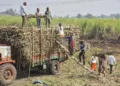
A decade ago, the sugar mill was a place sugarcane farmers in western Uttar Pradesh approached with dread rather than hope. Slips were rationed by middlemen, payments arrived months late, and sometimes farmers wouldn’t get a single penny. Multiple mills had simply shut down their shutters, leaving cane to rot in the fields or be sold at distress jaggery prices. The crop that anchored the rural economy of the state had become a source of recurring distress.
Chief Minister Yogi Adityanath, speaking on Saturday after laying the foundation stone of SAEL’s Rs 8,200-crore integrated solar manufacturing plant at Jewar in Gautam Buddh Nagar, returned to that memory to frame how far the state has travelled. “Around a decade ago, farmers were struggling with despair and disappointment,” he said, before laying out the foundation. Over the past nine years, his government has routed sugarcane price payments of Rs 3.22 lakh crore to growers, and the state has emerged as the single largest producer of ethanol in the country.
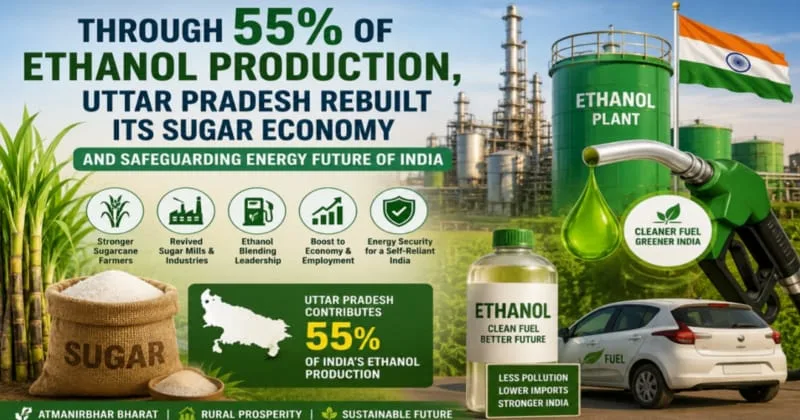
“Nearly 55 percent of the country’s ethanol production is contributed by Uttar Pradesh alone,” the Chief Minister noted, adding that the ethanol blending policy had pulled the state sugar mills out of virtual bankruptcy and made them self-reliant.
A Decade of Decline and Ignorance
The yogi government filtered the payment data to sugarcane mills and farmers. Official figures place sugarcane payments at Rs 52,131 crore during the BSP government between 2007 and 2012. Rs 95,215 crore during the Samajwadi Party government between 2012 and 2017. Against that baseline, the cumulative sum of Rs 3.22 lakh crore paid since 2017 is more than three times the entire previous decade combined. When the double-engine government took charge, one of its earliest acts was to clear cane arrears of Rs 10,661 crore that had been left pending from the preceding regime, alongside a farm loan waiver of more than Rs 36,000 crore.
The institutional rebuilding was equally deliberate. Mills that had closed during the previous governments were revived, new units were established and existing capacity was expanded. The government reopened shuttered mills, set up new ones and added crushing capacity running into tens of thousands of tonnes per day. Today, 121 sugar mills are operational across the state in the 2025-26 crushing season, comprising three mills of the UP State Sugar Corporation, 23 of the UP Cooperative Sugar Mills Federation and 95 in the private sector. A total of 877.96 lakh tonnes of sugarcane was produced, and 89.68 lakh tonnes of sugar were produced through mills.
What makes the production figures notable is efficiency rather than scale alone. Uttar Pradesh operates 121 mills against Maharashtra’s 210, yet records an average sugar recovery of 10.21 per cent, well ahead of Maharashtra’s 9.49 per cent and Karnataka’s 8.19 per cent. Cultivation has expanded too, covering 29.51 lakh hectares in 2025-26, and the state now ranks first in the country in both sugarcane cultivation area and ethanol production. The sector underpins the livelihoods of roughly 48 lakh sugarcane-farming families.
Technology That Cut Out the Middleman
If money is the visible part of the turnaround, the delivery is the less celebrated but arguably more consequential reform. The ‘Smart Ganna Kisan’ system has digitised the entire chain; sugarcane area registration, survey, calendaring and slip issuance now happen online. Farmers receive their cane slips directly on their mobile phones, and payments land in their bank accounts through Direct Benefit Transfer, bypassing the layer of intermediaries who once decided who got to sell and when. A 24-hour toll-free helpline backs the system for grievance redress.
The reform of the khandsari or unorganised jaggery segment followed similar logic. An online licensing system, introduced after amendments to the khandsari policy led to the establishment of hundreds of new units and generated direct and indirect employment for tens of thousands of people, drawing a previously informal industry into the formal fold.
The Ethanol Production and Energy
The strategic heart of the recovery lies in diversification. Rather than leaving mills dependent on a sugar market prone to gluts and price crashes, the state leaned into the central government’s ethanol blending programme. The results reshaped the industry’s economics: by diverting surplus cane into ethanol, mills found a second revenue stream that improved cash flow and, in turn, their ability to pay farmers on time. Ethanol production in the state has climbed steeply over the period, from around 42 crore litres in 2016-17 to several times that today and the 55 % national share the Chief Minister cited reflects how central UP has become to India’s energy-blending ambitions.
At Jewar, the Chief Minister urged farmers to stop burning crop residue and instead supply it to CBG plants, where it can be converted into CNG, compressed biogas and ethanol, turning a pollution problem into an income source. The state has set a target of generating 20,000 MW of renewable energy within three years, up from the current 6,000 MW and has previously announced plans to establish 100 CBG plants across UP.
Each such plant is projected to offer direct employment to over 100 people, while consuming agricultural waste, paddy straw, and cow dung that would otherwise be burned. A single CBG plant at Budaun, built at Rs 133 crore over 50 acres, processes 100 metric tonnes of paddy straw daily to produce biogas and organic fertiliser. The model addresses three problems at once: farm income, stubble-burning pollution, and dependence on imported fuel. As the country looks ahead to a future of tightening gas supplies and energy-security concerns, the CBG roadmap positions agricultural waste as a domestic buffer against any gas crisis.
The Recovery of the state’s economy and releasing due
A fair account does not end with the official figures, and the data itself flags where the work remains incomplete. Even by the government’s own reckoning, payments in the 2025-26 season are not fully cleared of the dues; around 90 per cent of farmers had been paid as of late May, with payments from some mills still pending and instructions issued to settle them quickly.
The scale of the gap drew national attention earlier this year. A Parliamentary Standing Committee on Consumer Affairs, Food and Public Distribution flagged that sugarcane arrears nationally had surged nearly 32 times over the previous financial year, reaching Rs 16,087 crore, about 20 per cent of the total payable as of mid-February 2026. Within that, Uttar Pradesh’s own dues rose from Rs 24 crore in 2023-24 to Rs 321 crore in 2024-25 and Rs 3,287 crore in 2025-26. The panel traced much of the strain to a structural surplus: national sugar production of 300-330 lakh tonnes against domestic consumption of 270-290 lakh tonnes leaves mills sitting on stockpiles that choke their cash flow.
Farmer leaders have pressed the point on the ground. Bharatiya Kisan Union leader Rakesh Tikait has acknowledged that the situation has improved while insisting mills still delay payments and that the government should honour its commitment to clear dues promptly. Others have pointed to crop losses from disease and the persistent gap between rising cane prices and a politically sensitive, slow-moving sugar price, a squeeze that mills cite as the reason for instalment-based payments. In a handful of cases, district administrations have moved to auction the assets of defaulting mills to recover farmers’ money.
The price hikes, too, sit within this tension. The government raised the State Advised Price by Rs 30 per quintal for the 2025-26 season to Rs 400 for early varieties and Rs 390 for general varieties, the fourth increase since 2017, worth an additional Rs 3,000 crore to farmers. It is a real gain for growers. But mill associations argue that without a commensurate rise in sugar prices, every cane-price increase widens the very gap that delays payments. The ethanol pivot is, in large part, the policy answer to that bind.
A Backbone of UP Still Being Strengthened
The trajectory is not in serious dispute. A sector that was synonymous with shut mills, hoarded slips and abandoned cane has become, in the government’s words, the backbone of the rural economy, efficient in recovery, first in cultivation, and the national leader in ethanol. The Smart Ganna Kisan system and DBT have changed not just how much farmers are paid but the dignity with which they are paid.
What the contrary data establishes is that the story is one of momentum rather than completion. Arrears have not vanished; they have shifted from a chronic, structural failure to a cyclical pressure driven by sugar surpluses and price economics. Whether the next phase of ethanol, compressed biogas and a 20,000 MW green-energy push can finally insulate the cane farmer from that cycle is the question the coming seasons will answer. For now, Uttar Pradesh has rebuilt the spine of its sugar economy. The task ahead is to make sure it never bends again.