India-Pak ‘Peace letter’ sparks row over Kashmir clause
July 2, 2026
  • Read Ecopy
  • Circulation
  • Advertise
  • Careers
  • About Us
  • Contact Us
Android AppiPhone AppArattai
Organiser
  • ‌
  • Bharat
    • Assam
    • Bihar
    • Chhattisgarh
    • Jharkhand
    • Maharashtra
    • View All States
  • World
    • Asia
    • Europe
    • North America
    • South America
    • Africa
    • Australia
  • Editorial
  • International
  • Opinion
  • RSS @ 100
  • More
    • Op Sindoor
    • Analysis
    • Sports
    • Defence
    • Politics
    • Business
    • Economy
    • Culture
    • Special Report
    • Sci & Tech
    • Entertainment
    • G20
    • Azadi Ka Amrit Mahotsav
    • Vocal4Local
    • Web Stories
    • Education
    • Employment
    • Books
    • Interviews
    • Travel
    • Law
    • Health
    • Obituary
  • Subscribe
    • Subscribe Print Edition
    • Subscribe Ecopy
    • Read Ecopy
  • ‌
  • Bharat
    • Assam
    • Bihar
    • Chhattisgarh
    • Jharkhand
    • Maharashtra
    • View All States
  • World
    • Asia
    • Europe
    • North America
    • South America
    • Africa
    • Australia
  • Editorial
  • International
  • Opinion
  • RSS @ 100
  • More
    • Op Sindoor
    • Analysis
    • Sports
    • Defence
    • Politics
    • Business
    • Economy
    • Culture
    • Special Report
    • Sci & Tech
    • Entertainment
    • G20
    • Azadi Ka Amrit Mahotsav
    • Vocal4Local
    • Web Stories
    • Education
    • Employment
    • Books
    • Interviews
    • Travel
    • Law
    • Health
    • Obituary
  • Subscribe
    • Subscribe Print Edition
    • Subscribe Ecopy
    • Read Ecopy
Organiser
  • Home
  • Bharat
  • World
  • Operation Sindoor
  • Editorial
  • Analysis
  • Opinion
  • Culture
  • Defence
  • International Edition
  • RSS @ 100
  • Magazine
  • Read Ecopy
Home Bharat

Why the J&K proposal in 60 member India-Pak letter is triggering alarm bells

A letter signed by 60 Indians urging Prime Minister Narendra Modi and Pakistani Prime Minister Shehbaz Sharif to revive India-Pak dialogue has triggered controversy over its proposal to revisit the 2004-07 Kashmir framework negotiated during the Manmohan Singh-Pervez Musharraf era

WEBDESKWEBDESK
Jul 2, 2026, 09:30 am IST
in Bharat, Jammu and Kashmir
Follow on Google News
India-Pak ‘Peace Letter’ Under Fire Over Kashmir Proposal

India-Pak ‘Peace Letter’ Under Fire Over Kashmir Proposal

FacebookTwitterWhatsAppTelegramEmail

A letter signed by around 60 Indian activists, academics and public figures urging Prime Minister Narendra Modi and Pakistani Prime Minister Shehbaz Sharif to resume comprehensive bilateral dialogue has triggered a political debate over its recommendations on Jammu and Kashmir.

While the document calls for restoring diplomatic engagement, people-to-people contact and trade ties, critics argue that one particular clause relating to Kashmir revives elements of the controversial India-Pakistan backchannel framework negotiated between 2004 and 2007.

What does the letter say?

The signatories have called for the resumption of a structured bilateral dialogue between India and Pakistan covering all outstanding issues.

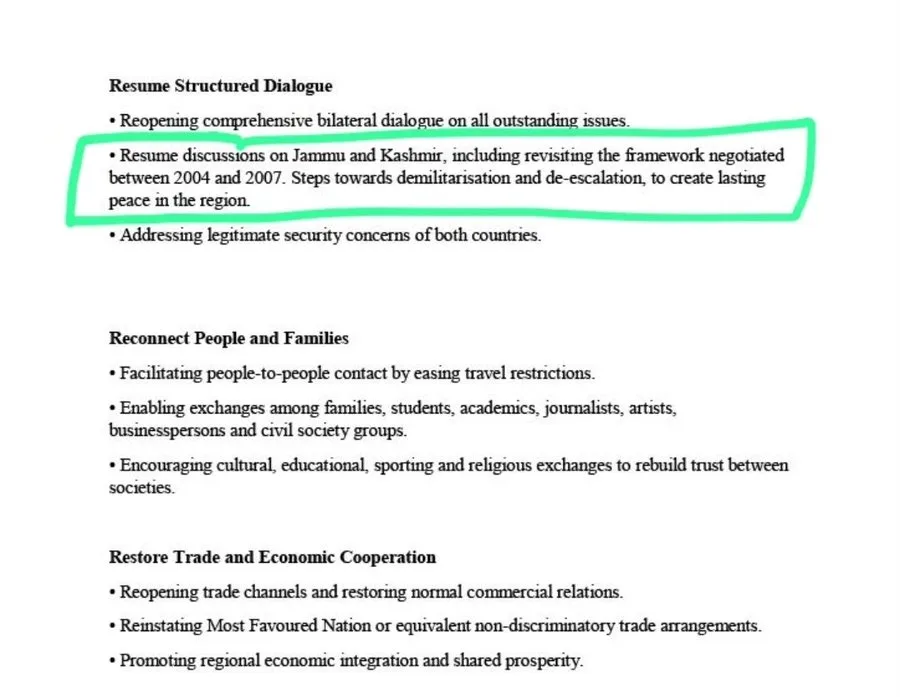
A key section of the document, titled “Resume Structured Dialogue,” urges both countries to:

“Resume discussions on Jammu and Kashmir, including revisiting the framework negotiated between 2004 and 2007. Steps towards demilitarisation and de-escalation, to create lasting peace in the region.”
The letter also advocates addressing the security concerns of both countries while rebuilding diplomatic channels.

Beyond Kashmir, the signatories have called for greater people-to-people engagement, including easing travel restrictions, facilitating exchanges among students, academics, journalists and civil society groups, and encouraging cultural and educational interactions.

The document further recommends restoring normal trade relations, reopening commercial channels and promoting regional economic cooperation.
Why is the Kashmir clause controversial?

The sharpest criticism has centred on the demand to revisit the 2004-07 India-Pakistan backchannel framework developed during talks between former Prime Minister Manmohan Singh and then Pakistani President Pervez Musharraf.

Although never formally signed or adopted by either government, the framework reportedly explored an alternative approach to resolving the Kashmir dispute.

Reviving discussions around this framework would reopen proposals that many believe run contrary to India’s long-standing position on Jammu and Kashmir.

What was the 2004-07 framework?

The backchannel negotiations reportedly revolved around several broad principles:

1. No Redrawing of Borders: The proposal envisaged that existing boundaries would remain unchanged, effectively treating the Line of Control (LoC) as the permanent dividing line.

Critics contend that such an arrangement would amount to accepting the status quo and abandoning India’s claim over Pakistan-occupied Kashmir (PoK), which New Delhi considers an integral part of India.

2. Self-Governance For Jammu And Kashmir: The framework reportedly discussed granting substantial self-governance to regions on both sides of the LoC.

Opponents argue that such provisions could have entrenched a special constitutional arrangement for Jammu and Kashmir indefinitely. They point out that India fundamentally altered the region’s constitutional status in August 2019 through the abrogation of Article 370 and the reorganisation of the former state into two Union Territories.

3. Joint Consultative Mechanism: Another reported feature was the creation of a consultative body comprising representatives from both sides of Kashmir.

Notably, such a mechanism could have provided Pakistan a continuing role in matters relating to Jammu and Kashmir, something New Delhi has consistently rejected. India’s official position remains that Jammu and Kashmir is an internal matter and that any issues with Pakistan relate primarily to the vacation of territories under its control.

India’s current position

India has repeatedly maintained that Jammu and Kashmir is an integral part of the country and that Pakistan’s support for cross-border terrorism remains the principal obstacle to normalisation of relations.

Since the abrogation of Article 370 in 2019, New Delhi has emphasised integration, development and security measures in the region while rejecting any third-party involvement in Kashmir-related matters.

Successive governments have also maintained that Pakistan-occupied Kashmir remains part of India and that any dialogue with Islamabad must take into account concerns relating to terrorism and security.

Notably, the call to revisit the 2004-07 framework goes beyond confidence-building measures and risks reopening proposals that they believe compromise India’s stated position on sovereignty, territorial integrity and Jammu and Kashmir.

As debate over the letter intensifies, the controversy is likely to focus less on its broader calls for peace and more on whether revisiting the Musharraf-era Kashmir framework is compatible with India’s current constitutional and strategic position.

Topics: India-Pakistan dialogueKashmir frameworkLoC borderJammu and Kashmirmanmohan singhPervez Musharraf
ShareTweetSendShareSend
✮ Subscribe Organiser YouTube Channel. ✮
✮ Join Organiser's WhatsApp channel for Nationalist views beyond the news. ✮
Previous News

GAGAN: How India’s homegrown satellite navigation system is transforming aviation and strategic infrastructure

Related News

India calls Indus Waters Treaty outdated at UNHRC, says Pakistan cannot seek cooperation while exporting terror

“Indus Waters Treaty outdated”: India slams Pakistan at UN for “exporting terror”

India slams Pakistan’s bid to hold elections in Gilgit-Baltistan, demands end to illegal occupation

From Partition to the National Advisory Council in 2004, Congress-led decisions are seen as having lasting impacts on India’s territorial integrity

Dark Chapter of Congress: How partition, territorial concessions and political decisions shaped India’s troubled legacy

A minor boy from Bijnor, whose alleged religious conversion in J&K sparked widespread controversy, has been safely rescued by the police

UP Conversion Case: Bijnor teenager rescued from J&K’s Kupwara, police question youth over alleged conversion to Islam

Red Fort Car Bomb Blast Case: NIA files 7,500-page chargesheet, Al-Qaeda-linked doctors named as accused

‘Drug money finances terror’: LG Manoj Sinha vows crackdown on narco networks in J&K

Load More

Latest News

India-Pak ‘Peace Letter’ Under Fire Over Kashmir Proposal

Why the J&K proposal in 60 member India-Pak letter is triggering alarm bells

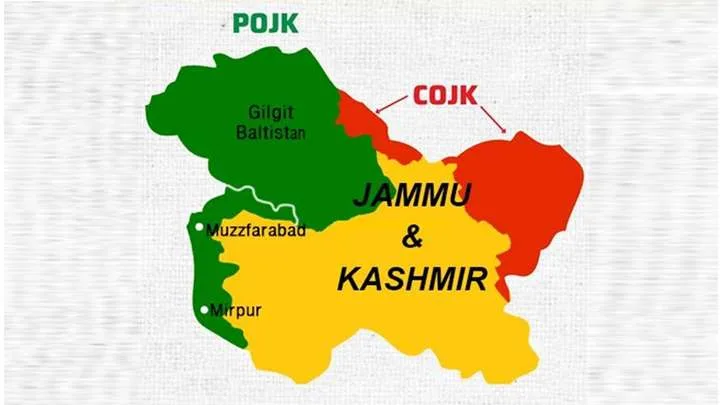
Representative image made using AI

GAGAN: How India’s homegrown satellite navigation system is transforming aviation and strategic infrastructure

Sunil Ambekar
Akhil Bharatiya Prachar Pramukh informed that Akhil Bharatiya Prant Pracharak Baithak of Rashtriya Swayamsevak Sangh will be held this year at Belagavi

RSS to hold Akhil Bharatiya Prant Pracharak Baithak in Belagavi from July 10-12

Tamil Nadu govt challenges High Court cow slaughter ban in Supreme Court; BJP slams CM Joseph Vijay

Farmer seriously injured in Haveri clash after Islamists attack him; R. Ashoka seeks tough action

Haveri Violence in Karnataka: Islamists severed hand of farmer for bursting crackers before mosque; BJP clams Congress

Chief Minister Mohan Charan Majhi chairs the Cabinet meeting at Lok Seva Bhawan in Bhubaneswar on July 1, 2026

Odisha Cabinet approves landmark KG-to-PG free education scheme, clears 12 key proposals

Dhami Govt rolls out Minority Education reforms, scraps Madrasa Board

Uttarakhand launches ‘Minority Education Authority’ on principle of One Nation-One Education, Madrasa Board abolished

R Ashoka accuses Karnataka Govt of undermining EC through Gruha Jyothi Survey

Karnataka Government using Gruha Jyothi Survey to bypass EC’s voter verification exercise: R Ashoka of BJP

P. Shailaja, Sudha Mohan, Amara Linganna (Left to Righ)

Telangana: Missionary Mayajaalam book probes Christian missionary deception in India’s civilisational narrative

UPTET 2026: 24x7 control rooms, enhanced security measures

UPTET-2026: Strict security, 24×7 control rooms in place across 955 centres; Separate exam for in-service teachers

Load More
  • Privacy
  • Terms
  • Cookie Policy
  • Refund and Cancellation
  • Delivery and Shipping

© Bharat Prakashan (Delhi) Limited.
Tech-enabled by Ananthapuri Technologies

  • Home
  • Search Organiser
  • Bharat
    • Assam
    • Bihar
    • Chhattisgarh
    • Jharkhand
    • Maharashtra
    • View All States
  • World
    • Asia
    • Africa
    • North America
    • South America
    • Europe
    • Australia
  • Editorial
  • Operation Sindoor
  • Opinion
  • Analysis
  • Defence
  • Culture
  • Sports
  • Business
  • RSS @ 100
  • Entertainment
  • More ..
    • Sci & Tech
    • Vocal4Local
    • Special Report
    • Education
    • Employment
    • Books
    • Interviews
    • Travel
    • Health
    • Politics
    • Law
    • Economy
    • Obituary
  • Subscribe Magazine
  • Read Ecopy
  • Advertise
  • Circulation
  • Careers
  • About Us
  • Contact Us
  • Policies & Terms
    • Privacy Policy
    • Cookie Policy
    • Refund and Cancellation
    • Terms of Use

© Bharat Prakashan (Delhi) Limited.
Tech-enabled by Ananthapuri Technologies