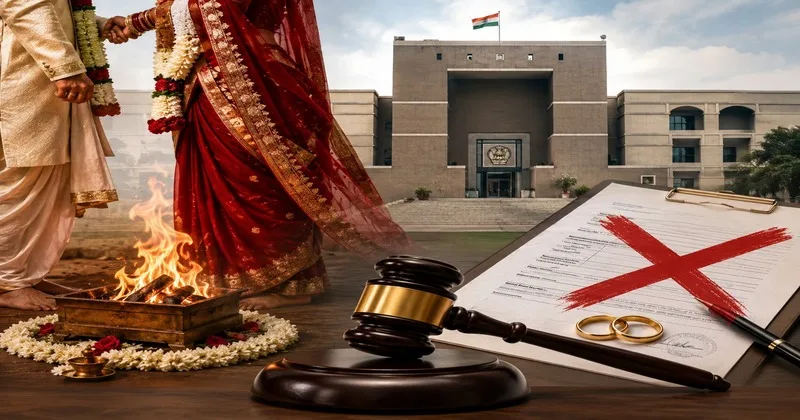
Ahmedabad: The Gujarat High Court has ruled that the mere registration of a Hindu marriage cannot make it legally valid if the essential customary rites and ceremonies, including saptapadi (the seven sacred steps), have not been performed. The court observed that marriage is not merely an occasion for “song and dance” but a sacred institution rooted in religious traditions.
In its June 23 order, the High Court said that customary marriage ceremonies, despite varying across regions and communities, are intended to purify and spiritually transform the individuals entering the marital bond. The ruling came while hearing an appeal filed by a UK-based man challenging a family court’s decision refusing to declare an alleged marriage between the parties as void.
Setting aside the family court’s November 2025 order, the division bench of Justices Ilesh Vora and R.T. Vachhani held that the performance of essential Hindu marriage ceremonies, particularly saptapadi, forms the very foundation of a valid Hindu marriage.
The Gujarat High Court observed that ceremonies such as saptapadi, the ritual in which the bride and groom jointly take seven steps around the sacred fire, are essential to confer the spiritual, social, and legal status of a sacrament (samskara) on a Hindu marriage.
The case arose from a petition filed by UK-based Kaushal Sonar, who sought a declaration that the alleged marriage between him and the respondent was null and void. Sonar told the court that he lives in the United Kingdom, while the respondent resides in Ahmedabad.
According to the appellant, he became aware of the alleged marriage only after the respondent approached his parents with a marriage certificate claiming to be his legally wedded wife. He maintained that no marriage had ever been solemnised between them, no Hindu rites or ceremonies were performed, and they had never lived together as husband and wife. Sonar further alleged that his signature on the marriage documents had been obtained fraudulently without his free and informed consent.
The High Court noted that the respondent had unequivocally admitted before the family court that no marriage rites or ceremonies had taken place and that the parties had never shared a marital relationship. In light of this admission, the division bench held that the family court erred in dismissing Sonar’s petition.
Referring to Section 7 of the Hindu Marriage Act, the court emphasised that a Hindu marriage must be solemnised in accordance with customary rites and ceremonies, including saptapadi where applicable, for it to be complete and legally binding. Since no such ceremonies were performed in the present case, the court held that the fundamental requirement for a valid Hindu marriage was absent.
The bench further observed that under Hindu tradition, a wife is regarded as the ardhangini (better half) of her husband while retaining her own identity and status as an equal partner in the marriage. It reiterated that Hindu marriage is a samskara and a sacrament that forms the foundation of a new family.
Describing marriage as an institution of immense social and spiritual significance, the court urged young men and women to understand its sacred nature before entering into it. It stressed that marriage is “not merely an occasion for ‘song and dance’ or ‘wining and dining’,” nor a commercial transaction, but “a solemn and foundational event” through which a man and a woman enter into a lifelong relationship and build a family.
The High Court added that marriage is sacred because it establishes a lifelong, dignified, equal, consensual, and healthy union between two individuals. It also observed that, under Hindu belief, a properly solemnised marriage helps an individual attain spiritual fulfilment and salvation. The court concluded that customary marriage ceremonies, despite varying across regions and communities, are intended to purify and spiritually transform the individuals entering the marital bond.