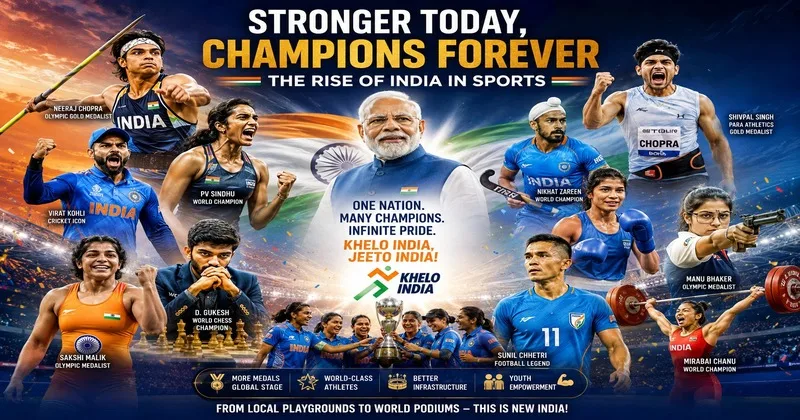
“In the realm of sports, cricket is India’s religion!”- this is a sentiment we have heard and lived by for decades. Whenever the Indian cricket team lost on the field, a silence would descend upon the entire nation; yet, that is now a thing of the past. If you shift your gaze today from the cricket pitch to India’s other sports complexes, athletics tracks, fencing strips, rowing waters and gymnastics floors, you will witness a completely different spectacle. It is a sight that compels you to believe your own eyes: alongside cricket, a “New India” has emerged in all its vastness.
In fact, industrialist Anand Mahindra recently drew attention to this transformed landscape on social media. His message highlights the shift in mindset that has become the greatest asset of Indian sports today. Indeed, India’s presence now resonates across the Olympics, World Championships and international sporting arenas.
Yes, we had a disappointing weekend in cricket.
But at the same time, I often find myself rubbing my eyes in disbelief at India’s growing competitiveness in sports where I never imagined we’d even be globally competitive.
Volleyball. Fencing. Gymnastics. Rowing. Athletics. The… https://t.co/rDb8fvpbCq pic.twitter.com/XOCNyBxBas
— anand mahindra (@anandmahindra) June 29, 2026
Today, India is challenging global giants even in sports where we were once considered non-existent. Whether it is towering spikes on the volleyball court, defeating an opponent in the blink of an eye in fencing, or going head-to-head with the world’s best runners and throwers in track and field, India is now emerging as a serious contender. Until a few years ago, the idea of India challenging the world’s top athletes in fencing or gymnastics at the Olympics would have been dismissed as a joke; today, it is a reality.
In a sport like fencing, traditionally dominated by European nations, a girl from a middle-class family in Chennai, C.A. Bhavani Devi not only qualified for the Olympics but also proved, by winning medals at the international level, that Indian athletes can master the technical nuances of any sport. When Dipa Karmakar- hailing from a small gym in Tripura, executed the perilous ‘Produnova Vault’ at the 2016 Rio Olympics, the entire world watched in awe. Although she finished fourth, she paved the way for a new generation of gymnasts in India who are now winning medals at World Cup and Asian levels. Similarly, Neeraj Chopra’s gold medal victory at the Tokyo Olympics transformed the self-confidence of Indian athletics forever.
In this context, international badminton player and certified (BWF Level 1) coach Pragya Rai says, “Today, India has more than just one Neeraj; Indian athletes are reaching world-class finals and touching the podium in events like javelin throw, long jump, triple jump, and the 4x400m relay race. Driven by Army personnel and youth from rural areas, India has established dominance in rowing at the Asian level and is successfully navigating the rigorous Olympic qualification process. Domestic events like the ‘Prime Volleyball League’ have breathed new life into Indian volleyball, allowing our players to compete against the world’s best clubs. And, of course, our performance in badminton is truly remarkable on the global stage.”
She adds, “Prominent players who have brought glory to India by winning international medals include PV Sindhu (Olympic and World Champion), Saina Nehwal (Olympic medalist), Prakash Padukone, Lakshya Sen and the doubles pair of Satwiksairaj Rankireddy and Chirag Shetty. In para-badminton, Pramod Bhagat has also won gold medals for the country. Today, we are achieving victory across every sporting arena.”
https://twittter.com/ianuragthakur/status/2071959163257659643?s=20
Professor Deepak Sharma, Head of the Department of Health Sciences at the Lakshmibai National Institute of Physical Education (LNIPE), states, “This transformation did not happen overnight. It is a ‘silent revolution’ born out of a struggle against decades of neglect, administrative apathy, and a lack of infrastructure. It is a story of shifting policies, the corporate sector stepping forward and above all, of young people emerging from India’s small villages and towns, youth who no longer harbor a fear of defeat in their eyes, but instead dream of global triumph.”
Professor Sharma adds, “We may still be a few steps away from the podium, the top three spots- in many sports, but finishing fourth or fifth or ranking among the world’s top eight athletes, proves that the gap is no longer measured in miles; it has narrowed down to mere centimeters and seconds.” He further remarked, “To achieve international success across all sports, India needs to progress systematically, much like what we observe in countries such as China, Japan and the USA.”
Prasad Mahankar, the All-India Organizing Secretary of Kreeda Bharati, observes, “It is essential to adopt an Indian perspective within the realm of sports; the focus should be on the philosophy of the sport rather than just the performance. When an athlete deeply grasps this concept, the results lead to ultimate success. With this in mind, Kreeda Bharati is working to ignite enthusiasm for sports among the youth, consistently encouraging them to engage with Indian sports, ranging from traditional disciplines like Kho-Kho and Kabaddi to various other sports.”
Indian Athletes Making Their Mark Globally
Prasad Mahankar says, “Today, Indian athletes are proving their mettle across the globe in every sport. ‘Kreeda Bharati’ has over 550 active sports units across the country, operating at levels ranging from the state to the district. These units are continuously working to encourage the youth to take up sports. Undoubtedly, the impact of the positive efforts we are making in this direction, alongside the work of numerous other organizations dedicated to sports, is visible everywhere today.”
प्रधानमंत्री श्री नरेंद्र मोदी जी के 12 वर्षों के विशिष्ट नेतृत्व में भारत ने खेलों के क्षेत्र में विश्व स्तर पर नए कीर्तिमान स्थापित किए हैं। लाखों नए स्टार्टअप्स की शुरुआत, देश का क्रांतिकारी डिजिटल कायाकल्प और किसानों की समृद्धि के लिए न्यूनतम समर्थन मूल्य (एमएसपी) में रिकॉर्ड… pic.twitter.com/cstTrWkhXS
— Satnam Singh Sandhu (@satnamsandhuchd) June 30, 2026
Raj Chaudhary, National General Secretary of Kreeda Bharati, believes that a robust administrative and infrastructural framework lies behind this unprecedented transformation. Both the central and state governments have realized that sports are not merely a form of entertainment but a showcase of the nation’s ‘soft power.’ The ‘Fit India Movement’ launched by the central government is a prime example; through this nationwide campaign, the government encourages citizens to incorporate physical activities and sports into their daily routines. Kreeda Bharati has been pursuing this same objective through traditional sports since its inception. Naturally, positive and encouraging results are now emerging from across the country.
The Odisha Model: An Exemplary Case of Sports Revival
When discussing sports development in India, Odisha stands out prominently. What the Odisha government has achieved serves as a global case study. Odisha effectively ‘adopted’ sports, creating world-class infrastructure, such as the Kalinga Stadium and the Birsa Munda Hockey Stadium, in Bhubaneswar and Rourkela. Consequently, India won an Olympic medal in hockey after a gap of 41 years at the Tokyo Games.
Odisha did not limit itself to hockey alone. The state administration partnered with corporate giants and renowned academies to establish ‘High-Performance Centers’ for athletics, football, gymnastics, swimming and shooting. Here, athletes receive scientific training, sports nutrition guidance and mental health support. Similar efforts to promote sports are underway in many states across the country. Girish Singh Jaiswal, the Organization Secretary for the Madhya Bharat region of ‘Kreeda Bharati’, notes that philanthropists are once again stepping forward to support sports in Madhya Pradesh.
जय हो भारत के शेर 🇮🇳🔥
भारत ने पहली बार जिमनास्टिक्स मे गोल्ड जीता, हर्षित दामोदरन ने पुरे एशिया को हिला दिया।
क्रिकेट से हटकर जब जिमनास्टिक्स-पैरालंपिक में गोल्ड आता है, तब समझ आता है – भारत का टैलेंट हर मैदान का है।
बधाई हर्षित दामोदरन pic.twitter.com/90ex3a8zyW
— Chandresh Gupta (@chandresh1912) June 25, 2026
Citing the example of Kapil Parmar from Sehore, India’s first Paralympic medalist in the men’s -60kg J1 judo category at Paris 2024, he mentioned that the local community raised funds to send him to the Paralympics. Bhavna Dehariya is another such inspiring figure; born in Tamia, a small village in the Chhindwara district of Madhya Pradesh, she overcame a rural background and limited resources through sheer determination and courage to achieve the impossible. She brought glory to the nation by scaling Mount Everest, the world’s highest peak, and has even earned a place in the Guinness World Records.
Central Government Schemes: ‘Khelo India’ and TOPS
National badminton coach Pragya Rai says, “The ‘Khelo India’ scheme has played a pivotal role in talent scouting at the grassroots level. National broadcasts of school and university-level sports have given young athletes much-needed recognition. Most importantly, talented athletes selected under this scheme receive long-term scholarships, which has significantly eased their financial burden.”
Meanwhile, the Target Olympic Podium Scheme (TOPS) has become a crucial initiative for promoting various sports in India; it has resolved a major hurdle for athletes, the issue of securing administrative approvals at the last minute. Under TOPS, top athletes receive direct funding, enabling them to hire foreign coaches of their choice, train abroad and participate in international competitions. Indian athletes no longer have to navigate a maze of government red tape just to travel overseas.
Contribution of the Corporate Sector and NGOs
Alongside government efforts, the private sector and non-profit organizations are also helping to accelerate progress. They have introduced professionalism and sports science into the Indian sports landscape. A prime example is JSW Sports and the Inspire Institute of Sport (IIS) in Vijayanagar, Karnataka, India’s first privately funded, state-of-the-art sports institute. Here, athletes in disciplines such as boxing, wrestling, athletics and judo gain access to the kind of technology and scientific environment that was previously available only in the US or Europe.
Congratulations to India's Historic Rowing Champions!
CISF congratulates Hav. Lakshay and Hav. Ujjwal Kumar Singh of the Indian Army Rowing Node on creating history by winning India's first-ever gold medal at the World Rowing Cup, clinching the LM2x title at the 2026 World… pic.twitter.com/FybFJDtooD
— CISF (@CISFHQrs) June 28, 2026
Similarly, Olympic Gold Quest (OGQ)- an organization founded by sports legends Geet Sethi and Prakash Padukone, recognized that government support alone is insufficient for an athlete to win a medal; there is a need for micro-management. OGQ provides athletes with world-class physiotherapists, mental trainers and personalized kits. These organizations have eliminated ‘red tape’ from sports administration. If an athlete suffers an injury, decisions regarding surgery and rehabilitation are made within hours rather than months. It is a result of this professionalism that our athletes are now returning to the field faster and stronger after sustaining injuries.
The Real Heroes: The Patience and Dedication of the New Generation
Government policies may be excellent, corporations may possess billions in funds and academies may be equipped with the world’s most modern machinery; yet, ultimately, it is a human being who steps onto the field, sweats, endures pain and holds the Tricolour aloft. In this context, the true torchbearers of India’s changing sports landscape are the athletes of this new generation. This generation is vastly different from its predecessors; they possess a new mindset. When Neeraj Chopra or Avinash Sable step onto the track, they compete fearlessly, looking the world’s best athletes straight in the eye.
Unimaginable Resilience and Fighting Spirit
Avinash Sable (3000m Steeplechase): Hailing from a farming family in an arid region of Maharashtra, he rose to prominence while serving the nation at its borders in the Indian Army. Sable has shattered the Kenyan dominance in the steeplechase event. Similarly, Lovlina Borgohain’s journey from a remote village in Assam, which once lacked even basic roads, to winning an Olympic medal in boxing exemplifies the extraordinary fighting spirit of this generation.
खेलों में हरियाणा की पहचान को और मजबूत बनाने की दिशा में एक ऐतिहासिक पहल।
प्रधानमंत्री श्री @narendramodi जी के 'विकसित भारत' के संकल्प और मुख्यमंत्री श्री @NayabSainiBJP जी के नेतृत्व में हरियाणा सरकार खिलाड़ियों के हित में लगातार बड़े और दूरदर्शी निर्णय ले रही है।
नई… pic.twitter.com/BFjfclpqBk
— Shakti Rani Sharma (@ShaktiRaniS) June 29, 2026
Girls from India’s rural heartlands are donning boxing gloves, pinning down boys in wrestling arenas and bringing glory to the nation. Female champions like Mary Kom, P.V. Sindhu, Mirabai Chanu and Vinesh Phogat have instilled the belief in millions of the country’s daughters that there are no limits to how high they can soar. In this context, Professor Deepak Sharma observes, “Our sporting horizon has expanded significantly and become far more diverse. While cricket will always hold a special place in the country, the next chapter of India’s sporting history is being written on athletics tracks, fencing strips and gymnastics mats. Our aspirations are no longer confined to the cricket pitch. Over the past few years, especially since the Tokyo Olympics, Indian sports enthusiasts have experienced a pleasant surprise; today, we are making our mark across a wide spectrum of sports.”
We may not yet be at the top of the medal tally, but it is undeniable that we are no longer out of the race. The gap between us and the podium, the top three spots- is no longer measured in kilometers, but in mere seconds and centimeters. This, indeed, is the greatest success for modern India in the realm of sports!