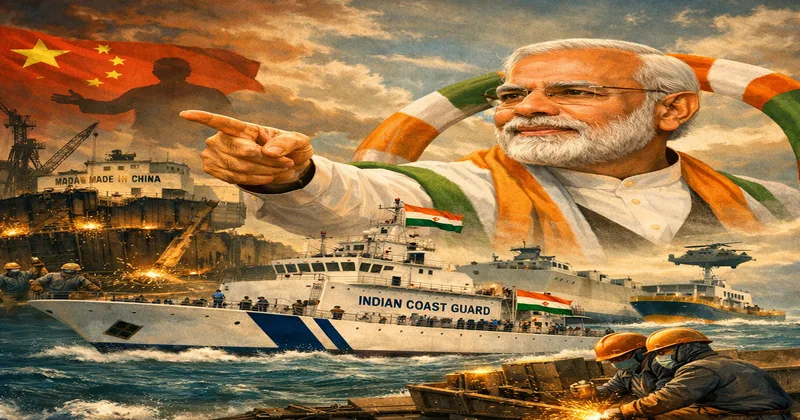
In the coastal expanse of Bhavnagar district in Gujarat lies Alang-Sosiya, the undisputed king of global ship recycling. This sprawling yard, stretching along the Gulf of Khambhat, is more than just a ship-breaking facility, it is a vital artery of India’s economy, a provider of livelihoods to lakhs, and a strategic asset that turns end-of-life vessels into raw material for national development.
Its importance cannot be overstated: deep natural drafts allow even the world’s largest ships to beach effortlessly, tidal advantages reduce costs dramatically, and the labour-intensive process has made India a global leader in ship recycling, handling a massive share of worldwide tonnage.
The Strategic and Economic Powerhouse of Alang
Established in 1983, Alang quickly rose to prominence. At its peak in 2011-12, it dismantled hundreds of ships annually, recovering millions of tonnes of high-quality steel and other materials that feed construction, manufacturing, and infrastructure projects across India.
This recycled steel reduces reliance on mining and imports, lowering costs for everything from roads and bridges to automobiles and consumer goods.
Economically, Alang is a powerhouse. It directly employs 30,000 to 40,000 workers, with indirect employment supporting over 3.5 lakh people through ancillary businesses, from scrap trading and transportation to food services and tool manufacturing. The majority of these workers are migrants from Uttar Pradesh, Bihar, Odisha, Jharkhand, and West Bengal, regions where alternative employment is scarce.
For many families, a few months or years at Alang means remittances that fund education, marriages, and basic sustenance back home.
The yard has generated billions in revenue over decades, contributing taxes and fees to the exchequer while exemplifying ‘Atmanirbhar Bharat’ in recycling long before the term gained popularity.
Beyond numbers, Alang holds geopolitical and environmental significance in a circular economy sense. Ships contain thousands of tonnes of steel, copper, and machinery.
Breaking them domestically prevents waste export and supports India’s metal self-sufficiency. Its very existence deters foreign dominance in a critical secondary raw materials market.
Without Alang, India would lose a competitive edge in global maritime recycling, with ripple effects on ports, shipping, and heavy industries.
The UPA Era: Regulatory Stranglehold and the China Angle
Despite these strengths, Alang faced an existential crisis during the Congress-led United Progressive Alliance (UPA) government under Prime Minister Manmohan Singh.
You'll be shocked to learn another low point about how low the Congress party has sunk.
Alang, located in Bhavnagar, Gujarat, is renowned worldwide for dismantling large ships.
The Alang Ship Breaking Yard is the world's largest ship breaking yard, and the reason for this is… pic.twitter.com/r8zApSREZI
— Arpita Shaiva (@arpispeaks) June 29, 2026
Environmental regulations, particularly under the Pollution Control framework, were tightened in ways that industry insiders and political critics describe as disproportionate and potentially motivated by external factors.
China, which had been aggressively expanding its own ship-breaking capabilities, reportedly found Alang a formidable rival due to its cost efficiency and scale. Unable to compete purely on market terms, Beijing allegedly leaned on diplomatic and trade channels.
The industry stakeholders now narrate how the UPA government, perceived as weak on national economic interests, succumbed to this pressure.
A series of central directives, committee reports, and enforcement actions effectively created hurdles that amounted to a de-facto ban or severe restriction on ships heading to Alang.
Supreme Court cases involving controversial vessels highlighted hazardous waste concerns, leading to prolonged litigation, delays in clearances, and operational paralysis.
While framed as environmental protection, critics argue the selective zeal ignored Alang’s economic role and the fact that similar activities continued or shifted elsewhere.
The result was uncertainty that threatened to wipe out the industry, throw migrant workers into unemployment, and cede global market share to Chinese yards that were simultaneously modernising with state support.
This episode is cited as another low in Congress’s governance, prioritising international optics or external influences over protecting Indian jobs and strategic assets.
The human cost would have been immense. Families dependent on Alang remittances faced ruin. Steel supply chains would have been disrupted.
A proud Indian success story, built over decades, risked being dismantled not by waves but by policy from Delhi.
Modi’s Intervention: The Saviour of Alang
Prime Minister Narendra Modi, who was then Chief Minister of Gujarat, refused to let this happen. Recognising Alang’s strategic importance, he launched a vigorous campaign. The Gujarat government challenged restrictive central moves in the Supreme Court and National Green Tribunal.
Modi personally highlighted the issue, framing it as an attack on Gujarat’s development model and India’s economic sovereignty. Public awareness, legal persistence, and state-level support ensured Alang did not collapse under the weight of regulations.
When the BJP came to power nationally in 2014 with Modi as Prime Minister, the approach transformed from defence to development.
Instead of shutdowns, the government pursued a balanced path: India became one of the first major ship-recycling nations to accede to the Hong Kong International Convention (HKC) in 2019.
The Recycling of Ships Act was enacted, setting clear standards for safety and environment while providing a legal framework for sustainable operations.
Yards at Alang invested in better infrastructure, lined pits for hazardous waste, improved training, personal protective equipment, and inventory systems for toxins.
This Modi-era intervention is credited with saving the industry. Operations stabilised, compliance improved, and Alang retained its global leadership.
How It Earns Money for Alang and India
Primary revenue: Sale of recycled steel (re-rollable plates for construction), machinery, equipment, and other scrap. This supplies a notable share of India’s steel without new mining.
Economic impact: Direct/indirect jobs for tens to hundreds of thousands; taxes, customs duties, and plot leases for the state; cumulative industry value in tens of billions of dollars.
Who Owns Alang?
Gujarat Maritime Board (GMB) regulates the site and leases the around 180–183 beach plots to private operators on 10-year terms. Yards are run by private Indian companies and business families.
Who Pays for Shipbreaking?
Ship owners sell the end-of life vessels (often via cash buyers) and receive payment based on steel prices. Breakers (at Alang) pay for the ship and profit from reselling materials. Breakers cover dismantling, labour, and waste costs.
Why Are Ships Broken (Scrapped)?
Ships reach end-of-life stage at around 25–30 years old and become uneconomical due to maintenance, corrosion, and regulations. Scrapping recovers value from steel/parts instead of ongoing losses and meets demand for cheap recycled materials.
Scrapping recycles nearly 97% of materials into usable products; sinking/exploding wastes resources. Any other process than a systematic dismantling and reprocessing carries the risk of uncontrolled pollution (toxins, debris), environmental damage, navigation hazards, and legal violations.
Why Alang Matters for India’s Future
The Alang saga is larger than one yard. It represents the battle between job-creating, resource-efficient industries and overly restrictive policies that can stifle growth. In a country with massive employment needs, especially for semi-skilled migrants, destroying such hubs under the guise of regulation carries heavy costs.
Alang’s steel recycling supports ‘Make in India’ by providing affordable raw materials. Its survival ensures India does not become dependent on foreign scrap or virgin metals.
Once the ship is beached, the manual labour comes into play for dismantling and reprocessing the material safely as per internationally prescribed norms.
Workers cut the hulls into plates and pieces using torches and other tools.
The metal (primarily high-quality steel scrap) harvested from ships broken at Alang is recycled into India’s steel supply chain, mainly for construction and manufacturing.
Key Steps for the Metal/Steel:
Sorting and Preparation: Steel plates and structural components are separated. Larger sheets are often “re-rollable,” while smaller pieces become scrap. Non-ferrous metals (copper, aluminum, etc.) and other materials are also salvaged separately.
Local Sale and Transport: The scrap is sold (often monthly) and trucked to nearby facilities, especially in Bhavnagar (about 50 km away). This supports a network of induction furnaces, re-rolling mills, and related industries.
Processing: Re-rolling mills heat and roll the plates into rods, bars (e.g., TMT bars/reinforced steel), and other construction materials. Furnaces melt scrap for new steel products.
Ship steel is valued for being malleable and of good quality, feeding India’s construction and infrastructure sectors. At peak times, it has contributed significantly (up to a few percent) to national steel output.
Broader Context
Other salvaged items (machinery, furniture, fittings, cables) go to second-hand markets around Alang/Bhavnagar for reuse across India or export. Residual waste follows approved disposal methods.
In summary, the harvested metal supports a circular economy, turning end-of-life ship steel into new products, primarily for construction, while sustaining local jobs and industries in Gujarat.
The contrast between the UPA era China-influenced approach and the Modi government’s protective, developmental stance underscores a core ideological difference: one accused of weakening Indian strengths, the other committed to safeguarding and strengthening them.
Today, despite market fluctuations and global competition, Alang endures as a testament to resilience. Its beaches may host silent steel giants being dismantled, but behind the scenes is a story of political will that prevented economic sabotage.
The deeds of the past, alleged attempts to scuttle a national asset, serve as a reminder, while the actions taken to save it highlight the difference effective governance can make.
Alang is not just scrap metal on a beach; it is steel in the spine of India’s progress.