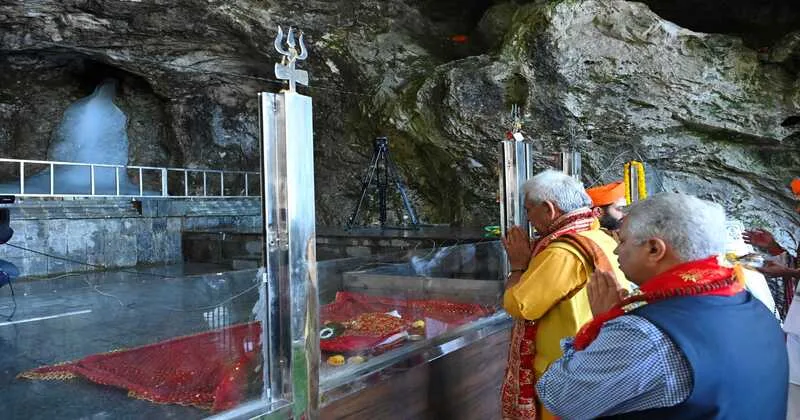
Srinagar: Lieutenant Governor Manoj Sinha performed the ‘Pratham Puja’ at the holy cave of Shri Amarnath, on June 29, Monday marking the ceremonial start of the annual pilgrimage. LG Sinha sought the divine blessings of Baba Barfani and prayed for the peace, prosperity, health and well-being of all.
He extended a heartfelt invitation to all devotees of Baba Barfani, encouraging them to join the holy pilgrimage in large numbers and experience the spiritual journey. “As the Yatra commences on July 3rd, Administration, Shri Amarnath Ji Shrine Board, Army, police, security forces, local community, service providers, volunteers are working in complete synergy. Every stakeholder is devoted to ensuring a safe, hassle-free and a memorable pilgrimage for all pilgrims”, he said.
“Not only that, with significantly upgraded infrastructure, enhanced facilities and invaluable support of people of the Union Territory (UT) of Jammu and Kashmir, we are fully prepared to welcome devotees for a spiritually fulfilling journey,” he added.
Shri Amarnath Shrine Board (SASB) organizes the Pratham Puja annually at the Holy Cave on Jyeshtha Purnima. This year’s 57-day pilgrimage will formally commence on July 3rd, 2026, simultaneously via both traditional routes- the Pahalgam axis in Anantnag district and the Baltal in Ganderbal district. The Yatra will culminate on August 28th, 2026, on Raksha Bandhan.
Pahalgam route via Pissu top
The route to the holy cave via Pahalgam is considered the traditional route for undertaking the pilgrimage. The pilgrims gather at Nunwan camp just outside main Pahalgam town overnight and depart from there for Chandanwari, around 16 km away. Up to this point from the Pahalgam side, vehicles ply and beyond it, the yatra can be undertaken on foot, on horseback or in palanquins carried by four persons.
From Chandanwari to Pissu Top, considered the first stop on this arduous 42-km journey, there is steep ascent. It takes good physical fitness to walk on this stretch located at the very beginning of the climb to the cave.
Mahaganesh Top, Sheshnag and Panjtarni stops can be used to halt overnight depending on one’s physical condition. From Panjtarni, the route leads to Domel where the Baltal route converges and there is a single track beyond this up to the cave. If done in a leisurely manner, the trip to the cave and back from Pahalgam can take five or six days.
Baltal route via Sonamarg in Ganderbal
The Baltal route starts from beyond Sonamarg in Ganderbal district and the entire trip to the cave and back to the base camp can be done in a single day. This route is considered tougher than the Pahalgam route as it entails travelling about 32 km in the span of a single day.
Of course, some people do it in two days, spending the first day climbing up to the cave and coming back to the base camp the next day after having darshan at the naturally formed Shivling inside the 53 metre high cave. Due to an improvement in the facilities available on this route, widening of the track being the most important of them all, this route is gaining in popularity.
During the Pratham Puja, Nalin Prabhat, DGP J&K police; S.J.M.Gillani, Special DG Coordination PHQ; Dr Mandeep K. Bhandari, Principal Secretary to LG and CEO Shri Amarnath Ji Shrine Board; Anshul Garg, Divisional Commissioner Kashmir; Rahul Yadav, Managing Director JKPDCL and Nodal Officer for Baltal Axis; VK Birdi, IGP Kashmir; Rajiv Omprakashn, DIG CKR; Jatin Kishore, Deputy Commissioner Ganderbal; Dr. Bilal Mohiuddin Bhat, Deputy Commissioner, Anantnag; Shreya Singhal, Director Information; and other senior officials were also present.