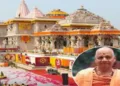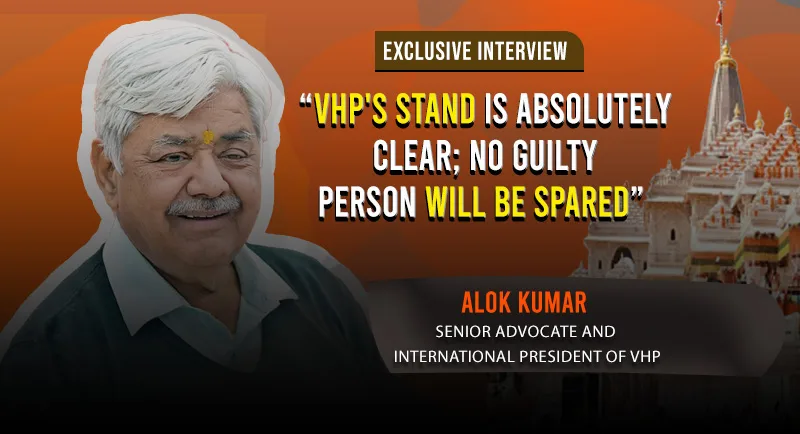
Following the construction of the Ram Mandir, the discourse on Hindutva and culture has entered a new phase. While the magnificent Ram Mandir in Ayodhya has become a focal point of faith for crores of Hindus, issues such as religious conversion, social harmony, population imbalance, global Hindu unity and cultural renaissance are simultaneously at the centre of national debate. In this context, Alok Kumar, Senior Advocate and International President of the Vishva Hindu Parishad (VHP), spoke with Organiser’s reperesentative Dr Mayank Chaturvedi at length about the future of Hindutva, social reform, the role of the youth, the post-Ram Mandir agenda and contemporary national issues. Excerpts :
What is the Vishva Hindu Parishad’s top priority today?
You see, when we speak of Hindu society, we are not merely talking about temples or religious events. Our foremost priority is to eliminate the disparities that exist within Hindu society. For centuries, certain sections of society were denied a life of dignity. They were forced to live on the outskirts of villages, endured social discrimination and were kept away from numerous opportunities.
The Vishva Hindu Parishad believes that much work remains to be done to achieve social equality. Alongside this, economic and educational backwardness and a lack of skills pose equally significant challenges today; Therefore, we strive to ensure that even the person at the very last rung of society can live a life filled with dignity, opportunity, and self-confidence. We aim to build a society grounded in values, developed, and
aligned with Dharma, one that can guide the world through its conduct.
Under your leadership, on which new initiatives is the VHP focusing?
The VHP is not an organisation centered around any single individual; it is an organisation driven by collective leadership. We deliberate together and act according to the needs of society. The Ram Janmabhoomi Movement accomplished the unprecedented task of uniting Hindu society. Today, we are engaged in extensive work in the fields of social service, education, and the inculcation of traditional values (sanskar). Hostels are being run for children from Janjatiya and Scheduled Caste communities. They are provided with a conducive environment, education and values so that they can eventually emerge as leaders within their own communities.
“The construction of the Ram Mandir was a significant milestone in our struggle, but not the ultimate goal. The true objective is for a Ram Mandir to be built within the heart of every Hindu as well. ‘Ram Rajya’ is not a political concept; it is an ideal based on morality, service, sacrifice and social responsibility. We aim to create a society where individuals live not just for themselves, but for society as a whole”
We have established Veda Vidyalayas (schools for Vedic studies). Most importantly, the right to study the Vedas is not restricted to any single class; efforts are underway to ensure that women and people from all sections of society can study them. The Veda Vidyalaya for tribal girls in Odisha is an example of this. Numerous projects are also being implemented for the preservation of Sanskrit, cow protection and the Bharatiya
tradition of knowledge.
How do you view today’s young generation?
I am very optimistic about the youth. Today’s Bharatiya youth are far more conscious of their cultural identity than in the past. It would be no exaggeration to say that the Bajrang Dal is currently the country’s largest youth organisation. The massive participation of youth in the Maha Kumbh is proof of this. The crowds thronging temples on New Year’s Day also signal this shift. Previously, under the influence of Western culture, New Year celebrations were confined to clubs and parties. Now, however, young people welcome the New Year by visiting temples and offering prayers. Naturally, this transformation signifies a resurgence of Bharatiya consciousness. Today’s youth want to understand their religion, culture and history. This is the greatest strength of Bharat’s future.
In recent years, the popularity of films based on ‘Hindutva’ themes has grown. How do
you view this?
Cinema is a mirror of society. Ultimately, the film industry operates based on audience preferences and market demand. If films based on subjects like the Ramayan, Chhatrapati Shivaji Maharaj, Sambhaji Maharaj, or The Kerala Story are succeeding, it means society wants to see such content. Today, Hindu society wishes to view its traditions, heroes and history with respect. That is why such films are not only being made but are also achieving success. This is an indication of Bharat’s changing cultural psyche.
What is your perspective on religious conversion?
Our stance is absolutely clear. Religious conversion is wrong and contrary to the very nature of Bharat. If an individual changes their religion voluntarily after deep spiritual contemplation, that is a different matter. However, in Bharat, most conversions take place based on greed, fear, or deception.
Gandhi ji also stated that if someone is induced to convert in exchange for education, medical care, or social service, it cannot be considered a religious act, it is simply a transaction. Therefore, we believe there should be an effective curb on such conversions.
What do you have to say about the issue of Love Jihad?
If a person conceals their identity to deceive a young woman and subsequently exploits her, it is a serious crime. The law has treated this seriously, but at the same time, we must also look within our own society. If our children lack knowledge of their own religion, culture and traditions, they can become confused. In the past, grandparents used to tell children stories about Ram, Krishna and great historical figures. The family is the first school for instilling values. If this tradition remains strong, society will also be strong.
What is the VHP’s next major goal following the construction of the Ram Mandir?
The construction of the Ram Mandir was a significant milestone in our struggle, but not the ultimate goal. The true objective is for a Ram Mandir to be built within the heart of every Hindu as well. ‘Ram Rajya’ is not a political concept; it is an ideal based on morality, service, sacrifice and social responsibility. We aim to create a society where individuals live not just for themselves, but for society as a whole.
As for the issues concerning Krishna Janmabhoomi, Kashi Vishwanath and certain other temples, I have personally examined the files related to these cases. The facts and arguments are in our favour. I am fully confident that truth will prevail in the future. Recently, a verdict was delivered regarding the Bhojshala in Dhar, Madhya Pradesh, a judgement everyone should read. It has gone in our favour.
What are your key expectations from the current Government?
We want the Hindu community to enjoy the same rights that are available to other religious communities. Just as Muslims manage mosques and Christians manage churches, the administration of Hindu temples should also be in the hands of the Hindu community. Furthermore, there should be parity in the management of educational institutions as well. Our aim is not to curtail anyone’s rights; rather, it is to ensure that the Hindu community also receives equal rights.
What is the VHP doing to unite Hindus at a global level?
Today, a large Hindu population resides in many countries across the world. We strive to ensure the preservation of their cultural identity and to assist in resolving the issues they face. Campaigns were conducted in over 100 countries regarding the atrocities against Hindus in Bangladesh. This issue was raised before various governments and on international platforms. We are confident that the unity of the global Hindu community will grow even stronger in the future.
You face accusations of deepening societal divisions. How do you respond to this criticism?
We are working to unite society. Our objective is to reduce caste-based divisions, foster social harmony and unite Hindu society as a single family. We are not working in opposition to anyone; rather, we are working to organise and strengthen our society. The Ram Mandir movement has infused Hindu society with new energy, but the most important task now is to channel that energy towards service, social harmony and nation-building. The Mandir has been built; now, the ideals of Ram-Rajya must be integrated into the society. This has been the primary objective of the VHP for the years ahead. The rise and supreme glory of Bharat is the ultimate aspiration of the Vishva Hindu Parishad.
“The Ram Mandir in Ayodhya is a focal point of faith for crores of Hindus. Therefore, it is essential to take any allegations related to it seriously. The Shri Ram Janmabhoomi Teerth Kshetra Trust is accountable for every single rupee received in the name of Bhagwan Ram ”
What is your response to the allegations of financial irregularities concerning the Ayodhya Ram Mandir?
The Ram Mandir in Ayodhya is a focal point of faith for crores of Hindus. Therefore, it is essential to take any allegations related to it seriously. The Shri Ram Janmabhoomi Teerth Kshetra Trust is accountable for every single rupee received in the name of Bhagwan Ram. That is why, the Trust itself requested Chief Minister Yogi Adityanath to constitute a Special Investigation Team (SIT). The Trust is cooperating fully and transparently with the investigation.
What action will be taken if anyone is found guilty during the investigation?
Our stance on this matter is absolutely clear. No guilty person will be spared, no matter how influential they may be. Any form of negligence regarding matters of faith and belief is unacceptable. We want the truth to come out; if someone is guilty, they must be punished and if no one is guilty, that fact must also be made clear.