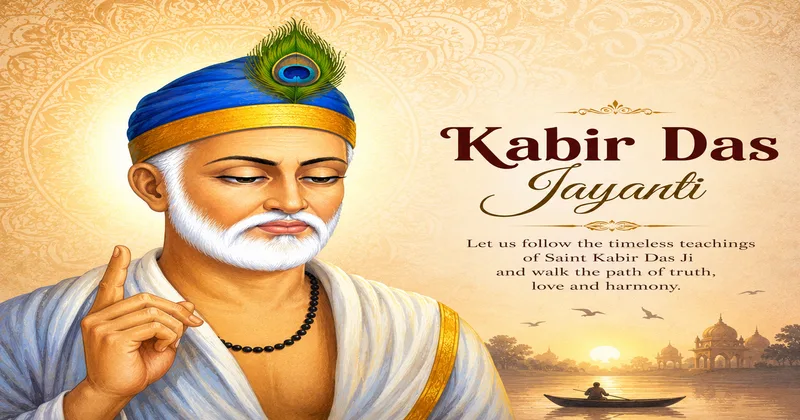
Sant Kabir Das occupies a unique place in India’s spiritual and literary heritage. Widely regarded as one of the foremost Bhakti sants, Kabir’s verses transcended religious boundaries and spoke directly to ordinary people in a language they could understand.
According to traditional accounts, Kabir was born around 1398–1399 CE near Varanasi. While details surrounding his birth remain a subject of historical debate, it is widely believed that he was raised by Niru and Nima, a family of weavers (Julahas), after being found near Lahartara. Growing up in a humble household exposed Kabir to diverse religious and philosophical influences that later shaped his teachings.
Many traditions associate Kabir with the Bhakti Sant Ramananda, whom he is believed to have accepted as his spiritual guru. Kabir himself refers to Ramananda with deep reverence in several of his verses, while emphasising that true spiritual knowledge comes through direct experience and devotion rather than ritualistic practices.
Although Kabir never received formal education, his compositions have become enduring classics of Indian literature. His disciples preserved his teachings in collections comprising Sakhis (couplets), Shabads (hymns), and Ramainis, many of which continue to be recited across India.
A Voice Against Social Divisions
Kabir was among the earliest voices to openly criticise caste discrimination and social inequality.
His famous couplet:
“Jaati na puchho sadhu ki, puchh lijiye gyaan”
(“Ask not a saint’s caste; ask instead about his wisdom.”)
captures his belief that knowledge, character and devotion—not birth—define an individual.
Similarly, through verses such as “Bura jo dekhan main chala…” and “Kabira khada bazaar mein...”, Kabir encouraged introspection, humility and goodwill towards all.
His teachings consistently emphasised compassion, moderation and self-reflection over social status or external identity.
Critique of Ritualism Across Communities
A defining feature of Kabir’s philosophy was his rejection of ritualism and hypocrisy wherever he perceived it.
He questioned practices that, in his view, prioritised outward religious observance over inner spiritual transformation. His verses contain pointed critiques of ritualistic practices among both Hindus and Muslims, reflecting his broader message that genuine devotion cannot be achieved through ceremonies alone.
Among his well-known observations are verses questioning mechanical religious rituals, public displays of piety and practices he believed contradicted compassion and moral conduct.
Kabir’s criticisms were directed not at communities as a whole but at what he regarded as empty ritualism, dogmatism and social hypocrisy. His message urged individuals to cultivate sincerity, ethical conduct and devotion rooted in truth.
The Philosophy of Love
Perhaps Kabir’s most enduring teaching is his emphasis on love as the highest spiritual path.
His celebrated couplet:
“Pothi padh padh jag mua, pandit bhaya na koye; Dhai aakhar prem ka, padhe so pandit hoye.”
(“The world may read countless books, yet wisdom remains elusive; one who understands the two-and-a-half letters of ‘love’ is the true scholar.”)
This philosophy continues to resonate across generations as a call for empathy, humility and human unity.
An Enduring Legacy
Centuries after his lifetime, Kabir’s verses remain part of India’s cultural consciousness. They are sung in devotional gatherings, taught in schools and universities, and studied by scholars of literature, religion and philosophy.
His teachings influenced the Bhakti movement and also found resonance among Sufi traditions, reflecting his ability to bridge social and spiritual divides.
In contemporary society, Kabir’s message continues to inspire discussions on equality, ethical living, religious harmony and the rejection of prejudice.
As India commemorates Sant Kabir Jayanti, his timeless wisdom serves as a reminder that truth, compassion and self-realisation remain the strongest foundations for a just and harmonious society.