The National Council of Educational Research and Training (NCERT) has strongly refuted reports claiming that the Preamble to the Constitution of India has been removed from the newly introduced Class 9 Social Science textbook, describing such reports as “misleading”.
The clarification comes amid a political and academic debate triggered by media reports suggesting that references to the Preamble, secularism and related constitutional concepts had been dropped from the revised textbook developed under the National Curriculum Framework (NCF).
According to NCERT sources, the Preamble continues to be part of NCERT textbooks and constitutional values remain embedded within the curriculum. Officials have argued that recent criticism stems from a misunderstanding of how the revised curriculum has redistributed topics across different grade levels.
NCERT says curriculum has been redesigned
Sources within NCERT explained that the latest curriculum revision was carried out under the National Curriculum Framework, which seeks to reorganise subjects and concepts across classes rather than concentrating them in a single textbook.
Under this approach, themes related to the Constitution, democratic values and citizenship are introduced progressively at different stages of schooling.
Officials said that several topics previously taught together in one chapter have now been spread across multiple grades to ensure age-appropriate learning and better conceptual understanding.
As a result, the absence of a specific chapter in one class should not be interpreted as the removal of that subject from the curriculum altogether.
“The curriculum has been redesigned. Topics have been redistributed across grades instead of being covered in a single textbook,” NCERT sources said.
Preamble still part of NCERT textbooks
Rejecting claims that the Preamble had been dropped, NCERT sources said it continues to appear in the opening pages of new textbooks, including the latest Social Science books.
The education body also pointed to material included in lower classes to demonstrate that students continue to be introduced to the Constitution and its guiding principles.
According to NCERT, constitutional values such as justice, liberty, equality, secularism and socialism are discussed in detail in middle-school classes, particularly in Social Science textbooks for Classes 6, 7 and 8.
Images accessed by media organisations showed that the Preamble has been included in Class 7 textbooks along with explanations of its meaning and significance.
Officials said this reflects the broader curricular approach of introducing constitutional concepts gradually rather than limiting them to a single chapter in Class 9.
Constitutional values introduced earlier
NCERT sources stressed that constitutional education now begins earlier than before.
Students are introduced to democratic institutions, constitutional principles and citizenship-related concepts from middle school onwards.
The revised curriculum seeks to familiarise students with ideas such as justice, liberty, equality, secularism and democratic participation through multiple lessons spread across different grades.
Officials argue that this approach allows children to engage with constitutional values at different stages of intellectual development instead of encountering them only in one chapter during secondary school.
They also noted that several constitutional themes are revisited and expanded upon as students move to higher classes.
Constitution covered extensively in Class 10
NCERT clarified that while some topics have been shifted from Class 9, they continue to receive substantial coverage in higher grades.
According to officials, the Constitution and related concepts are discussed in greater detail in Class 10 textbooks.
This includes discussions on democratic institutions, constitutional governance, citizens’ rights and responsibilities, and the functioning of India’s political system.
The council argued that the restructuring should be viewed as a pedagogical change rather than an ideological shift.
How the controversy began
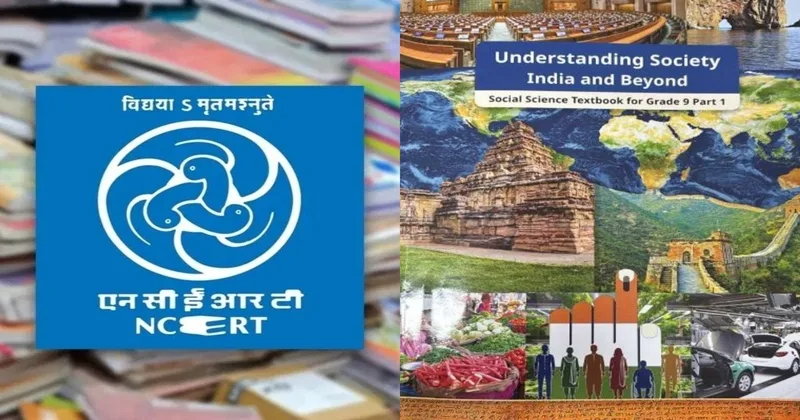
The controversy emerged after reports highlighted changes in the newly released Class 9 Social Science textbook titled Understanding Society: India and Beyond.
Comparisons with older editions showed that certain sections found in previous textbooks were no longer present in the same format.
This led to claims that references to the Preamble and concepts such as secularism had been removed.
The reports sparked reactions from political parties, educationists and social media users, with critics questioning whether constitutional principles were being diluted in school education.
NCERT’s clarification seeks to address these concerns by emphasising that the subjects have been redistributed rather than deleted.
Emergency introduced in class 9 textbook
While rejecting claims regarding the Preamble, NCERT confirmed that the revised textbook introduces a detailed discussion on the Emergency imposed in 1975 under the government led by then Prime Minister Indira Gandhi.
This marks the first time that the Emergency has been specifically discussed in a Class 9 Social Science textbook.
The chapter examines the strengths and challenges of India’s democratic system and describes the Emergency as one of the most significant challenges faced by Indian democracy.
According to excerpts from the textbook, students are introduced to the political and social circumstances that led to the declaration of Emergency.
The text notes that public dissatisfaction with the government was rising in the early 1970s due to factors such as unemployment, inflation and allegations of misgovernance.
It then explains how a National Emergency was declared in June 1975 on the grounds of internal disturbance.
The inclusion of the Emergency chapter comes shortly after the country marked the 51st anniversary of its declaration.
Why the Emergency chapter is significant
The decision to include the Emergency has attracted considerable attention because it introduces students at an earlier stage to one of the most debated periods in India’s political history.
The Emergency lasted from June 1975 to March 1977 and witnessed the suspension of several civil liberties, the arrest of political opponents and extensive restrictions on press freedom.
Many historians and political observers describe the period as a major test for India’s democratic institutions.
By incorporating the topic into the Class 9 curriculum, NCERT appears to be placing greater emphasis on understanding democratic challenges and constitutional safeguards.
Supporters of the move argue that students should learn about both the achievements and challenges of Indian democracy.
Special Intensive Revision (SIR) added to curriculum
Apart from the Emergency chapter, the revised textbook has also introduced a section explaining the Special Intensive Revision (SIR) process used by the Election Commission of India.
The inclusion comes roughly a year after the Election Commission carried out the exercise ahead of the Bihar Assembly elections.
According to the textbook, SIR is a mechanism used to update, verify and correct electoral rolls.
The text explains that the process helps ensure that all eligible citizens are included in voter lists while removing ineligible entries.
NCERT describes India’s electoral process as unique due to its scale and complexity and presents voter list revision as an important administrative exercise aimed at maintaining accurate electoral records.
The inclusion of SIR in school textbooks has also generated discussion because it introduces students to contemporary electoral processes that are rarely covered at this level.
Debate over curriculum changes
The latest controversy highlights the intense scrutiny that often accompanies changes to school textbooks in India.
Curriculum revisions frequently become subjects of public debate because school textbooks play a crucial role in shaping how young citizens understand history, politics and society.
Supporters of the revised curriculum argue that the National Curriculum Framework seeks to modernise education by reducing content overload and improving conceptual learning.
Critics, however, often examine textbook changes closely to assess whether certain themes are receiving more or less emphasis than before.
The debate surrounding the Preamble, secularism, the Emergency and electoral processes reflects the broader significance attached to educational content in India.
NCERT maintains no constitutional values have been removed
Despite the controversy, NCERT has maintained that constitutional principles remain firmly embedded within the curriculum.
Officials insist that students continue to learn about the Preamble, constitutional values, democracy, citizenship and governance across multiple classes.
The council has emphasised that the revised structure should not be viewed as a deletion of content but as a reorganisation designed to make learning more gradual and age-appropriate.
As discussions continue over the revised textbooks, NCERT’s position remains clear: the Preamble has not been removed, constitutional values continue to be taught, and the curriculum changes are part of a broader effort to redesign how students engage with civic and constitutional education.