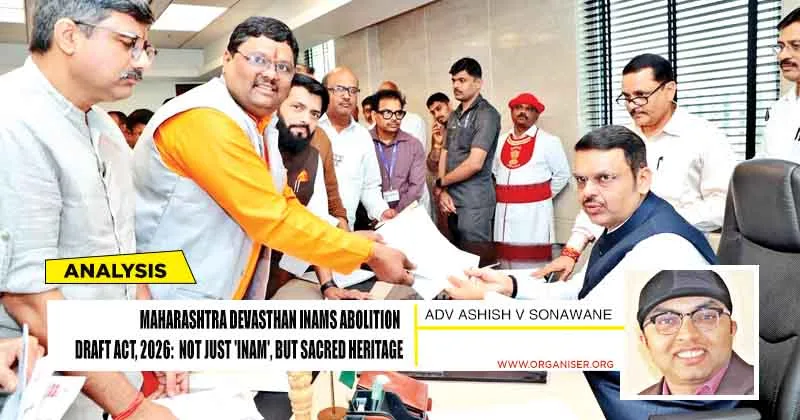
The Government of Maharashtra has recently circulated a proposed piece of legislation titled the “Maharashtra Devasthan Inams Abolition Draft Act, 2026” and is seeking public comments until June 5, 2026 from the public on it. Ordinary citizens may not immediately realise the immense stakes involved in this bill by reading its title.
The draft concerns lands that were historically dedicated to Hindu Mandirs, deities, mathas, and sacred religious or charitable institutions. These endowments were never intended as personal gifts to a pujari, vahiwatdar, or a manager, nor were they surplus state lands. They formed the Devasva — the permanent, inalienable religious corpus of the Devasthan, explicitly earmarked to sustain daily worship (nitya puja), naivedya, traditional festivals (utsav), annachhatras (community kitchens), dharmashalas, gaushalas, temple restorations, cultural and environmental protection, Vedic learning, and the continuation of ancient Dharmic traditions.
By seeking to abolish this very tenure, the draft opens dangerous pathways for these sacred lands to transition into private holdings or vest part of such lands in the Government. This proposal is not a routine revenue reform; it is a direct assault on the structural integrity of Hindu religious endowment property in Maharashtra.
Foundations of Hindu Endowments
To fully comprehend the gravity of this threat, one must look beyond modern real estate economics and understand the true spiritual, social, and legal meaning of Devasthan land. In the traditional life of Bharat, the establishment of a village was organically intertwined with the invocation of its Gram devata (village deity). The deity, the temple architecture, the annual utsav, the yatra, and the agricultural lands attached to the Devasthan formed a singular, living socio-cultural-economic system.
Property was endowed precisely so that the deity’s worship and the village’s collective spiritual life would endure uninterrupted through the generations. Consequently, the manager, pujari, gurav, archak, vahiwatdar, or sevakari was never the owner of this land; they were sacred custodians bound to safeguard the property of the Divine.
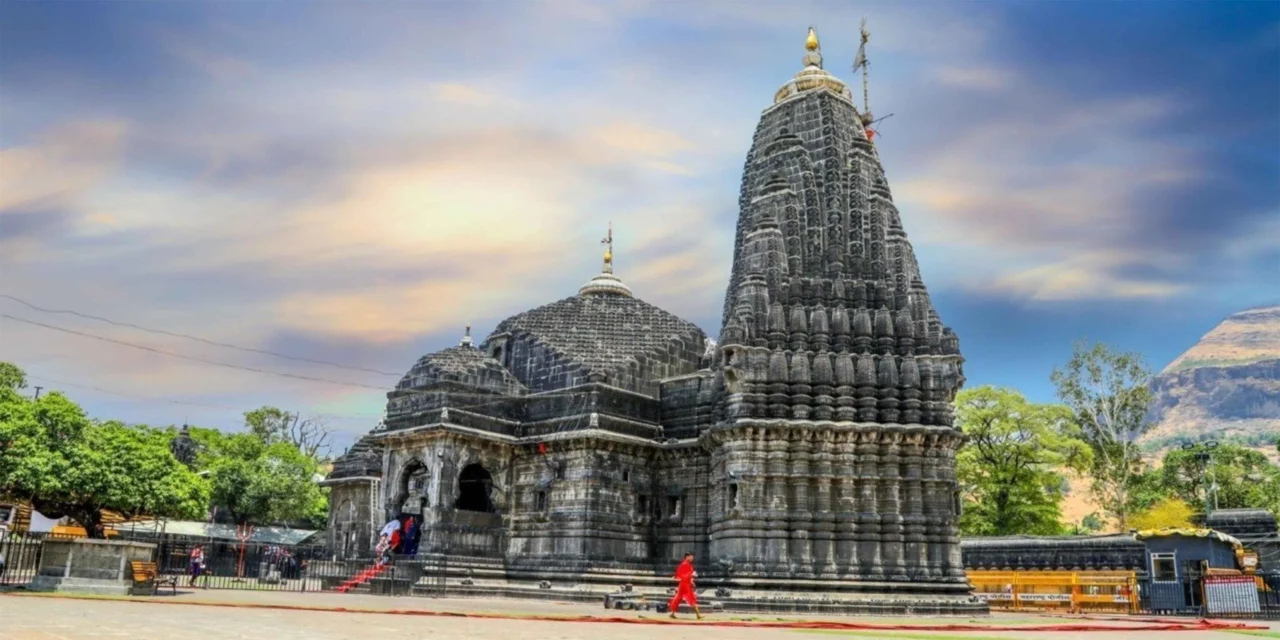
This is not a matter of sentimentality or blind faith; it is the settled, foundational position of Hindu law that Property once dedicated to a deity cannot be treated as the private estate of the human agency managing it. The roots of this jurisprudence are deeply embedded in classical Hindu legal history. Long before the advent of the British Raj, the administration of Hindu endowments was seamlessly governed by original Hindu Law sources. Treatises such as the Yajnavalkya Smriti, Vijnanesvara’s authoritative commentary in the Mitakshara, and the governance principles of the Shukra Niti articulated a sophisticated doctrine of religious property.
In this classical jurisprudence, the dedication of property to the Divine is formalised through precise, sacred legal mechanisms:
● Sankalpa: The solemn, inviolable declaration of intent to dedicate.
● Utsarga: The formal, public renunciation of private ownership, effectively dedicating the asset for the collective spiritual good.
● Danam: The sacred gift that completes the transition of title.
The moment utsarga is performed, the human donor’s private rights are completely and irrevocably extinguished. The property transitions into the realm of Devasva or Devadravya — belonging exclusively to the deity as a juristic entity. Crucially, this ancient legal framework cast a primary, absolute duty upon the Sovereign. Under the timeless tenets of Rajadharma, the ruler was not merely a political sovereign but also a protector of Dharma. The King was never permitted to seize or dissolve these endowments; rather, he was mandated to act as their ultimate guardian. It was the King’s primary executive duty to ensure that the intent of the donor was respected and that Devasva was never diverted to secular or private hands.
The Unbroken Shield of Precedent
This protective approach survived even the transition into the colonial legal framework. Early enactments such as Bengal Regulation XIX of 1810, Madras Regulation VII of 1817, and Bombay Regulation XVII of 1827 explicitly refused to treat religious endowment property as resumable State property. Their sole object was to preserve the endowment and ensure that the income was applied according to the exact intention of the donor.
Section 8(3) of the Bombay Exemptions from Land Revenue (No. 1) Act, 1863, statutorily codified this protection, creating an absolute embargo against the transfer or alienation of lands held on behalf of religious or charitable institutions. This provision remains a powerful legal wall today, reflecting an elemental legal truth: land dedicated to a religious institution is res extra commercium — it is completely outside the realm of ordinary commerce and cannot be treated like private real estate.
Our ancestors endowed land to temples because they understood that land is permanent. Portfolios of money can be spent, stolen, mismanaged, or eroded by inflation
In the landmark case of Manohar Ganesh v. Lakhmiram (1888), Justice West of the Bombay High Court eloquently recorded this historical continuity: “Under the native system of government though it was looked on as a heinous offence to appropriate to secular purposes the estate that had once been dedicated to pious uses… yet the State in its secular executive and judicial capacity habitually intervened to prevent fraud and waste in dealing with religious endowments.”
Furthermore, in Shankarlal Tapidas v. Secretary of State, the Bombay High Court established that the right of a religious institution to land revenue exemption is fixed in perpetuity, and the State cannot exploit or benefit from the negligence or misconduct of a temple manager to dispossess the deity.
Following Independence, the Maharashtra Land Revenue Code and the Indian judiciary consistently reinforced this protective barrier through an unyielding line of modern jurisprudence. There are a few leading judgements such as the constitution bench’s judgement in the iconic The Shirur Mutt Case in 1954. In the Ayodhya Ram Janmabhoomi Judgement also, a constitutional bench judgement reaffirmed that a consecrated Hindu deity is a juristic person in whom property vests in an ideal legal sense. Such property is permanently impressed with the purpose of the endowment and must be preserved for the deity and the worshippers. In State of Madhya Pradesh v. Pujari Utthan Avam Kalyan Samiti, the Hon’ble Apex Court explicitly clarified that the presiding deity is the sole owner of temple land, and the pujari is merely a manager without any proprietary entitlement. In AA Gopalakrishnan v. Cochin Devaswom Board (2007), the Hon’ble Supreme Court issued a stern warning that temple properties are highly vulnerable to usurpation via false claims of ownership, tenancy, or adverse possession, and cast a mandatory duty upon courts and trustees to zealously protect them. Likewise, recently, the Bombay High Court applied these exact principles to Maharashtra’s Devasthan Inam lands. In Smt Suvarna Appasaheb Kshirsagar v. State of Maharashtra (2025), the Court held that Devasthan lands belong strictly to the deity. The Court exposed the common modus operandi of land grabbers: first, manipulate revenue entries to delete the word “Devasthan”; second, remove the land revenue exemption; and finally, treat the sacred land as private property to be sold for profit. The High Court ruled that revenue entries are strictly for fiscal purposes and do not prove ownership, declaring that Section 8(3) of the 1863 Act remains a permanent legal wall against alienation.
The Fatal Flaws
It is against this unyielding wall of protective jurisprudence that the proposed Draft Act falters fundamentally. Section 3 of the draft operates as the core abolition provision, while Sections 4 and 5 systematically construct pathways for authorised holders, mirasdars, tenants, inferior holders, and even unauthorised holders to obtain Occupant Class-I status. Section 4(3) expressly mandates that land granted under its purview shall be held as Occupant Class-I private holdings.
The moment this occurs, the Devasthan is permanently stripped of its recurring, generational income stream. A minuscule one-time compensation, occupancy price, or nominal annuity can never replace an appreciating, permanent religious corpus. Our ancestors endowed land to temples because they understood that land is permanent. Portfolios of money can be spent, stolen, mismanaged, or eroded by inflation. Land, if fiercely protected, continues to sustain an institution across generations. The ancient religious ideal was explicitly written into our historical grants: Yaavaccandradivaakarau — as long as the sun and the moon endure. A law that forcefully converts such a permanent spiritual corpus into private occupancy rights completely defeats the very purpose for which these endowments were created.
Perhaps the most disturbing dimension of the draft is its unprecedented leniency towards unauthorised possession. Section 2(20) correctly defines an “unauthorised holder” as a person occupying land under an alienation that is null and void under applicable law. Yet shockingly, Section 5(1) permits the Collector to regrant title to these very violators as Occupant Class-I. In gaothan residential cases under Sections 4(5) and 5(2), the draft goes so far as to contemplate regranting ownership without charging any occupancy price or nazarana. Furthermore, the cut-off date of 01.01.2011 specified in these sections is completely arbitrary and devoid of any disclosed constitutional, historical, or policy basis. A person in unauthorised occupation of sacred land before that date does not possess any moral or legal superiority over a subsequent encroacher. This classification rewards past encroachment and fails the fundamental test of reasonableness under Article 14. “This is not an anti-encroachment law. It is an encroachment reward scheme.”
Constitutional Disparity
When analysing this bill, the contrast with existing Waqf law is impossible to ignore. Lands covered by the Waqf Act are expressly and meticulously excluded from the purview of this draft under Sections 1(2) and 2(9). Under the Waqf Act, 1995, the mutawalli is strictly treated as a statutory manager, never an owner. Waqf properties are stringently registered, supervised, and insulated.
Under Sections 51(1A) and 104A of the Waqf Act, any sale, gift, exchange, mortgage, or transfer of Waqf property without prior sanction is deemed completely void ab initio. Waqf law provides powerful, specialised mechanisms for Collector-assisted recovery (Section 52), immediate eviction of encroachers (Sections 54 and 55), and severe penal consequences for unauthorised alienation (Section 52A).
Crucially, Section 104B of the Waqf Act mandates that if the Government itself occupies Waqf property for a public purpose, the land must either be returned to the Board or its rent/compensation must be determined by a specialised Tribunal at prevailing market values. By contrast, Section 9 of the proposed Devasthan Draft Act permits the Government to simply vest specified public-purpose lands within Devasthans unto itself, completely extinguishing the deity’s rights and allowing the Collector to dispose of it freely.
Why must Hindu Devasthans be denied the same institutional safeguards? The state cannot logically or morally construct a protective fortress for one class of religious endowment while engineering an “abolition-and-regrant” regime for another. If religious property is deemed too sacred to be secularised, regularised in favour of occupants, or converted into private estates in one instance, that exact principle must apply equally to Hindu Devasthan lands, which is in line with the settled Hindu Law jurisprudence.
This stark differential treatment creates a profound equality issue and cannot withstand judicial scrutiny on the touchstone of Articles 14, 25, 26, and 300A of the Constitution of India. Article 14 strictly prohibits arbitrary discrimination between similarly situated religious endowments. Articles 25 and 26 guarantee the preservation of religious practice — which requires a reliable land base to sustain its expenses — and the fundamental right of religious denominations to administer their own property. Article 300A protects entities from being deprived of property except by authority of law. While reasonable regulation is permissible, the outright statutory divestment and privatisation of a religious corpus can never be classified as legitimate regulation.
Bypassing Trust Protections
Furthermore, the draft concentrates sweeping, disproportionate powers within ordinary revenue authorities. Section 6 empowers the Collector to conclusively decide whether a tract of land constitutes Devasthan Inam land and to arbitrarily determine whether an individual is an authorised holder, tenant, pujari, archak, gurav, or sevakari. Compounding this risk, Section 14 completely bars the jurisdiction of civil courts.
Similarly, Section 16 applies the general tenancy laws to operate on Devasthan lands which exposes the Devasthan lands to become highly vulnerable to claims of protected tenancy, deemed purchase, and permanent cultivation rights exercised against the deity, permanently defeating the purpose of the endowment.
Contrary to the Maharashtra’s continued state policy for the protection: What makes this draft profoundly shocking is that Maharashtra’s historical trajectory has always moved in the exact opposite direction. The Government Resolution of 1996 (explicitly aimed at keeping lands in the possession of Devasthans and preventing transfers), similarly the 2010 Resolution (mandating that each mutation entry be “microscopically examined” and illegal entries cancelled), the 2011 Corrigendum to 2010 notification, and the 2018 Directions all operated on the unshakeable premise that Devasthan lands must be protected, and illegally transferred lands must be restored to the Devasthan.
The 2011 Corrigendum was a magnificent milestone, explicitly clarifying that upon a breach of conditions, the land must not vest in the Government but must be reinstated directly in the name of the Devasthan. The Draft Act of 2026 completely abandons this proud legacy of restoration, shifting the state’s posture from protection to abolition. The Government of Maharashtra stands at a historic crossroads. It can either march forward with a bill that secularises and liquidates Devasva into private hands, or it can script a model law that fiercely protects temple lands, restores stolen endowments, and strengthens the civilisational foundations of Maharashtra. Devasthan lands are not a revenue problem to be solved by abolition. They are sacred public trusts to be protected for generations to come.