For decades, American universities were regarded as the global benchmark for higher education, attracting students from across the world and symbolising academic excellence, innovation and social mobility. Today, however, that model is under unprecedented pressure. Declining student enrolment, soaring tuition costs, mounting student debt, expanding administrative structures, ideological controversies and changing labour market demands have converged to create a systemic crisis.
While a handful of elite institutions continue to benefit from their global reputation, a large section of America’s four-year colleges and universities is struggling to remain financially sustainable as demographic shifts and public dissatisfaction reshape higher education.
Shrinking student pool and rising financial pressures
One of the most significant structural challenges confronting American universities is demographic decline. During the 1960s, the United States recorded a fertility rate of around 3.6 children per family. Although births have recovered slightly in the last three years, the fertility rate now stands at approximately 1.7 children per family. As a result, the population of 17-, 18- and 19-year-olds, the traditional college-going age group, has fallen to less than half of earlier levels.
Harvard students have recently become involved in the Gaza encampment movement. A concerned Netanyahu has responded by releasing a video likening student protests on US campuses to Nazi Germany.#Harvard #GazaEncampment #Netanyahu #StudentProtests #USCampuses #HistoryMaking pic.twitter.com/yRDnLKHh8a
— The Workers Rights (@theworkersright) April 26, 2024
This demographic contraction has fundamentally altered the higher education marketplace. Instead of students competing for admission into universities, many institutions are now competing aggressively to attract a shrinking number of applicants. While a limited number of top-tier universities may still rely on their longstanding brand value despite experiencing declining applications and admissions, most four-year colleges face increasingly difficult financial circumstances as enrolment weakens.
The financial burden on students has simultaneously intensified. Over the past fifty years, university tuition has increased at a rate roughly three times higher than annual inflation. Rising educational costs have become one of the principal reasons many families question whether a traditional four-year degree continues to offer sufficient value for money.
Administrative expansion and changing institutional priorities
Critics increasingly argue that rapidly expanding administrative structures rather than academic necessities have driven much of the increase in university costs. Administrative staffing has grown substantially across many institutions. At Stanford University, for example, a Wall Street Journal analysis is suggesting that when both undergraduate and graduate students are counted, there is approximately one administrator or administrative staff member for every student.
According to this critique, universities have increasingly adopted responsibilities extending far beyond teaching and research. Rather than functioning solely as centres of higher learning, institutions have assumed extensive responsibilities for monitoring students’ personal wellbeing, handling disciplinary matters, responding to allegations of misconduct and addressing an expanding range of social and political issues throughout campus life.
Critics contend that universities have increasingly viewed their mission not merely as providing disinterested, evidence-based education but also as shaping students’ broader political and social outlook. They argue that institutions have sought to challenge traditional social institutions, including the family, religion and community, while promoting particular ideological perspectives. Such perceptions, whether universally accepted or not, have contributed to declining public confidence in higher education among many sections of American society.
Academic employment practices have also come under scrutiny. Tenure remains a distinctive feature of American universities. Outside the most selective institutions, critics argue that tenure has often become relatively routine after six years of service. At the California State University system, for instance, approximately 90 per cent of assistant professors reportedly obtained tenure.
Teaching responsibilities have simultaneously declined at many institutions. In numerous colleges, full-time faculty now teach between two and four courses annually. Even within the California State University system, the world’s largest public university system, teaching loads have reportedly fallen on many campuses from four classes per semester to three. Universities have increasingly relied on “release time,” allowing faculty members to reduce teaching commitments while undertaking administrative responsibilities, tutoring or special projects.
To compensate for reduced teaching by permanent faculty, institutions have expanded their dependence on temporary and part-time lecturers. These instructors are frequently paid only about 40 per cent of the per-course compensation received by full-time or associate professors while receiving fewer employment benefits. At some universities, temporary lecturers now teach between 40 and 45 per cent of all courses, illustrating the growing casualisation of academic labour.
Research funding, foreign students and political controversies
Financial pressures have also shaped universities’ approach to research funding. Critics argue that institutions increasingly rely upon substantial indirect cost recoveries from research grants. In some cases involving grants from the National Institutes of Health (NIH), universities have reportedly charged indirect costs reaching 40 per cent or more rather than 10 or 15 per cent. Thus, if a professor secured a federal research grant worth one million dollars, the university could retain roughly 40 per cent to cover institutional overhead such as laboratories, offices and administrative infrastructure.
According to critics, these overhead charges reflect broader financial weaknesses driven by expanding administrative structures and the proliferation of research centres and programmes that add institutional costs without directly contributing to undergraduate education.
🚨#BREAKING: A 21-year-old Chinese national, Tianrui Liang, has been arrested and is facing charges after photographing a U.S. “doomsday plane” and other military aircraft without authorization at Offutt Air Force Base in Nebraska. He was taken into custody at JFK Airport…
— R A W S A L E R T S (@rawsalerts) April 21, 2026
International student recruitment has similarly become an increasingly important revenue source. More than one million foreign students currently study in American universities. Unlike many domestic students, international students generally receive few scholarships or tuition discounts and often pay full or premium tuition rates. For financially stressed universities, these students have become an essential source of income.
However, critics argue that heavy dependence on international enrolment has generated new political concerns. Around 300,000 students have come from China, while more than 200,000 have arrived from countries in the West Asia. Additional international students originate from various countries across Africa, Asia and the Western Hemisphere, including several states described as politically illiberal or authoritarian.
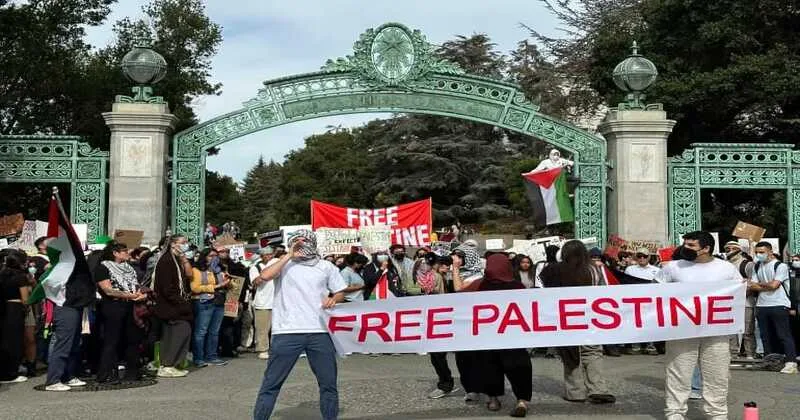
Following the October 7 conflict in the West Asia, universities witnessed widespread demonstrations, many involving international students. Protest slogans such as “From the river to the sea, Palestine will be free” became especially controversial, with critics interpreting the phrase as advocating the elimination of the State of Israel. Violent demonstrations on several campuses intensified concerns regarding campus security and political radicalisation.
Security concerns have also entered the debate. The Federal Bureau of Investigation (FBI) has suggested that between 1 and 5 per cent of Chinese students may be actively involved in espionage activities. These developments have contributed to broader public unease regarding the scale and composition of international student enrolment, particularly when American families believe domestic applicants may lose places to higher-paying foreign students.
Ideological battles, student debt and government incentives
Debates surrounding diversity, equity and inclusion (DEI) policies have become another defining feature of the higher education crisis. Critics argue that many universities continued using race, gender and sexual orientation as important considerations in admissions, hiring, promotion and faculty retention despite state referenda, Supreme Court rulings and the Civil Rights Act. They contend that these practices prioritised identity characteristics over merit and academic performance.
Many universities also required applicants for academic positions to submit diversity statements. Critics maintain that openly opposing DEI policies within these statements significantly reduced an applicant’s prospects of being hired, reinforcing perceptions that ideological conformity had become increasingly influential in faculty recruitment.
The expansion of federally guaranteed student loans has likewise transformed university financing. Once the federal government guaranteed educational loans, universities acquired greater confidence that students would have access to funding regardless of tuition increases. Critics argue that this encouraged institutions to continue raising tuition at rates far exceeding inflation.
The consequences are now evident in America’s enormous student debt burden, estimated at approximately 1.7 trillion dollars. Current estimates suggest that between 30 and 35 per cent of borrowers are either delinquent or have defaulted on their loans.
Completion rates further complicate the picture. Students who once expected to graduate within four years now require an average of six years to complete their degrees. Meanwhile, between 30 and 40 per cent of students who begin university never graduate at all. Yet loan financing continues to support university enrolment regardless of eventual completion or employment outcomes.
Critics argue that federally guaranteed loans also enabled universities to expand programmes in disciplines such as peace studies, race studies, Black studies and environmental studies without sufficient attention to labour market demand or graduate employability. Institutions faced limited financial pressure to assess whether students completed these programmes or secured appropriate employment after graduation.
Labour market reality challenges the traditional degree
The changing American labour market has exposed another weakness in the traditional university model. The United States currently faces shortages of several million skilled tradespeople, including plumbers, electricians, carpenters, roofers, sheet rock installers and oil workers. These occupations remain essential to economic growth and infrastructure development.
Critics argue that universities encouraged many young Americans to pursue lengthy academic programmes that often resulted in substantial debt without guaranteeing stable employment. Students could spend much of their twenties studying, sometimes without completing their degrees, while accumulating large financial liabilities.
In contrast, skilled trades increasingly offer attractive financial opportunities. A master electrician entering the workforce at around 22 years of age can earn more than $100,000 annually. By comparison, graduates holding bachelor’s degrees in psychology or sociology, or students who leave such programmes without graduating, may struggle to find employment directly related to their education.
Even when employed, their earnings may amount to only half those of experienced electricians, carpenters or roofers. These economic realities have intensified questions about the return on investment provided by many university degrees. As employers increasingly prioritise practical skills alongside academic qualifications, vocational careers have gained renewed prominence.
Taken together, declining demographics, escalating tuition, expanding administrative costs, reliance on international tuition revenue, ideological disputes, mounting student debt and shifting labour market demands have combined to place America’s higher education model under sustained pressure. Critics argue that meaningful structural reform has become unavoidable, warning that without significant changes universities are unlikely to reverse these long-term trends through voluntary institutional adjustments alone.