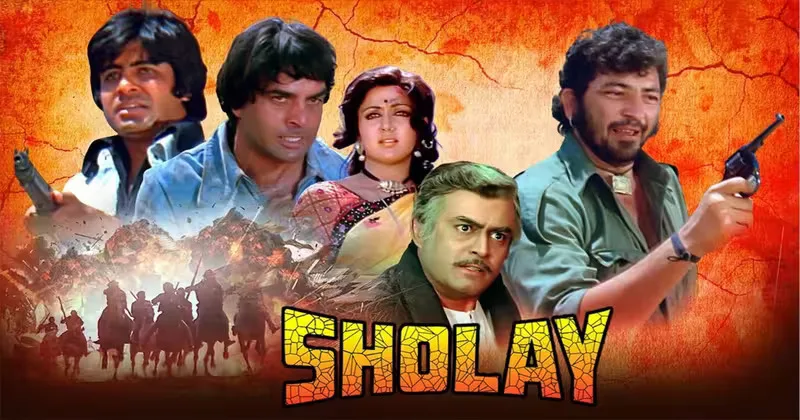
When Sholay released in August 1975, India was not merely watching a film. The country itself was living through one of the darkest chapters of independent India’s democracy.
Prime Minister Indira Gandhi had declared the Emergency just weeks earlier. Civil liberties were suspended, political opponents jailed, newspapers censored and artistic expression came under unprecedented government scrutiny. Cinema was no exception.
Brave leaders in Opposition such as Jai Prakash Narayan, Atal Bihari Vajpayee, LK Advani, George Fernandes, Arun Jaitley, HD Deve Gowda, Mulayam Singh Yadav, Lalu Prasad Yadav were all jailed. Many escaped arrests and operated as underground activists or fled abroad to raise international awareness.
One of the biggest casualties of that atmosphere was not an outspoken political film, but what would become India’s greatest commercial entertainer.
The ending that audience never saw
For fifty years, audiences believed they knew how Sholay ended.
The evil and scary dacoit of a villain Gabbar Singh is finally defeated. Just as Thakur Baldev Singh prepares to kill the bandit who had massacred his family and severed both his hands, the police arrive in the nick of time.
The law prevails. Gabbar is arrested. Justice, at least legally, is served.
That ending, however, was never director Ramesh Sippy’s original vision, neither the way it was shot.
The original climax was considerably darker and emotionally more satisfying from the standpoint of Thakur’s personal journey. After years of waiting, the disabled former police officer was meant to crush Gabbar to death beneath the steel spikes fixed to his shoes, finally completing the revenge that had driven the entire narrative.
Emergency-era censorship changed everything
The Emergency had transformed the Censor Board into an unusually interventionist authority. The Indira Gandhi led Emergency era government also feared a people’s movement that would overthrow the powers that indulged in excesses to retain a political hold over the glorious democracy called Bharat. Therefore, it feared any media that gave the public the seeds to ideas of violence and rebellion.
Sholay director Sippy later recalled that officials objected to the violence throughout the film, even though much of it was suggested rather than explicitly shown. He argued that scenes such as the cutting off of Thakur’s hands were never graphically depicted, relying instead on implication.
Eventually, the Board shifted its focus to something much larger.
The climax itself.
Officials objected that an ex-police officer could not be shown taking the law into his own hands. They insisted that Gabbar must survive and be arrested instead.
According to Sippy, the filmmakers had only days before release. The entire cast had to return to Bangalore to reshoot the ending, with Sanjeev Kumar being recalled from an overseas trip to complete the revised climax.
Thus was born one of Bollywood’s most familiar clichés:
The police arrive at the very last moment.
Ironically, in Sholay, they arrived because the government wanted them to.
The original ending returns after five decades
During the film’s restoration for its fiftieth anniversary, archivists discovered the original camera negatives that contained Sippy’s intended climax.
The restored version now allows audiences to finally witness the ending that censorship prevented in 1975.
It also serves as a reminder that one of India’s most celebrated films reached theatres in an altered form because of the political climate of the Emergency.
Looking beyond the emergency
The censorship story is documented history. Less frequently discussed is another aspect of Sholay that later viewers have increasingly debated: its religious imagery and portrayal of different communities.
Several scenes have attracted attention over the years.
One involves Veeru, played by Dharmendra, hiding behind the murtis or idols of Hindu deities during a comic sequence. Veeru speaks from behind the idol, altering his voice to sound booming and divine. He pretends to be Lord Shiva directly communicating with the old aunt of his love interest Mausi, telling her that he (the deity) he favours the match and that she must let Basanti marry Veeru.
Writers Salim Khan (also the father of actor Salman Khan) and Javed Khan (self-proclaimed atheist who never forgets to script anti-Hindu imagery in film scripts) argue that the scene is a harmless slapstick typical of 1970s Hindi cinema to alleviate tensions.
Over the years, it has been amply clear that the casual irreverence towards Hindu religious icons was thoughtfully stitched in while the Muslim characters in the film are shown as patriotic, selfless
Another frequently discussed aspect is the portrayal of the elderly Imam, played by AK Hangal. Hangal played Rahim Chacha, the blind village Imam (Muslim priest). He is most famous for his devastating, grief-stricken query upon finding his murdered son: “Itna sannata kyun hai, bhai?” (Why is there so much silence?).
Rahim Chacha is blind and physically frail, yet the first to openly stand and catalyze the villagers’ resistance. Salim-Javed gave Rahim Chacha the job to normalize Muslim identity as deeply patriotic, indigenous, and deeply rooted in the Indian social fabric. So much so that when the son of the old man is killed by the dacoits, he has no regrets and says out aloud that he wishes that his Allah had given him more sons to sacrifice for the motherland.
Ironically, Muslims are taught by their Imams across India to proudly and loudly say “Pehle mera Majhab aur mere Nabi and then the watan” – meaning their faith, their prophet is more important and the nation comes secondary. They even refuse to sing the national song “Vande Mataram” because it says salute to the motherland. So, effectively, in a call to stand up for the country against jihadi elements, they clearly choose the Islamist interests and openly scream out “Gustakhe Nabi Ki ek hi saza, Sar Tan se juda” – meaning “We shall decapitate anyone who insults our prophet or God”.
The Rahim Chacha imagery in Sholay was but a part of a recurring cinematic tendency of the era to emphasise Muslim characters in emotionally elevated moral roles.
Some commentators have also pointed to the visual depiction of the village itself. Ramgarh is shown suffering severe hardship, with no signs of electrification.
Yet the mosque appears to continue functioning with loudspeaker announcements for prayers. Similarly, practical questions occasionally arise from viewers: if the village lacked reliable electricity and modern infrastructure, how was the elevated water tank continuously supplied?
A film that reflects its times
None of these debates diminish Sholay’s cinematic achievements. Its unforgettable characters, memorable dialogues, and ground-breaking storytelling ensured its place in Indian film history.
Yet the film also reflects the social and political atmosphere of the 1970s. The Emergency demonstrably shaped its ending through direct state censorship. At the same time, its religious imagery, character portrayals, and symbolic choices continue to be interpreted differently by successive generations.
Whatever opinions one may hold, even half a century later, Sholay remains more than a blockbuster. And exactly that is why these depictions in cinema matter. The subtle play with the nuances of characters that speak of appeasement are so in your face, they are undeniable.