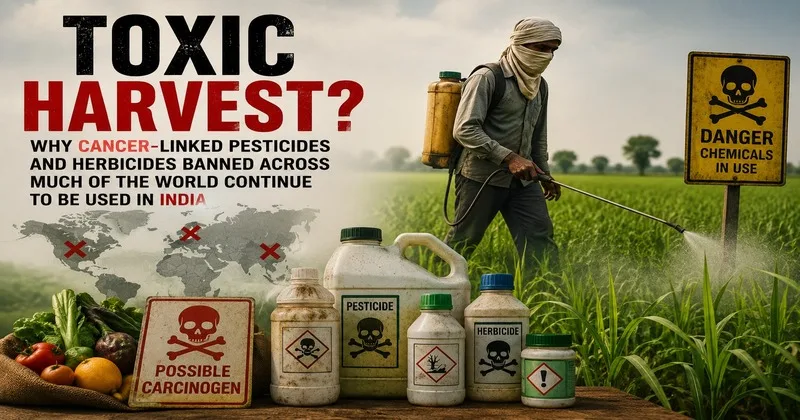
As Europe rejects Indian food exports over chemical residues, millions of Indians continue consuming food grown with pesticides and herbicides that have been restricted or banned elsewhere. India is confronting a troubling paradox. Agricultural products grown in the country are increasingly rejected in international markets due to excessive pesticide residues, yet many of the same chemicals continue to be legally used on Indian farms. The result is a growing debate over food safety, public health, environmental sustainability, and the value placed on human life.
Recent data from European regulatory authorities revealed that between May 2024 and May 2026, the European Union flagged and rejected 365 consignments of Indian agricultural products due to pesticide residues and heavy metal contamination. While export losses are concerning, a more pressing question emerges: if these products fail foreign safety standards, what does that mean for the food consumed daily by Indians?
The Silent Journey from Farm to Human Body
Modern agriculture relies heavily on chemical pesticides, herbicides, and insecticides to protect crops from weeds and pests. However, many of these substances do not remain confined to the fields where they are sprayed. Residues can persist in fruits, vegetables, grains, water sources, and soil, eventually making their way into human bodies through food consumption.
Several chemicals commonly used in Indian agriculture have been linked by international scientific agencies to cancer risks, neurological disorders, environmental damage, and biodiversity loss. Some have been banned in dozens of countries, while others face stringent restrictions. Yet they remain available and widely used across India. The debate is not merely scientific. It is also ethical, economic, and political.
Paraquat: The Herbicide Banned by Much of the World
Among the most controversial chemicals still used in India is paraquat. Originally commercialised by British agrochemical giant Imperial Chemical Industries (ICI) and later associated with Swiss company Syngenta, paraquat is considered one of the most toxic herbicides ever developed.
The European Union banned paraquat in 2007, citing concerns over human health and worker safety. Today, more than 70 countries prohibit its use.
Research has linked paraquat exposure to:
-Severe lung damage
-Kidney failure
-Fatal poisoning even in small quantities
-Increased risk of Parkinson’s disease
Unlike many poisons, paraquat has no specific antidote. Despite these concerns, the herbicide remains legal in India and is widely used by farmers. Farmer organisations and environmental groups have repeatedly demanded stricter regulation, while several states have sought restrictions. A petition seeking a nationwide ban continues to be examined by the courts.
Glyphosate: The Global Weedkiller War
No pesticide has generated more controversy worldwide than glyphosate. Introduced commercially by Monsanto under the brand Roundup in 1974, glyphosate became the world’s most widely used herbicide. Its popularity transformed global agriculture.
The controversy intensified in 2015 when the International Agency for Research on Cancer (IARC), the cancer research arm of the World Health Organisation, classified glyphosate as a “probable human carcinogen.” The classification triggered lawsuits, regulatory reviews, and scientific disputes across the globe.
While regulators in the United States and Europe maintain that available evidence does not conclusively prove glyphosate causes cancer, Bayer, which acquired Monsanto in 2018, has paid billions of dollars in settlements related to claims that Roundup exposure caused cancer. The company continues to deny that glyphosate is carcinogenic. In India, glyphosate remains widely available and is used extensively in agriculture.
2,4-D: A Chemical with a Wartime Legacy
The herbicide 2,4-D carries a particularly controversial history. Developed in the 1940s, it later became one of the principal components of Agent Orange, the defoliant used by the United States during the Vietnam War to destroy forests and crops. Although today’s commercial formulations differ significantly from wartime mixtures, concerns persist. In 2015, the IARC classified 2,4-D as “possibly carcinogenic to humans.” The agency noted limited evidence from human studies but found enough data from animal experiments and laboratory research to raise concerns.
In India, 2,4-D remains one of the most commonly used herbicides, especially in:
-Wheat
-Paddy
-Sugarcane
-Maize cultivation
Unlike paraquat, 2,4-D has not been universally banned. Several countries continue to permit its use under regulated conditions. However, health advocates argue that long-term exposure risks require closer scrutiny. The question remains whether India’s regulatory framework is adequately monitoring those risks.
Acephate and the Disappearing Pollinators
Not every agricultural chemical raises concerns primarily because of cancer. Acephate, a widely used insecticide, illustrates a different challenge. Environmental scientists warn that acephate and its degradation products can harm pollinators such as:
Honey bees
Butterflies
Beneficial insects
These species are crucial for food production because they facilitate pollination in numerous crops. Globally, declining bee populations have emerged as a major ecological concern. Reduced pollinator numbers can directly affect crop yields and food security. Despite these concerns, acephate remains registered and widely used in India because of its effectiveness against pests such as aphids, whiteflies, jassids, and thrips.
The Cancer Question
India already faces a significant cancer burden, with the number of cases projected to rise in the coming years. Scientists caution against simplistic conclusions. Cancer is a complex disease influenced by multiple factors, including:
-Genetics
-Lifestyle choices
-Tobacco use
-Air pollution
-Occupational exposures
-Environmental contaminants
However, public-health experts generally agree on one principle: exposure to substances classified as probable or possible carcinogens should be minimised whenever practical alternatives exist. The issue is not whether a pesticide definitively causes cancer in every individual. The concern is the cumulative risk created by long-term exposure across a population of more than 1.4 billion people.
Why Does India Continue to Allow These Chemicals?
The answer lies at the intersection of economics, science and politics. Supporters of continued pesticide and herbicide use argue that modern agriculture depends heavily on effective crop-protection tools to maintain yields and ensure food security. They warn that abrupt bans on widely used chemicals could increase production costs, reduce farm productivity and ultimately lead to higher food prices for consumers. Many also contend that safer alternatives are either not yet affordable or not available at the scale required for Indian agriculture. Given that India’s farm sector supports hundreds of millions of livelihoods and feeds one of the world’s largest populations, policymakers face the difficult task of balancing agricultural productivity with public-health concerns.
The Way Forward
The solution is unlikely to lie in abrupt bans alone. Agricultural experts advocate a gradual and science-based transition that balances food security, farmer livelihoods and public health. Such an approach would include stronger pesticide regulation, independent scientific reviews of chemical safety, expanded monitoring of pesticide residues in food, and wider adoption of integrated pest management practices that reduce reliance on hazardous chemicals. Experts also emphasise the need to promote safer alternatives, improve farmer education and awareness programmes, and ensure greater transparency in food-safety testing and regulatory decisions. The objective should not be to burden farmers or undermine agricultural productivity, but to help them adopt practices that safeguard both crop yields and the health of consumers and the environment.