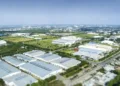
For decades, eastern Uttar Pradesh wore its backwardness as a blanket. In the last eight years, the Gorakhpur Industrial Development Authority has facilitated roughly 500 industries with investments exceeding Rs 11,600 crore and the generation of about 40,000 employment opportunities across the Gorakhpur region. The figure is not an isolated projection; it is the measurable situation of a wider story in which a once-neglected belt has been re-engineered into a destination for capital, industry and faith-driven commerce. Several forces drive this transformation in concert: a reformed industrial authority pulling in record investment, the revival of marquee public-sector industry, a craft-export economy reaching global markets and an arterial expressway grid that has finally given Purvanchal a physical spine.
From a Decade of Decay to Record Industrial Allotment
To measure the turnaround of the Industrial Revolution, one must know where GIDA began. The Authority was incorporated by the Uttar Pradesh government on 30 November 1989 under the UP Industrial Development Act 1976, mandated for the complete and planned development of eastern Uttar Pradesh, with a development-plan area of 13,135 acres across 32 sectors. The promise curdled almost at once. Between 1989 and 1998, industrial activity in the GIDA jurisdiction declined sharply, and the Gorakhpur mega fertiliser plant was shut down. The institution meant to anchor the region’s industrial ambitions instead became a monument to administrative drift.
The contrast with 2025 could scarcely be sharper. A total of 116 industrial plots covering 8,71,841 square metres were allotted during the year, attracting investment proposals worth Rs 6,139 crore and generating employment opportunities for 11,072 people described by GIDA leadership as the largest single-year industrial land allocation since the Authority’s founding. The investment has flowed into food processing, beverages, dairy, textiles, logistics and manufacturing a diversified base rather than dependence on any single vulnerable sector.
What changed was governance philosophy. GIDA leadership frames it plainly that an excellent ecosystem for industrial investment has been created in Gorakhpur, with land allotted according to investor preferences, producing continuous growth in investment. Land is matched to demand rather than parcelled out by bureaucratic whim, the investor.
Greater GIDA and the Southward Push
The clearest proof that this momentum is being institutionalised lies south of the city, in the Dhuriyapar Industrial Township being developed as Greater GIDA. The Uttar Pradesh government has acquired 600 acres in Gorakhpur for this modern township, explicitly intended to lift investment in eastern UP, which has historically lagged the western half of the state. The ambition is corrective as much as commercial, attempting to close the east–west development gap that has shadowed UP for generations.
The township is already drawing capital. Dhuriapar has received investment proposals worth Rs 4,200 crore and, together with the traditional GIDA zone, is expected to generate employment for more than 17,000 people. Its viability rests on infrastructure laid in parallel: a robust industrial land bank of 800 acres flanking the Gorakhpur Link Expressway has been created for allotment to industrial units, a textbook illustration of how the Yogi government has sequenced roads and industry together rather than hoping one would summon the other.
Capital follows credibility, and the roster of investors now staking claims in Purvanchal reads like a directory of Indian and global industry. Major brands, including PepsiCo, the Adani Group and Coca-Cola, are establishing or planning new units in Gorakhpur, with Reliance also among the investors drawn to the region. The broader canvas reinforces the point that after the double-engine government came to power, Uttar Pradesh received investment proposals worth Rs 45 trillion. The district-level surge is the granular expression of that statewide tide pledges landing as brick and payroll rather than evaporating as headlines.
Fertiliser Issue: A Shuttered Plant Reopened
No single project captures Purvanchal’s reversal of fortune more vividly than the Gorakhpur fertiliser plant. Lying shut for more than 30 years, it was revived and rebuilt at a cost of around Rs 8,600 crore, with its foundation stone laid by Prime Minister Narendra Modi on 22 July 2016. The plant that symbolised eastern UP industrial collapse now embodies its recovery. When it closed in 1990, it had an installed capacity of 900 tonnes of urea per day; it now produces about 3,800 tonnes per day, over four times the former capacity, translating to 12.7 lakh metric tonnes of indigenous neem-coated urea every year.
The venture structure reflects national resolve. It operates under Hindustan Urvarak & Rasayan Limited, a joint venture of NTPC, Coal India, Indian Oil Corporation, the Fertilizer Corporation of India and Hindustan Fertilizer Corporation, working to revive the Gorakhpur, Sindri and Barauni plants in pursuit of self-sufficiency in urea. Its employment footprint is substantial, the plant is expected to give direct employment to about 20,000 people and generate roughly 1.5 lakh indirect jobs across packaging, transport, logistics and support services. Its 149.5-metre prilling tower, taller than twice the Qutub Minar, now stands as a visible landmark of the region’s revival.
The same prime ministerial visit delivered a parallel dividend in healthcare. Modi dedicated to the nation the fully functional AIIMS Gorakhpur, built at a cost of over Rs 1,000 crore, comprising a 750-bed hospital, a medical college, a nursing college and an AYUSH building, alongside the new ICMR-Regional Medical Research Centre. For a region long synonymous with encephalitis deaths, tertiary healthcare of this scale is itself a form of economic infrastructure, anchoring skilled employment and halting the medical exodus to distant cities.
Faith as Economy: The Kashi Multiplier
If Gorakhpur is Purvanchal’s industrial heart, Varanasi is its spiritual and commercial dynamo, and the Yogi government has converted devotion into a measurable economic force. Since the Kashi Vishwanath Dham Corridor was inaugurated by Prime Minister Modi in December 2021, over 25.28 crore devotees have visited Baba Vishwanath, providing the state’s economy an estimated Rs 1.25 lakh crore boost. The mechanism is straightforward, with visitors spending an average of over Rs 5,000 per person, with the ripple effect drawing them onward to Vindhyavasini Dham, Prayag, Ayodhya and beyond, lifting the wider regional economy.
The footfall figures confirm a structural shift: in 2024, Varanasi recorded 11,00,97,743 tourists, of whom 3,09,932 were foreign visitors, and foreign tourist arrivals across Uttar Pradesh rose from 16 lakh in 2023 to over 22 lakh in 2024, with Varanasi contributing a major share. The momentum has carried into the present government records show that in the first six months of 2025 alone, more than 12.9 crore tourists visited the city. This inflow has translated directly into livelihoods for boatmen, priests, vendors, hoteliers and transport operators, proving that civilisational revival and economic uplift can be one project rather than competing ones.
From Looms to Global Carts: The Craft-Export Surge
Purvanchal’s revival is not confined to factories and temples; it runs through the region’s looms and workshops, now plugged into global markets via the One District One Product programme. Chief Minister Adityanath has framed ODOP as the deliberate replacement of an earlier “One District, One Mafia” reality, noting that all 75 districts have secured Geographical Indication tags, with Varanasi leading the effort. The export numbers give the rhetoric substance. Bhadohi’s carpet industry now contributes around Rs 8,000 crore to exports, anchoring eastern UP’s standing in a sector where Uttar Pradesh accounts for 39.52 per cent of India’s carpet exports and 16.56 per cent of its handicraft exports, ranking as the country’s fourth-largest exporter and the top exporter among landlocked states.
The standout performer is Varanasi’s signature craft. Silk products recorded the highest growth of any category, surging 156 per cent from Rs 589 crore to Rs 1,507 crore, reflecting rising international demand for premium silk from Varanasi and its surrounding weaving centres. This sits within a historic statewide milestone: UP’s exports crossed Rs 2 lakh crore for the first time, rising from Rs 1.57 lakh crore in 2021-22 to Rs 2.01 lakh crore in 2025-26, nearly 28 % growth credited in part to improved expressway connectivity and the ODOP programme bringing smaller districts into the export ecosystem. The state is institutionalising the gains. Factories have been set up in Gorakhpur and other districts, with Common Facility Centres planned in Mirzapur and Bhadohi under the ODOP scheme to support artisans.
The Connectivity Spine: Expressways That Made It Possible
None of this arithmetic would compute without the road revolution that preceded it. The foundational artery is the Purvanchal Expressway. Spanning 340.8 km and built at a cost of Rs 22,497 crore, the six-lane access-controlled highway connects Lucknow to eastern Uttar Pradesh, driving up land prices and real estate interest in towns such as Sultanpur, Barabanki and Azamgarh. It transformed connectivity dead-ends into accessible nodes on a high-speed grid.
The 2025 capstone was the Gorakhpur Link Expressway, which stitched the region’s largest city into that grid. Inaugurated on 20 June 2025 by Chief Minister Yogi Adityanath, the 91.35 km, Rs 7,283 crore access-controlled expressway runs from Jaitpur in Gorakhpur to Salarpur in Azamgarh, linking four districts, Gorakhpur, Sant Kabir Nagar, Ambedkar Nagar and Azamgarh directly to the Purvanchal Expressway. Its impact on lived time is dramatic: the Gorakhpur -Lucknow journey has been cut from six hours to roughly three and a half, a 42% reduction, with onward links via the Agra–Lucknow and Yamuna Expressways to Delhi.
It is Uttar Pradesh’s seventh operational expressway and the state now commands 42 % of India’s access-controlled expressway network, a share set to climb to 62 %t once the Ganga Expressway is complete. Connectivity now extends to water as well as road: India’s first inland waterway is operational between Varanasi and Haldia, complementing the metro projects underway across the state.
Million of Budgets to the Districts of Purvanchal
The investment has not been pooled in a single showcase district. Across Purvanchal, groundbreaking allocations have spanned Jaunpur (90 projects worth Rs 2,299 crore), Ballia (Rs 1,586 crore), Basti (Rs 1,339 crore), Mau (Rs 929 crore), Deoria (Rs 711 crore), Kushinagar (Rs 635 crore), Azamgarh (93 projects worth Rs 595 crore), Maharajganj (83 projects worth Rs 572 crore) and Ghazipur (Rs 527 crore) a distribution that treats the whole belt as a growth canvas rather than betting on one flagship.
What is unfolding across Gorakhpur, Varanasi, Bhadohi, Azamgarh, and the wider east is more than a cluster of ribbon-cuttings. It demonstrates that India’s most populous and historically most neglected belt can be re-engineered into a growth pole when governance supplies institutional muscle, investor confidence, market access and physical connectivity at once. In districts the political class once visited only at election time, the cranes, the freshly tarred lanes, the reborn fertiliser tower, the crowded ghats and the globe-bound looms now tell a single story of an India determined to develop its own heartland on its own terms, leaving no region behind in the march toward a self-reliant and trillion-dollar economy.