The recently finished Bengal state assembly elections marked not merely another victory for the BJP, but a significant defeat for both internal and external adversaries. This election was pivotal not only for West Bengal but also for the entire northeastern region. Foreign adversaries, along with some local political factions, had been attempting to destabilize Bharat once more. The people of Bengal, especially the Hindus, deserve commendation for their unity against political parties that have compromised the state’s integrity. This change is a testament to the efforts of the RSS and BJP dating back to the Jansangh era. It’s important to recognize the extensive work put in over the decades.
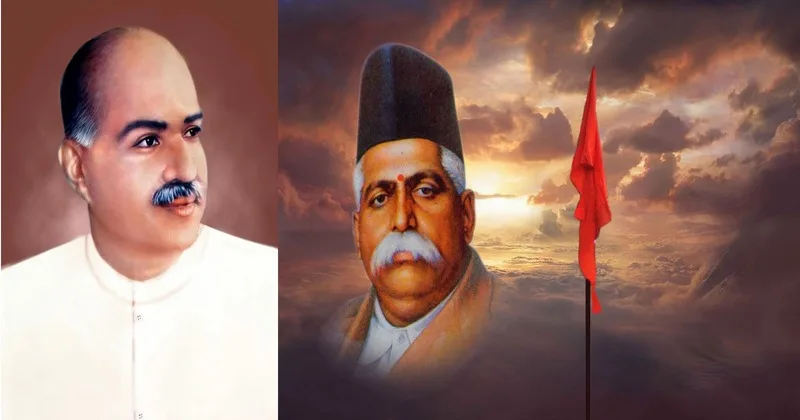
The connection between West Bengal and the Rashtriya Swayamsevak Sangh (RSS) and the Bharatiya Janata Party (BJP) extends beyond the current political scene. It is deeply rooted in the pre-history of the Sangh’s establishment and the creation of the Jana Sangh. This relationship stems from the ideological groundwork laid by Dr. Keshav Baliram Hedgewar and the political contributions of Dr. Shyama Prasad Mookerjee, both of whom were significantly influenced by West Bengal.
In 1910, when a young Hedgewar arrived in Calcutta (now Kolkata) for his medical studies, the region was a hub of revolutionary activities. His ardent patriotism drew him toward the prominent revolutionary group, the Anushilan Samiti. While at Calcutta Medical College, he engaged not only in medical education but also became involved in nationalistic efforts alongside renowned revolutionaries, inspired by figures like Bipin Chandra Pal, Pulin Bihari Das, and Rash Behari Bose, participating in numerous clandestine revolutionary actions. The organizational insights he gathered in Calcutta, coupled with Dr. Mookerjee’s establishment of the Jana Sangh, mark the initial phase of this historical narrative. Furthermore, the later strengthening of these ideological connections and the BJP’s political triumphs amid formidable opposition from the Left and Trinamool Congress serve as crucial moments in modern Bharatiya history.
Cultural Connections
Dr. Hedgewar was perturbed by Congress’s approach to appeasement during the Khilafat movement, believing that a nation must address social issues like caste discrimination to thrive. On September 25, 1925, he founded the Rashtriya Swayamsevak Sangh in Nagpur, emphasizing that discipline, character, and organization were crucial for sustaining freedom, drawing from his experiences in Bengal.
Decades later, Dr Mookerjee, a notable nationalist and the youngest Vice-Chancellor of Calcutta University, played a critical role in safeguarding Hindus during Bengal’s partition. He later resigned from his ministerial position in Nehru’s cabinet to oppose the Nehru-Liaquat Pact and Article 370, seeking a political alternative that would support cultural nationalism. He engaged with the RSS, which sent prominent members like Atal Bihari Vajpayee and Lal Krishna Advani to assist him. Dr. Mookerjee’s push for Kashmir’s full integration into Bharat and his untimely death during the Kashmir agitation ignited a surge of nationalism across the country. Following the 1947 partition, many Hindu refugees from East Pakistan (now Bangladesh) flocked to West Bengal. In response, RSS volunteers set up relief camps to provide support during this challenging time.
Despite facing challenges from the Left, the RSS built connections in rural areas through educational and service initiatives. They worked covertly to make Bengal’s focus from worshipping just local deities to honoring the Bharat Mata. On October 21, 1951, Dr. Mookerjee founded the Bharatiya Jana Sangh, the precursor to the modern BJP, with a Bengali individual as its first national president—a detail that remains noteworthy.
Even after Mookerjee’s sacrifice, the Jana Sangh persisted in Bengal, upheld by leaders like Haribhau Godbole and Prof. Haripada Bharti despite difficult circumstances. However, after the Left Front assumed power in Bengal for 34 years, followed by the Trinamool Congress, BJP and RSS activists faced severe political repression, yet they remained steadfast in their beliefs. In 2011, Mamata Banerjee ousted the Left, but subsequent ‘appeasement politics’ and restrictions on BJP-RSS activities, such as Ram Navami processions, alienated many educated and rural segments of Bengal.
A latent wave of change for overall development and bringing back Sanatan culture
As the sentiments of national identity began to erode in Bengal, the Bengali people started realising the ideological and developmental efforts across the nation and in NDA-ruled states by BJP. Post-2014, BJP leadership, including Prime Minister Narendra Modi and then-president Amit Shah, focused on Bengal, celebrating its cultural heritage linked to figures like Rabindranath Tagore, Swami Vivekananda, and Dr. Mookerjee.
The BJP’s expansion in West Bengal is viewed not merely as a political strategy but as a significant historical foundation. West Bengal is where Dr. Hedgewar’s ideological roots took shape and where the Jana Sangh emerged through Dr. Mookerjee. Thus, the history of the Sangh and BJP is inextricably woven into Bengal’s fabric.
The patriotic fervor that young Hedgewar brought from Bengal to Nagpur in 1910 has blossomed into a robust movement, with contemporary sentiments echoing this legacy. When slogans like ‘Jai Shri Ram’ and ‘Vande Mataram’ resonate in Bengal, it represents not just a political achievement but a historical recognition by its people of the ideological legacies left by Dr. Hedgewar and Dr. Mookerjee. This narrative illustrates that when an idea is deeply rooted in its origin, it can always re-emerge with renewed vigor, regardless of attempts to suppress it.