“In the case in hand, the facts, as have been discussed in the preceding paragraphs, are even more glaring as the incidents are not isolated to one place in the State. Rather, the violence which erupted after polls and declaration of results was state-wide. Number of persons had died. The women were raped. The house of certain persons who had not supported the party in power were demolished. Their other properties were damaged. Their belongings were looted including the chattels. Allegations are also that the complainants are being threatened to withdraw their cases. Number of cases of murder are sought to be claimed as natural death without recording FIRs and the investigations of cases as per procedure established by law. Number of persons are alleging that they were forced to leave their houses and villages and had not been able to come back because of threat. Social boycott and closure of their business establishments are the other allegations.”
– Calcutta High Court (Appellate Side) observation while hearing the cases related to post-poll violence in West Bengal, Susmita Saha Dutta vs The Union Of India And Ors on 19 August, 2021
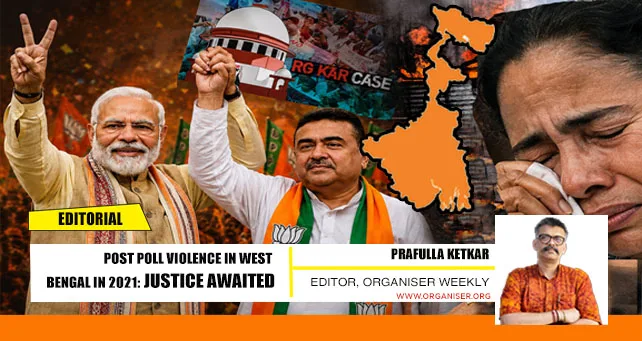
May 4, 2026, was a historic day not just for West Bengal but for the entire Bharat. The people of Bengal delivered a decisive electoral verdict in favour of regime change, rejecting the ruling party and the lawlessness prevalent in the state. The 2026 elections result is not a limited story of the Bharatiya Janata Party (BJP) trouncing the Trinamool Congress (TMC) from the power position. It is the victory of people who silently and democratically overthrew the regime against which they were afraid to speak. With the change of guards in the State, they have the courage to speak about their ordeal. Hence, Organiser Weekly decided to revisit the victims, especially women, to record their versions.
When most media houses and political parties, under the guise of ‘secularism’, were not ready to question the crumbling down of democracy in West Bengal, Organiser followed up on the cases and brought the ground realities to the fore. The culture of political violence had not been new to Bengal. Since the Muslim League took the reins in 1937 in the Bengal province, violence had been normalised during elections. Communists, like Islamists, believe in a culture of vehemence, continued the policy and killed thousands of political opponents. In 2011, Mamata Banerjee-led Trinamool Congress won the mandate with the slogan of Maa, Maati and Manush, but faltered on all three fronts.
Manush means humanity. If we go by sheer numbers and the kind of crimes that were committed during the TMC regime, the word inhumanity would be insufficient to express the horrors. If we go by the numbers quoted in the National Human Rights Commission’s report and referred to in the High Court, there were 1979 cases involving 15000 victims across the State, only after the 2021 election results. The earlier counts during various polls would never be calculated in the face of the complete politicisation of the police machinery. The identity and other cards of the victims were taken away by the goons and destroyed to deprive them of the benefits of Government schemes. Fear was instilled to such an extent that BJP workers could not return home for months. Even when they returned, they were fined in different ways. FIRs were not registered even for cognisable offences. People were left completely at the mercy of local goons.
When promoting and protecting infiltrators is the policy, how can you commit yourself to Maati – the soil? The illegal infiltrators called the shots and occupied land as they pleased. Schools and private properties were forcefully occupied for political purposes. Though ‘Bengali Asmita’ – identity was always a political plank for Mamata and her party, it was the policy of promoting Islamisation at the cost of Bengali culture. Many criminals from Bangladesh found safe haven in Bengal. The syndicates of fake Aadhar Cards and counterfeit currency were given political patronage. All measures to secure the geo-strategically sensitive Siliguri region – known as the ‘chicken neck’- to strengthen the role of the Border Security Force (BSF) and to fence the border were halted for petty vote-bank politics. None of these is a sign of commitment to the motherland.
The most horrific side of the TMC regime was the normalisation of crime against women. The way rapes were weaponised for political purposes, and criminals were provided with political cover, was beyond imagination. The white sarees were stocked to send to the families of the opposition party workers. Protection was provided to the perpetrators of heinous crimes like rapes and torture from Sandeshkhali. The plight of victims was such that they were afraid to tell their stories and name the perpetrators, even before the Court-appointed committees. Most of the rapists come from one religion, and victims are from the Scheduled Castes and Tribes, which is now a coincidence. The RG Kar Medical College and Hospital rape-murder case was the final nail in the coffin for the TMC regime. A woman Chief Minister with the first slogan of Maa was supposed to protect the dignity of womanhood; instead, the Mamata regime facilitated the cover-up in the heart-wrenching case of rape-murder.
The change of guard in West Bengal is a sigh of relief for the people in Bengal. The new Government led by Suvendu Adhikari is clearly charting the course for economic and cultural revival, the restoration of law and order, and national security by curbing infiltration. On the same lines, the countless women who were disrobed and humiliated under the political cover of Mamata Banerjee-led Trinamool Congress are expecting justice to be delivered by punishing the perpetrators. Hopefully, soon, the Government will follow up on the pending cases and restore the dignity of women in Bengal. Lest we forget, should be our national resolve to restore the faith in the rule of law and democracy for the daughters of Bengal.