
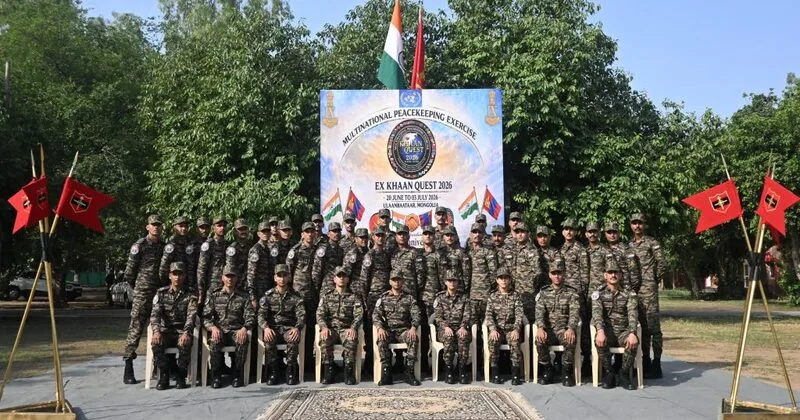
As the world grapples with complex conflicts, fragile states, humanitarian crises and the growing challenges of post-conflict stabilization, peacekeeping operations have become far more demanding than traditional ceasefire monitoring missions. Modern peacekeepers must be soldiers, diplomats, first responders and humanitarian protectors simultaneously. It is in this context that the Indian Army’s participation in Exercise Khaan Quest 2026, being held from June 20 to July 3 at the Five Hills Training Area near Ulaanbaatar in Mongolia, assumes strategic significance.
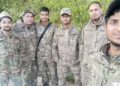
The 23rd edition of Khaan Quest brings together more than 1,000 military personnel from 18 nations in one of the world’s largest multinational peacekeeping exercises. India has deployed a 40-member contingent, primarily drawn from a battalion of the distinguished Jat Regiment, along with personnel from other arms and services. Their mission extends beyond military training; it reflects Bharat’s enduring commitment to international peace, multilateral cooperation and responsible global leadership.
From bilateral drill to global peacekeeping platform
Khaan Quest has undergone a remarkable transformation since its inception in 2003. What began as a bilateral military engagement between the Mongolian Armed Forces and the United States has evolved into a premier multinational peacekeeping exercise. Since 2006, the exercise has expanded steadily, attracting participation from militaries across Asia, Europe, North America, and beyond.
Hosted by the Mongolian Armed Forces and co-sponsored by the United States Pacific Command (previously called United States Indo-Pacific Command), Khaan Quest focuses specifically on preparing troops for peace support operations conducted under Chapter VII of the United Nations Charter, which authorizes peace enforcement measures when international peace and security are threatened.
The exercise has become a globally recognized platform where participating militaries exchange operational knowledge, build trust, and develop interoperability for future multinational deployments.
Bharat’s distinguished peacekeeping legacy
India’s participation in Khaan Quest is rooted in a much larger historical commitment to global peace. Few nations can match Bharat’s contribution to United Nations peacekeeping operations.
Since independence, more than 290,000 Indian peacekeepers have served in over 50 UN missions across the globe, from Africa and the Middle East to the Balkans and Southeast Asia. Bhartiya soldiers have earned a reputation for professionalism, restraint, courage, and cultural sensitivity. They have often operated in some of the most volatile regions of the world, protecting civilians, facilitating humanitarian assistance, and helping restore stability.
Bharat has also been a pioneer in deploying women peacekeepers. The all-female Formed Police Unit deployed to Liberia remains one of the most celebrated examples of women’s participation in international peacekeeping.
Against this backdrop, participation in Khaan Quest 2026 is not merely another military exercise. It represents the continuation of Bharat’s long-standing role as a net contributor to global peace and security.
Training for the realities of modern conflict
The contemporary security environment differs significantly from the traditional battlefield. Peacekeeping missions increasingly take place in urban settings, conflict zones involving non-state actors, regions affected by terrorism, and areas experiencing humanitarian emergencies.
Accordingly, Khaan Quest 2026 emphasizes practical operational scenarios that mirror real-world peace support missions.
Participating troops will train in:
- Establishment of static and mobile checkpoints
- Cordon and search operations
- Area domination patrols
- Civilian evacuation from hostile environments
- Counter-Improvised Explosive Device (IED) operations
- Combat first aid
- Casualty evacuation procedures
- Joint planning and mission execution
These drills are designed to improve rapid decision-making, enhance situational awareness, and strengthen multinational coordination under stressful operational conditions.
In peacekeeping environments, success often depends less on overwhelming firepower and more on disciplined restraint, communication skills, and the ability to coordinate effectively with international partners. Exercises such as Khaan Quest help cultivate precisely these competencies.
Interoperability: The new strategic necessity
One of the most important objectives of Khaan Quest is enhancing interoperability among participating militaries.
Modern peace operations are rarely conducted by a single nation. They involve multinational contingents operating under unified command structures. Differences in communication systems, operational procedures, equipment standards and military doctrines can create friction during actual deployments.
By training together in Mongolia, soldiers learn to overcome these challenges before entering conflict zones. Shared drills and mission planning exercises enable participants to understand one another’s operational approaches and develop common procedures.
For the Indian Army, such interactions are particularly valuable. As Bharat expands its defence partnerships across the Indo-Pacific and beyond, the ability to work seamlessly with friendly foreign militaries has become an important strategic capability.
Strengthening the Bharat–Mongolia strategic partnership
Khaan Quest also highlights the growing strategic relationship between Bharat and Mongolia. The two nations share deep civilisational links rooted in Buddhism and have steadily strengthened their political, economic and defence cooperation over the past two decades. In 2015, during Prime Minister Narendra Modi’s historic visit to Mongolia, bilateral relations were elevated to the level of a Strategic Partnership.
Defence cooperation has since emerged as an important pillar of this relationship. Military exchanges, training programmes, and participation in joint exercises have helped deepen mutual trust between the armed forces of both countries.
Bharat’s continued participation in Khaan Quest reflects its commitment to supporting Mongolia’s role as an important partner in the Indo-Pacific region while simultaneously advancing shared objectives of peace, stability, and international cooperation.
Peacekeeping and Bharat’s global vision
Prime Minister Narendra Modi’s foreign policy has consistently emphasized Bharat’s role as a responsible stakeholder in global affairs. Whether through humanitarian assistance, disaster relief operations, vaccine diplomacy, maritime security initiatives or peacekeeping missions, Bharat increasingly projects itself as a provider of solutions rather than merely a participant in international discussions.
Military diplomacy forms an important component of this vision. Exercises such as Khaan Quest help strengthen strategic partnerships, foster goodwill and showcase the professionalism of Indian soldiers on the global stage.
They also reinforce Bharat’s longstanding support for a rules-based international order where peace and stability are maintained through cooperation rather than coercion.
Beyond the battlefield
The significance of Khaan Quest extends beyond military preparedness. It serves as a reminder that modern security challenges require collective responses.
Peacekeeping today demands not only tactical proficiency but also cultural understanding, humanitarian sensitivity, and multinational cooperation. Soldiers must be capable of protecting civilians, facilitating humanitarian operations and building trust among communities affected by conflict.
The Indian Army’s participation in Khaan Quest 2026 demonstrates that Bharat remains committed to these principles. As Indian soldiers train alongside counterparts from 17 other nations under the vast Mongolian skies, they carry forward a proud tradition of service that extends beyond national borders.
In an era marked by geopolitical uncertainty, Khaan Quest offers a powerful example of how nations can work together to prepare for peace rather than war. For Bharat, it is another step in its journey from being a regional power to becoming a trusted global security partner committed to the cause of international peace and human dignity.