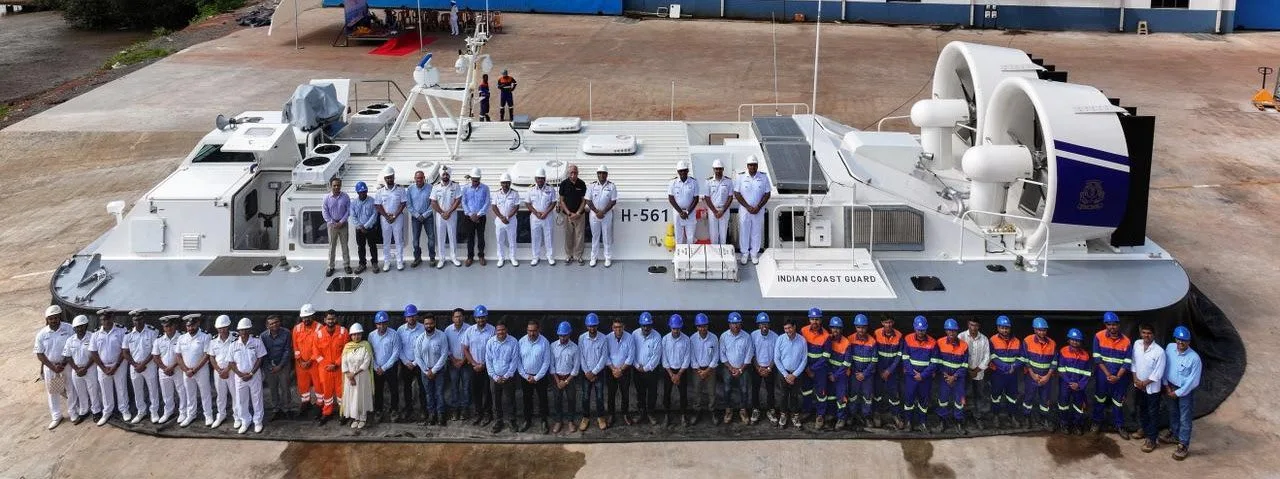
The Indian Coast Guard (ICG) inducted first of the six indigenous Air Cushion Vehicles (ACVs), being constructed by Chowgule & Company Private Limited in Goa on June 18, 2026.
The hovercraft aims to enhance ICG’s operational effectiveness across a broad spectrum of maritime duties and reinforce its ability to respond to emerging challenges. Its induction would further the vision of Aatmanirbhar Bharat, and serve as a reflection of the growing strength of the maritime industrial base of the country.
A landmark in #MaritimeSecurity. The first indigenously built Air Cushion Vehicle H‑561 has been inducted today, into @IndiaCoastGuard at Chowgule Shipyard, #Goa.
Strengthening coastal security & showcasing Bharat’s shipbuilding prowess, this milestone advances the vision of… pic.twitter.com/sb9CjWLX5o
— Indian Coast Guard (@IndiaCoastGuard) June 18, 2026
The induction ceremony was held in the presence of senior ICG officials and representatives from the shipbuilding industry. The induction underscores the organisation’s continued focus on modernisation and capability enhancement in support of its mandate to safeguard the nation’s maritime interests. The contract for the acquisition of six ACVs for ICG was signed between the Ministry of Defence and Chowgule & Company Private Limited on October 24, 2026.
The Air Cushion Vehicle (ACV), also referred to as a hovercraft, will be used for multiple maritime operations. Its primary roles include high-speed coastal patrolling and reconnaissance in shallow waters, marshy areas, and deep-sea regions. The ACV will also be deployed for interception and interdiction operations within its area of operation, both during the day and at night.
In addition, the ACV will be utilised for search and rescue missions and for rendering assistance to ships and other ACVs in distress. It is also capable of transporting armed personnel, stores, and logistical supplies, thereby supporting a wide range of operational and emergency requirements.