
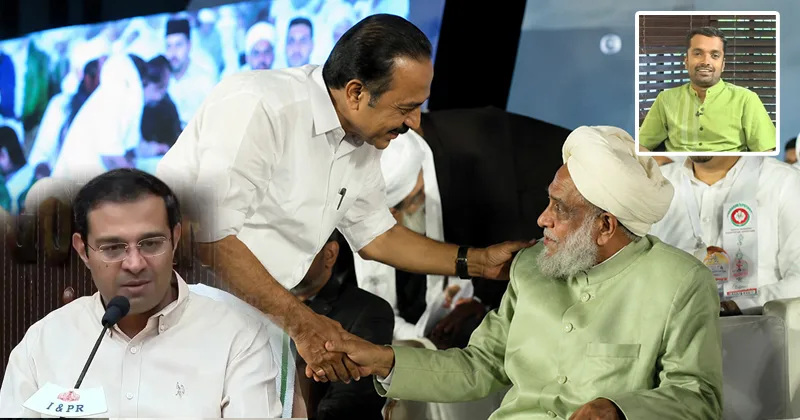
Let’s stop pretending this is normal politics. What is happening in Keralam under Chief Minister V.D. Satheesan is not a typical coalition government dealing with challenging partners. It is far more intentional and calculated. Anyone paying close attention can see it. Weeks after the United Democratic Front’s major 102-seat victory in May 2026, the new government is already revealing whose agenda it intends to serve. And it isn’t the voters of Kerala. The Satheesan government has not even finished its first month in office, yet Jamaat-e-Islami has made its presence felt within its administrative structure.
It began with what appeared to be a routine staffing choice. U. Shaiju was named Additional Private Secretary to Minister Roji M. John, who leads the Higher Education Department. In a healthy democracy, a ministerial staff appointment would hardly warrant attention. However, Shaiju is not just any choice. He is an active, documented member of the Welfare Party, the political arm of Jamaat-e-Islami. He also acts as a management representative for Media One, the TV channel commonly linked to Islamist sympathies in Kerala. This channel was temporarily banned by the I&B Ministry for telecasting pro Pakistan narrative.
Videos of Shaiju actively supporting Welfare Party candidates during the Kayamkulam local body elections have been circulating on social media since news of his appointment emerged. This is not someone who kept his ideological ties hidden. He displayed them openly. Yet, he was placed in the office of a Congress minister where Muslim League is having 5 ministers in the Cabinet.
Youth Congress Files Complaint to Congress
A Youth Congress leader has filed a complaint with the KPCC president, claiming that loyal party workers, who dedicated years at the grassroots level, are being overlooked in favor of individuals with no ties to the Congress organization. The complaint is valid; it just stops short of identifying what is truly happening.
This is not an oversight. This is a strategy. Jamaat-e-Islami is building its influence inside the Kerala government, one appointment at a time.
Not a First Attempt — Just a Rerouted One
What makes this situation particularly telling is that Shaiju’s name had already come up in government discussions before this appointment. Sources suggest that there was a previous attempt to place him on the personal staff of Minister M. Liju, Minister for Co-operation, who represents the Kayamkulam constituency. That effort fell apart due to local Congress pressure. The plan did not die; it was just redirected. Shaiju’s name resurfaced, now linked to Minister Roji M. John’s office.
This is not a coincidence. This is persistence. And this kind of persistence, in the face of internal party resistance, implies support from a powerful source within the UDF. Janmabhumi, which first covered the story, characterized the pattern as intentional— a calculated effort by Jamaat-e-Islami to place its members in key administrative roles across the state government in exchange for electoral backing in the 2026 Assembly elections.
Who Is Roji M. John — And Why He Was Chosen
Roji M. John, the Congress MLA from Angamaly, was not someone anyone expected to be chosen for the Cabinet. Before the UDF’s victory, his name was not included in any serious ministerial lists. He was just a junior legislator, not a prominent figure. Yet he received a significant portfolio: Higher Education. The choice of this portfolio is critical. The Muslim League had openly wanted the Higher Education Department for itself. When Congress decided to keep the portfolio and assign it to Roji, the League expressed strong dissatisfaction. That dissatisfaction did not simply disappear; it was channeled.
The League’s demand for the Fisheries portfolio right after the swearing-in, which delayed official notifications for hours, was partly due to this frustration. However, the League found its consolation prize through another means. If Congress would hold onto Higher Education on paper, Jamaat, the League’s ideological partner, would control it in practice. Place a compliant, junior Congress MLA at the top, and then insert a Jamaat operative within his office. The formula is both clever and cynical.
Roji M. John has already shown he is willing to play along. When 3 University Vice Chancellors attended Rashtriya Swayamsevak Sangh Sarsanghchalak Mohan Bhagwat ji centenary program in Kerala, Roji was the second to criticise the VCs and ask apology from them — now which can be interpreted as the Islamist radical group’s pressure.
Five Ministers, One Master: Muslim League’s Real Tally
Chief Minister Satheesan has spoken openly and unapologetically about Congress’s connections with Jamaat-e-Islami, the Welfare Party, Samastha, and Islamists radical organisations. The CM has mentioned it before the election. He was not concealing anything. What he did not fully explain was the complete structural impact of those connections.
Count the numbers carefully. The Muslim League holds its own 5 ministerial posts in the Satheesan Cabinet. But now add the Higher Education portfolio, which is technically with Congress but functionally under League control. Add the Education Ministry itself, held by Muslim League leader N. Shamsudheen. Include the influence exerted through operatives like Shaiju placed in Congress ministers’ offices, and then do the math honestly, the Muslim League is not just another partner in this government. It is the dominant force, with six effective ministers through both its formal seats and its informal control over Congress portfolios.
Muslim League is always keen to grab the education ministry whenever the UDF came to power. It is one of the portfolios that the party doesn’t compromise at all, as it decides the future of the coming generation. Most of the professional – higher institutions in Keralam are under either Muslim League or any other Islam radical organisations.
Keralam’s Congress is not in charge. It is managing on behalf of its real Muslim League Masters
Appeasement Has a Price — Kerala Is Paying It
None of this came about overnight. Congress’s gradual surrender to Islamist political pressure in Keralam has been building for years. With each election cycle, the cost of League and Jamaat support has increased. Each time, Congress has paid — in portfolios, appointments and policy concessions — What more they will sacrifice now?
What is new is how obvious it has become. The Shaiju appointment broke cover not because those who arranged it were careless, but because the scale of the initiative has surpassed what can be quietly handled. When you are placing operatives across multiple ministries, some information will surface.
The question facing Kerala’s voters—and India’s democratic institutions—is stark. When a state government’s administrative apparatus is being systematically filled with activists from a radical Islamist group, in exchange for electoral support, at the clear expense of ordinary party workers who spent years building the organisation from the ground up—what is the plan?
For now, U. Shaiju remains in Higher Education Minister Roji M. John’s office leading the Muslim League to control 6 port folios in Keralam Cabinet.