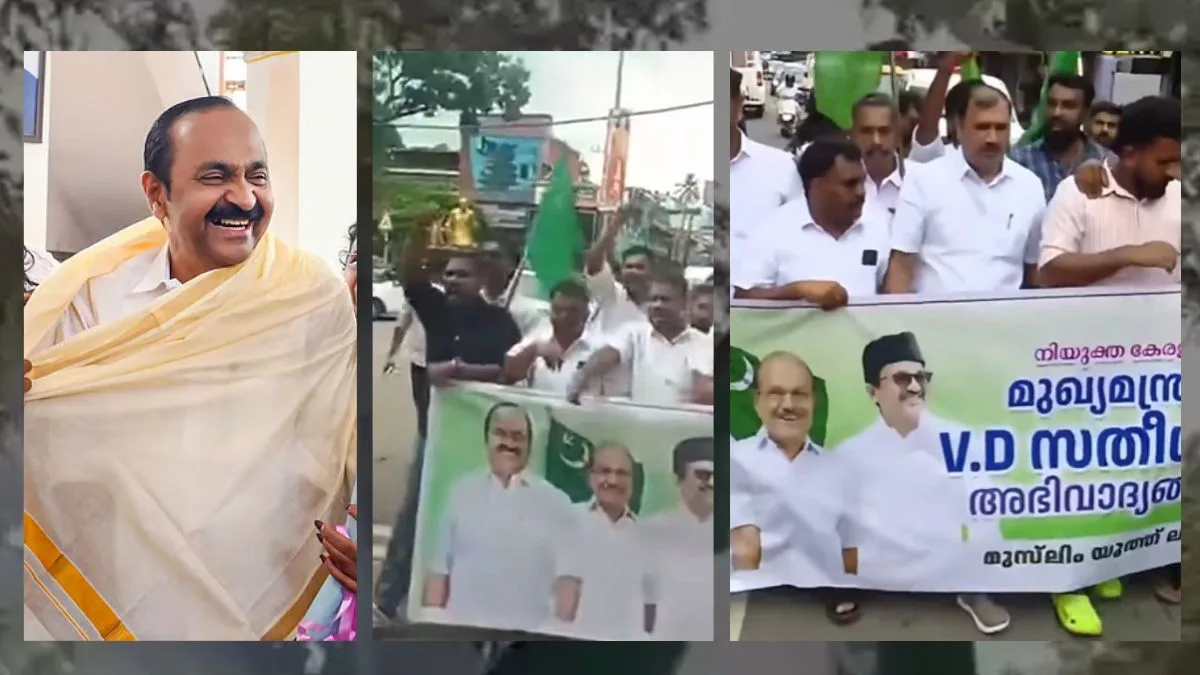
The ink was barely dry on the announcement when the green flags came out. On May 14, 2026, within hours of V.D. Satheesan being named Kerala’s Chief Minister-designate, Muslim League cadres poured onto the streets of Thodupuzha, Thrissur, Kasaragod, Idukki and beyond — not to celebrate a coalition victory, but to declare something far more chilling: that the League had come to power, and that those who dared to question it would pay a price.
In Thodupuzha, as crescent moon green flags filled the air, the slogans raised against SNDP Yogam general secretary Vellappally Natesan and NSS general secretary Sukumaran Nair were not political dissent. They were raw abuse. “Aaraada ee Vellappally… Ethavanada Sukumaran” — roughly translated: “Who the hell is this Vellappally… who the hell is this Sukumaran.” Then came the declaration the League cadres had been waiting to make: “League will rule Kerala’s soil. The laws of this land will be decided by the League.”
The fear of Muslim league will rule instead of Congress in Kerala is becoming true on the very first day of announcement of V D Satheeshan as CM
League workers took out celebration march in abusive language against hindu cast leaders like Vellapally Nadeshan & Sukumaran Nair pic.twitter.com/6sXgaLJODJ
— Venugopal (@venuvakeel) May 14, 2026
What was this for?
They had said, publicly, that the Education portfolio should not be handed to the Muslim League in the new government. That was the crime. One opinion. One sentence. And the streets answered with abuse, threats, and a territorial claim over an entire state.
This was not a fringe moment. This was a coordinated eruption — across multiple districts, on camera, in broad daylight — that revealed what the Muslim League’s street apparatus truly believes this election result means. Not that the UDF won Kerala. But that the League now owns it.
The Idukki district Youth League committee was suspended after its members raised provocative slogans against Vellappally Natesan and NSS leader Sukumaran Nair. The Muslim League itself acknowledged the slogans were unacceptable — but the suspension came after the slogans had already echoed through the streets, already been filmed, already spread.
Multiple Videos of Muslim League rallies surfaces
In one of the videos, Muslim League leaders were seen issuing death threats to a Hindu activist, Jithin Lal. During a celebratory rally organised by Indian Union Muslim League (IUML) workers, the atmosphere shifted from political triumph to explicit hostility as participants were recorded raising anti-Hindu slogans and issuing graphic death threats against local activists. One particularly chilling target of this vitriol was Hindu activist Jithin Lal, who was subjected to public chants promising brutal physical violence and death.
Islamists in Keralam now openly issuing death threats to Hindu activists after Congress' CM announcement:
“Jithin Lal, you son of a dog — we will chop your hands and legs. You will die without seeing your mother’s face. We will make sure you are killed.”
pic.twitter.com/sqCDFne70b— Treeni (@treeni) May 14, 2026
The Pattern — Not the First Time
This is not the first time Kerala has watched this play out. In Kanhangad, Kasaragod district, a rally organised by the Muslim League sparked controversy after members raised provocative anti-Hindu death slogans, including threats to hang and burn Hindu believers in front of temples. Disturbing video footage circulated widely on social media, prompting outrage across the state and the country.
Kerala Police booked over 300 persons, mostly members of the youth wing of the IUML, for raising provocative slogans during a march. Cases were registered under Section 153A of the IPC — the section that deals with promoting enmity between different groups on grounds of religion.
The Declaration — “The League Has Come to Power”
What made May 14 different was the framing of the celebration itself. This was not being celebrated as a Congress victory. It was not being celebrated as Kerala’s democratic choice. On the streets, in Malappuram and beyond, the narrative being chanted was blunt and unambiguous: the League had won. The League’s man was going to be Chief Minister. The League had come to power.
Even before the formal announcement, the League’s street arm was already claiming ownership — and targeting Congress’s own party president. As V.D. Satheesan arrived in Delhi for discussions, he was welcomed by activists of the Muslim Students Federation — the student wing of the Muslim League — who raised slogans against KPCC President Sunny Joseph.
And in Wayanad, something more chilling: provocative posters surfaced carrying warnings directed at the Congress leadership and Priyanka Gandhi. The posters carried a line that needed no translation in Indian political vocabulary:
Satheesan’s Contradiction — And What Jamaat-e-Islami Actually Believes
To understand why these slogans, carry the weight they do, one must recall what the Chief Minister-designate himself has said — and what those closest to him believe.
Not long ago, V.D. Satheesan stated publicly that Jamaat-e-Islami is secular and has given up the concept of the “theocratic state.” It was a remarkable claim — one designed to mainstream an organisation that has never, in its own words, renounced its foundational ideology.
Kerala Ameer of Jamaat-e-Islami, P. Mujeebur Rahman, made the organisation’s position unambiguous: they have not given up any of their basic tenets. Jamaat-e-Islami has repeatedly and openly declared its belief in Hukumath-e-Illahi — Divine Governance, Rule of God, Kingdom of God. The concept holds that supreme sovereignty belongs to Allah alone, and that governance must be conducted according to Sharia — divine law — rather than human-made laws or democratic constitutions.
What Is Hukumath-e-Illahi
Hukumath-e-Illahi — literally “Divine Governance” or “Rule of God” in Urdu — is a theological and political doctrine central to Jamaat-e-Islami’s ideology.
It holds that supreme sovereignty belongs to Allah, and that the state must be governed according to Sharia (divine law) rather than constitutions written by human legislatures.
Kerala Ameer P. Mujeebur Rahman has stated clearly that Jamaat-e-Islami has not abandoned this or any other of its foundational principles — directly contradicting Satheesan’s claim that the organisation has “given up the concept of the theocratic state.”
This is not a distant theological debate. It is a live political question in a state where the Chief Minister-designate has chosen to vouch for an organisation whose own leadership contradicts him in writing. Where Muslim League cadres take to the streets declaring that the League will make the laws of Kerala. Where the Education portfolio — the institution that shapes what the next generation of Keralites is taught — is being aggressively claimed as communal territory.