The C-295 programme and India’s manufacturing revolution
September 8, 2026
  • Read Ecopy
  • Circulation
  • Advertise
  • Careers
  • About Us
  • Contact Us
Android AppiPhone AppArattai
Organiser
  • ‌
  • Bharat
    • Assam
    • Bihar
    • Chhattisgarh
    • Jharkhand
    • Maharashtra
    • View All States
  • World
    • Asia
    • Europe
    • North America
    • South America
    • Africa
    • Australia
  • Editorial
  • International
  • Opinion
  • RSS @ 100
  • More
    • World Hindu Congress 2026
    • Op Sindoor
    • Analysis
    • Sports
    • Defence
    • Politics
    • Business
    • Economy
    • Culture
    • Special Report
    • Sci & Tech
    • Entertainment
    • G20
    • Azadi Ka Amrit Mahotsav
    • Vocal4Local
    • Web Stories
    • Education
    • Employment
    • Books
    • Interviews
    • Travel
    • Law
    • Health
    • Obituary
  • Subscribe
    • Subscribe Print Edition
    • Subscribe Ecopy
    • Read Ecopy
  • ‌
  • Bharat
    • Assam
    • Bihar
    • Chhattisgarh
    • Jharkhand
    • Maharashtra
    • View All States
  • World
    • Asia
    • Europe
    • North America
    • South America
    • Africa
    • Australia
  • Editorial
  • International
  • Opinion
  • RSS @ 100
  • More
    • World Hindu Congress 2026
    • Op Sindoor
    • Analysis
    • Sports
    • Defence
    • Politics
    • Business
    • Economy
    • Culture
    • Special Report
    • Sci & Tech
    • Entertainment
    • G20
    • Azadi Ka Amrit Mahotsav
    • Vocal4Local
    • Web Stories
    • Education
    • Employment
    • Books
    • Interviews
    • Travel
    • Law
    • Health
    • Obituary
  • Subscribe
    • Subscribe Print Edition
    • Subscribe Ecopy
    • Read Ecopy
Organiser
  • Home
  • Bharat
  • World
  • Operation Sindoor
  • Editorial
  • Analysis
  • Opinion
  • Culture
  • Defence
  • International Edition
  • RSS @ 100
  • Magazine
  • Read Ecopy
Home Bharat

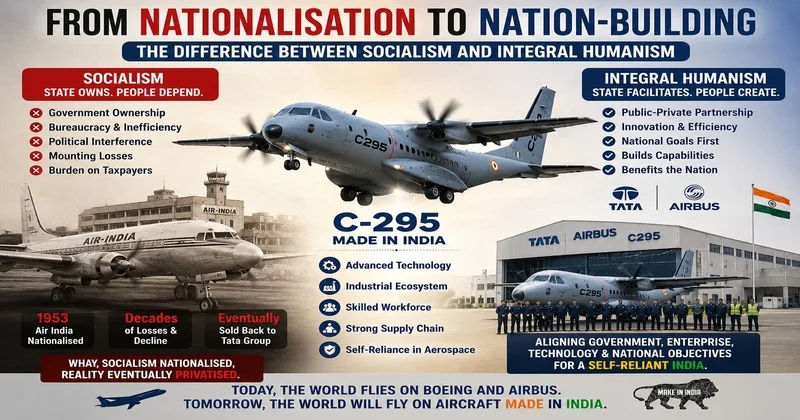
From Nationalisation to Nation Building: The difference between socialism and integral humanism

India’s first domestically manufactured C-295 aircraft symbolises a transformative shift from state-controlled economic models to nation-building through public-private collaboration. It reflects how Integral Humanism seeks to create national capabilities by aligning government policy, enterprise, and technology for long-term development

A AshvathamanA Ashvathaman
Jun 18, 2026, 07:00 pm IST
inBharat
Follow on Google News
India’s first made-in-India C-295 aircraft marks a shift from state control to nation-building through public-private partnership

India’s first made-in-India C-295 aircraft marks a shift from state control to nation-building through public-private partnership

Facebook
Twitter
WhatsAppTelegramEmail

The successful maiden flight of India’s first domestically manufactured C-295 aircraft marks far more than a milestone in defence production. It represents the beginning of a long-term national strategy , one that could eventually transform India from one of the world’s largest aviation markets into one of the world’s major aviation manufacturers. To understand why this project is important, one must first understand what the C-295 programme actually is. In 2021, the Government of India signed a landmark agreement to acquire 56 Airbus C-295 military transport aircraft for the Indian Air Force.

Under the arrangement, the first 16 aircraft would be delivered in fly-away condition from Spain, while the remaining 40 aircraft would be manufactured in India. For this purpose, Airbus partnered with Tata Advanced Systems Limited to establish a complete aircraft manufacturing ecosystem in India. This is not merely an assembly operation.

The project involves aircraft manufacturing, component production, supply-chain development, testing, certification, maintenance capability, and the creation of a highly skilled aerospace workforce. For the first time, a private Indian company is participating in the complete manufacturing of military transport aircraft within India. The significance of this project extends beyond the aircraft themselves. It is creating the technological foundation, industrial ecosystem, supplier network, and human capital necessary for India’s future aerospace ambitions.

In many ways, the C-295 programme is not the destination. It is the beginning of a journey. To appreciate the significance of this shift, it is necessary to look at India’s past. In 1932, J.R.D. Tata founded Tata Airlines, which later evolved into Air India. Built through entrepreneurship, innovation, and commercial excellence, it became one of India’s most respected institutions and a symbol of Indian capability. However, post-independence India increasingly adopted socialist economic policies.

The prevailing belief was that government ownership was superior to private ownership and that strategic sectors should be controlled by the State. Economic power was viewed with suspicion when held by entrepreneurs but considered acceptable when concentrated within government institutions. This philosophy culminated in the nationalisation of Air India in 1953. During the Indira Gandhi era, socialist policies expanded even further. Banks were nationalised. Government control over industry increased. The licence-permit-quota system became deeply entrenched.

The State increasingly assumed responsibility for economic activity that had previously been driven by private initiative. Air India became one of the most visible examples of the consequences of this approach. What had once been a world-class airline gradually became burdened by bureaucracy, political interference, inefficiency, and mounting debt. Commercial decision-making was increasingly replaced by political considerations. Taxpayers repeatedly paid the cost of keeping the airline operational. The irony is striking. Air India was taken from the Tata Group in the name of socialism. After decades of losses, the government eventually sold it back to the Tata Group. What had been acquired from Tata without a voluntary market transaction had to be purchased back by Tata through a commercial transaction involving thousands of crores of rupees. History delivered its verdict. What socialism nationalised, reality eventually privatised. Yet the India of today is increasingly guided by a different philosophy. That philosophy is Integral Humanism. Articulated by Pandit Deendayal Upadhyaya, Integral Humanism rejects the notion that the State must own productive assets in order to advance society. Instead, it views society, enterprise, and government as complementary institutions that should work together toward national development. Under socialism, the State becomes the owner.Under Integral Humanism, the State becomes the facilitator. Under socialism, private enterprise is viewed as something to be controlled. Under Integral Humanism, private enterprise is viewed as a national asset when aligned with national goals. The Tata-Airbus C-295 programme reflects this philosophy in practice.

Also Read: Maharashtra’s Jalna School Row: Pakistani song, Mumtaz Qadri image lead to police probe, spark radicalisation concerns

The government is not attempting to manufacture aircraft itself. Nor is it surrendering national interests to private corporations. Instead, it is aligning state policy, private-sector capability, foreign technology, and national objectives toward a common purpose. The result is not merely forty transport aircraft. The result is the creation of national capability.

Prime Minister Narendra Modi has repeatedly articulated a larger vision behind such initiatives. India, he argues, should not remain merely a buyer of aircraft manufactured elsewhere. Indians should one day travel in aircraft manufactured in India. This vision extends beyond defence production. It concerns India’s place in the global industrial order. Today, the global commercial aviation industry is dominated by two giants—Boeing and Airbus.

For decades, the world has relied upon aircraft produced by these companies. They represent one of the most sophisticated manufacturing ecosystems ever created. The significance of the C-295 programme lies in the fact that it begins building similar capabilities within India. Aircraft manufacturing cannot emerge overnight. It requires decades of technological development, precision engineering, skilled manpower, supplier networks, certification expertise, and industrial experience.

The C-295 programme is helping India acquire precisely those capabilities. Socialism sought development through government ownership. Integral Humanism seeks development through national capability. One philosophy took a successful enterprise from its creators and weakened it. The other seeks to create entirely new industries capable of serving the nation for generations. One concentrated power in the State. The other mobilises the strengths of government, society, and enterprise together. The aspiration is clear. Today, the world flies primarily on Boeing and Airbus aircraft. Tomorrow, the world may also fly on aircraft designed, manufactured, and exported by India. That is the difference between nationalisation and nation-building. That is the difference between socialism and Integral Humanism.

 

Topics: Narendra ModiMake In IndiaIntegral HumanismDeendayal UpadhyayaC-295 AircraftSocialismTata Airbus PartnershipIndian Aerospace Industry
Share
Tweet
SendShareSend
✮ Subscribe Organiser YouTube Channel. ✮
✮ Join Organiser's WhatsApp channel for Nationalist views beyond the news. ✮
Previous News

Karnataka’s fake teacher salary scam: RTI exposes closure of departmental inquiry against tainted officials

Next News

Madras HC stays Church near temple in Coimbatore; petitioner alleges post-TVK govt push, flags malafide intentions

Related News

RSS Sarsanghchalak Dr Mohan Bhagwat

RSS at 100: Dr Mohan Bhagwat’s global dialogue highlights Bharat’s civilisational message to the world

New York City Mayor Zohran Mamdani

From Socialist Radical to NYC Mayor: Zohran Mamdani’s extremist agenda and hostility toward Hindu values exposed

PM Modi interacted with National Teachers’ Award winners on screen addiction, drug abuse and keeping childhood alive

From “Aura” banter to screen addiction and drug abuse: PM Modi’s candid chat with National Teachers’ Award winners

PM Modi gifted Kyrgyzstan President Sadyr Japarov Bibek Debroy’s 10-volume English translation of the Mahabharata

From the Mahabharata to Manas: PM Modi’s gift highlights India-Kyrgyzstan’s shared epic heritage

Prime Minister Narendra Modi in Tashkent

PM Modi pushes for Thirukkural translation in Tashkent as India-Uzbekistan ties reach comprehensive strategic level

India strengthens Defence supply chain as 405 items linked to fighter jets, tanks, missiles and warships go indigenous

India Boosts Defence Self-Reliance: 405 more items to be indigenised, covering Su-30MKI, T-90 and key weapon systems

Load More

Latest News

Manipuri music teacher Chongtham Vikram was beaten to death in Delhi’s Ashram area, sparking outrage among the Northeastern community

Manipuri Music Teacher Murder: Chongtham Vikram killed in Delhi; ABVP meets DCP, Northeast groups demand justice

PFI’s ‘Reporter Wing’, Arms Training and Targeting of Hindu Leaders: Kerala HC Denies Bail to Three in Sreenivasan Murder Case

Sreenivasan Murder Case: Kerala HC denies bail to 3 PFI accused over ‘Reporter Wing’, arms training

Gangster-Turned-Politician Gurpreet Sekhon Joins AAP: Nabha Jailbreak Conviction, Murder Acquittal and Dozens of Cases Resurface

Punjab: Gangster-turned politician Gurpreet Sekhon joins AAP despite 47 criminal cases, Nabha jailbreak conviction

Chief Minister of West Bengal Suvendu Adhikari

No DJs, liquor sale ban on Ashtami in West Bengal: CM Suvendu Adhikari announces new rules for Durga Puja

: Eminent author and speaker Ratan Sharda addresses a special session on youth empowerment and nationalism at Centurion University, Bhubaneswar.

Odisha: “Youth must combine national pride, skills & responsibility to build Viksit Bharat by 2047,” says Ratan Sharda

Madras HC: Christian Woman Cannot Invoke Hindu Marriage Act Against Hindu Husband

Madras HC: Christian woman cannot invoke Hindu Marriage Act against Hindu husband

Paradip Port makes deep-water leap, berths first-ever capesize vessel with 16.5 metre draft

Dr BR Ambedkar Residential School, in Hassan, Karnataka

Karnataka: No space, few toilets; 172 children in shed for 5 years? Hassan Ambedkar School faces outrage

Ram Mandir CEO Air Marshal (Retd.) Jitendra Mishra (left), Another Fake person (Right) (Image Source: X)

Fact Check: Pakistan-originated fake video on Ram Mandir CEO Jitendra Mishra amplified by Congress & CJP debunked

CCP Indoctrination

China makes daily state news watching mandatory for students under CCP’s indoctrination drive

Load More
  • Privacy
  • Terms
  • Cookie Policy
  • Refund and Cancellation
  • Delivery and Shipping

© Bharat Prakashan (Delhi) Limited.
Tech-enabled by Ananthapuri Technologies

  • Home
  • Search Organiser
  • Bharat
    • Assam
    • Bihar
    • Chhattisgarh
    • Jharkhand
    • Maharashtra
    • View All States
  • World
    • Asia
    • Africa
    • North America
    • South America
    • Europe
    • Australia
  • Editorial
  • Operation Sindoor
  • Opinion
  • Analysis
  • Defence
  • Culture
  • Sports
  • Business
  • RSS @ 100
  • Entertainment
  • More ..
    • Sci & Tech
    • Vocal4Local
    • Special Report
    • Education
    • Employment
    • Books
    • Interviews
    • Travel
    • Health
    • Politics
    • Law
    • Economy
    • Obituary
  • Subscribe Magazine
  • Read Ecopy
  • Advertise
  • Circulation
  • Careers
  • About Us
  • Contact Us
  • Policies & Terms
    • Privacy Policy
    • Cookie Policy
    • Refund and Cancellation
    • Terms of Use

© Bharat Prakashan (Delhi) Limited.
Tech-enabled by Ananthapuri Technologies