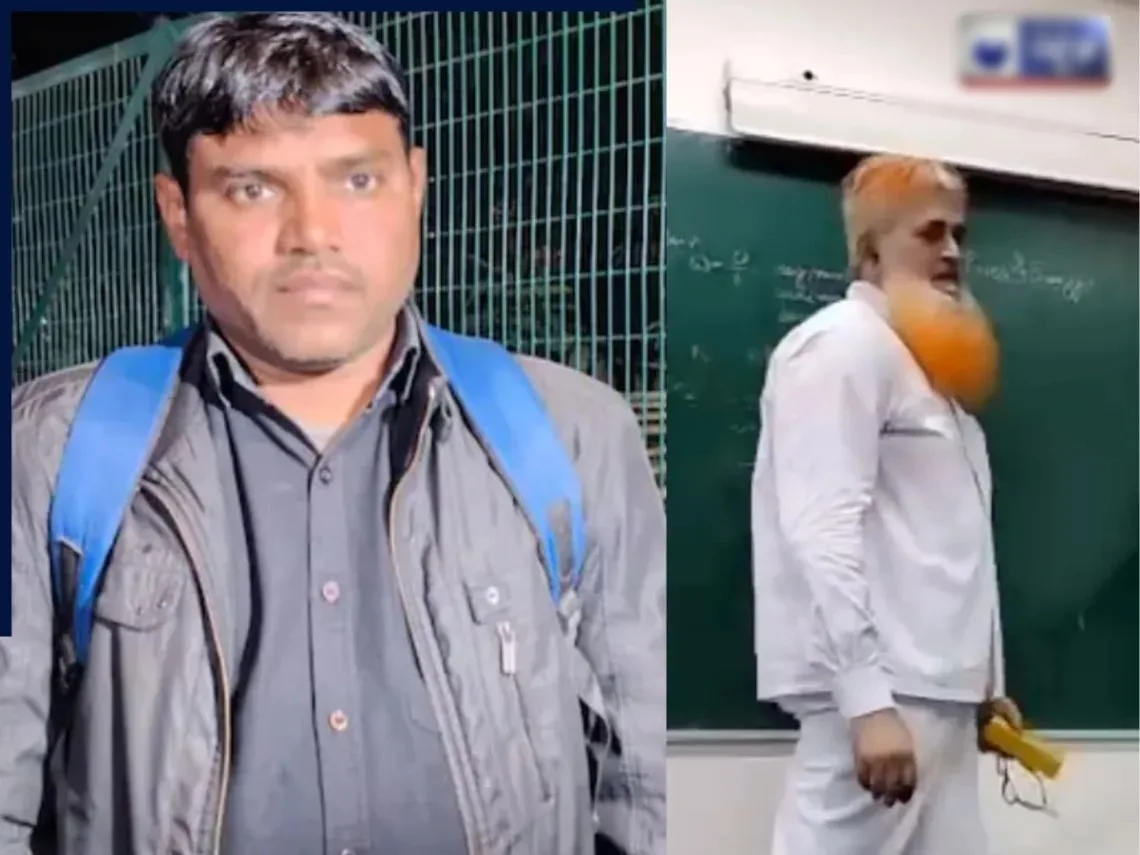
The controversy surrounding Jamia Millia Islamia has taken a fresh turn after a complaint filed by university employee Ram Phool Meena reached the National Commission for Scheduled Tribe (NCST), bringing renewed scrutiny to allegations of caste discrimination, religious harassment and institutional retaliation within the Central university.
Nearly four months after accusing a faculty member of caste abuse and physical assault, Meena has approached NCST authorities alleging that instead of taking action against the accused, the university administration transferred him from his workplace in what he describes as a “punishment posting”.
In a detailed rejoinder submitted on May 18, 2026, Meena alleged that his transfer from Jamia’s University Polytechnic to the Balak Mata Centre was not an administrative necessity but a retaliatory measure designed to silence him after he filed complaints against Associate Professor Dr Riyazuddin. He has sought an independent inquiry, restoration to his original posting, protection from further harassment and action under the Scheduled Castes and Scheduled Tribes (Prevention of Atrocities) Act.
“Instead of taking action against the accused, I was removed from my workplace,” Meena stated in his representation to authorities.
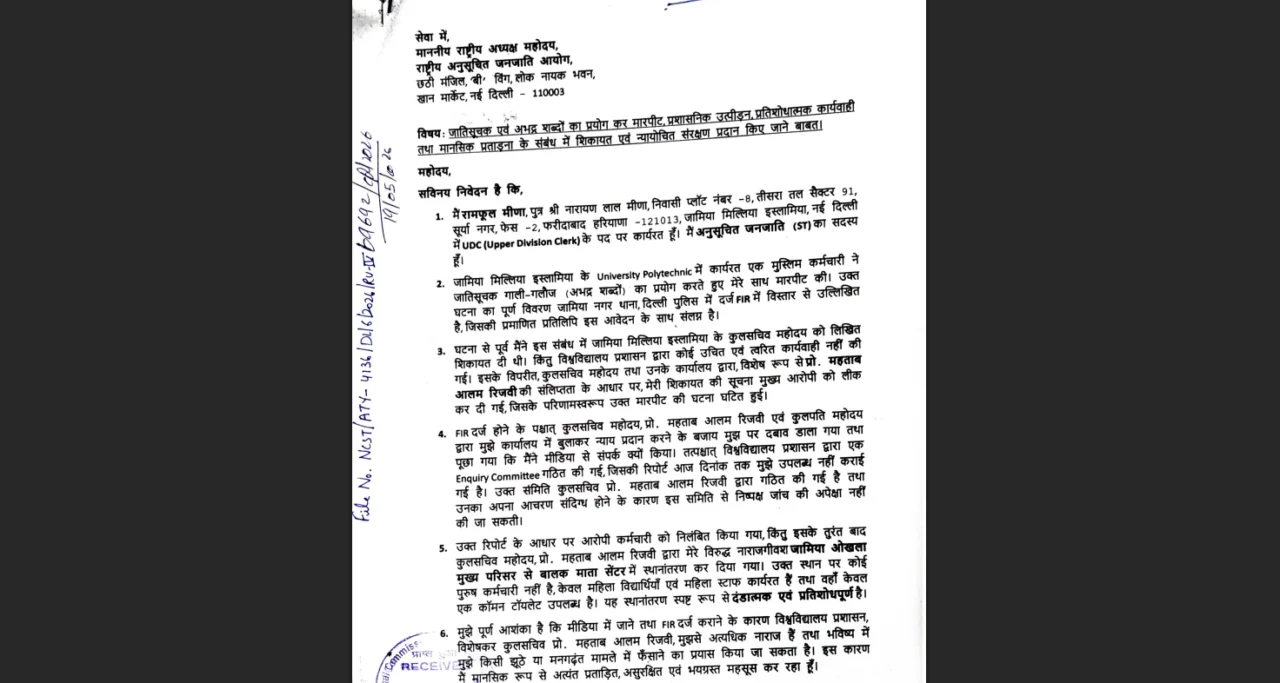
Meena alleged that despite submitting written complaints against Associate Professor Dr Riyazuddin, Jamia Registrar Prof. Mohammad Alam Rizvi and his office failed to take timely action and that information from his complaint was allegedly leaked to the accused, resulting in further escalation of the dispute. He further claimed that after the FIR, he was summoned by Registrar Prof. Rizvi and other university authorities and questioned about why he had spoken to the media. Meena also challenged the impartiality of the university’s internal inquiry committee, arguing that it had been constituted under the authority of officials whose conduct was under question.
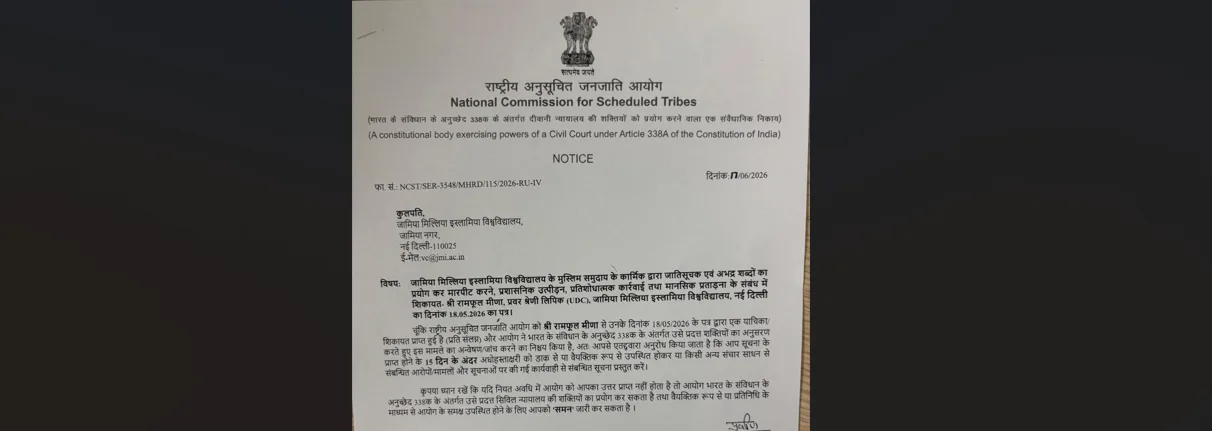
The development comes as constitutional bodies continue to seek reports in cases involving allegations of caste-based discrimination and retaliatory transfers, with official communications indicating that such complaints are under active examination.
Speaking to Organiser, Meena said the transfer was not merely an administrative relocation but one that has left him feeling vulnerable and exposed. According to him, Balak Mata Centre is located nearly 1.5 kilometres from Jama Masjid, and approximately 15 kilometres away from his original workplace at the University Polytechnic.
He alleged that the library is staffed almost entirely by women and is frequented predominantly by female students, with very few male employees present. Meena claimed that he has repeatedly expressed concerns to the university administration about the posting, arguing that as the lone male employee in such an environment, he could be exposed to false allegations or unnecessary controversies at any time. “Why was I sent there when there are several other departments in the university?” he asked.
Meena further alleged that instead of ensuring his safety after he complained of caste abuse and assault, the administration posted him in what he described as a hostile environment, claiming the decision was intended to isolate him socially and professionally.
How dare you complain against me?
According to a complaint submitted to Delhi Police on January 17, 2026, Meena, an Upper Division Clerk (UDC) at Jamia’s University Polytechnic, alleged that the hostility began after a complaint was made against Dr Riyazuddin over alleged misconduct involving students.
Although Meena maintains that he was not the complainant in that matter, he alleges that he became a target after a related video surfaced publicly.
The first incident allegedly occurred on January 13, 2026, when the faculty member entered his office and verbally abused him using caste-linked language. Meena says he immediately reported the matter to the university administration.
Three days later, on January 16, the confrontation allegedly escalated dramatically.
According to Meena’s complaint, the faculty member entered his office and angrily questioned how he had dared to complain.
The complaint quotes the accused as allegedly saying: “Tumhari aukaat kaise hui ki tumne mere khilaaf complaint ki?”
The abuse then took a caste and religious turn. According to Meena, the faculty member said: “Tum saale Adivasi jangli ho, Musalmanon ke idare mein rehkar mere khilaaf shikayat karne ki jurrat kaise ki?”
The statement forms a central part of Meena’s complaint and is among the allegations now before authorities.
‘I was repeatedly called a Kafir’
Beyond the alleged assault and abuse, Meena claims that he was subjected to sustained religious harassment within the university ecosystem.
According to him, he was repeatedly referred to as a “kafir” and faced direct and indirect pressure to embrace Islam.
Speaking about his experience, Meena alleged that the hostility he faced stemmed from his refusal to convert and his identity as a Hindu employee.
His allegations echo earlier complaints that have emerged from within Jamia over the past two years, where employees and students claimed they faced pressure to adopt Islamic practices or convert to Islam in exchange for career advancement, favourable treatment or social acceptance.
The complaint alleges that when Meena objected to the abuse, the confrontation became physical.
According to his statement, the faculty member punched him in the face and struck him several more times.
Meena claims the assault left his lips bleeding and caused swelling below his eye.
He subsequently sought treatment at Jamia’s Ansari Health Centre and attached medical documents with his complaint.
The incident, he says, caused not only physical injuries but also severe mental trauma and humiliation because the abuse was allegedly linked to his caste and religious identity.
Complaint leaked, violence followed
One of the most serious allegations made by Meena concerns the handling of his complaints by university authorities.
According to his representation, after submitting a written complaint to the Registrar, no action was taken for several days.
Instead, he alleges, details of his complaint were communicated to the accused faculty member.
Meena claims that the alleged leak directly led to the subsequent confrontation and assault.
The rejoinder also names senior officials and alleges that despite repeated representations, the administration failed to provide relief or protection.
‘Why did you go to the media?’
Meena’s rejoinder contains another allegation that raises questions about the university’s response.
According to the complaint, after the FIR and representations were filed, senior officials allegedly summoned him and questioned him about approaching the media rather than focusing on the allegations he had raised.
He has also questioned the neutrality of an internal committee constituted to examine the matter, arguing that it was created under the authority of officials whose actions were themselves under scrutiny.
The most contentious aspect of the case concerns the timing of Meena’s transfer.
According to his complaint, on the evening of January 16, after meeting university authorities and seeking action against the accused faculty member, he was assured that the matter would be addressed.
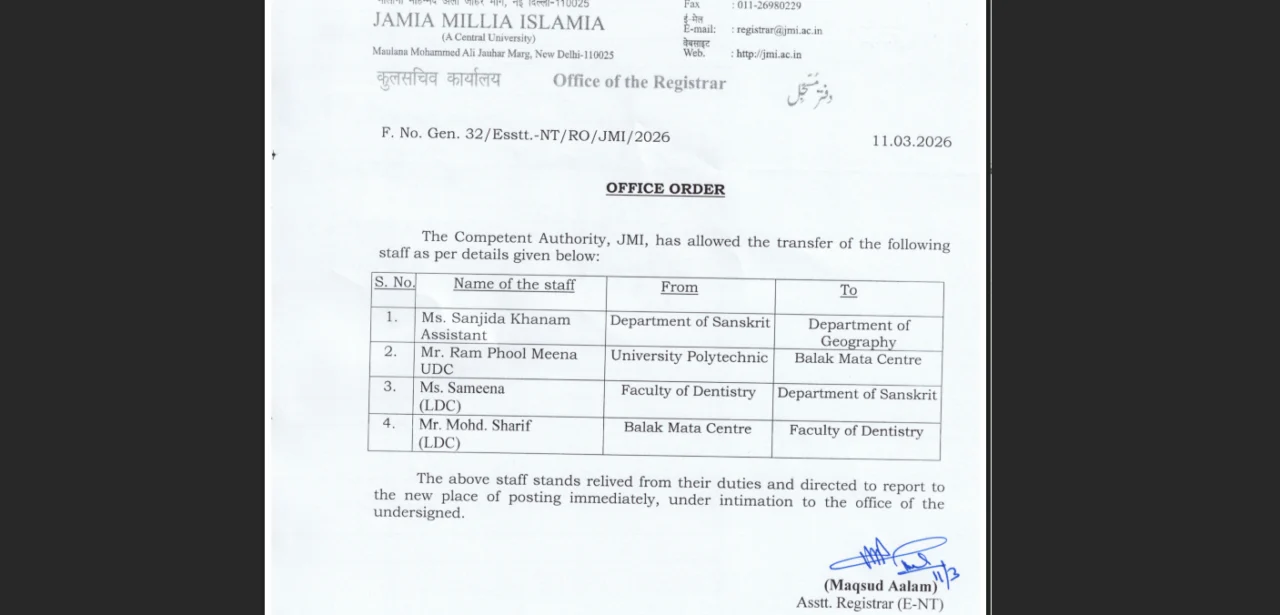
Yet on the very same day, a transfer order bearing F. No. Gen. 32/Esstt.-NT/RO/JMI/2025 was issued, shifting him out of the University Polytechnic.
In his rejoinder, Meena states that he was moved to the Balak Mata Centre, a posting he describes as professionally isolating and entirely unrelated to his existing work profile. He alleges that the transfer was intended to victimise him and send a message to others who might consider filing complaints against influential individuals within the institution.
Not the first conversion controversy
The latest allegations revive a series of controversies that have dogged Jamia Millia Islamia in recent years.
In July 2024, a Dalit employee alleged that a senior university official told him: “Bring Iman, and we will secure your and your children’s career.”
A few months later, a differently-abled woman employee alleged that she was encouraged to convert and told that wearing a hijab would bring “noor” to her face.
Those allegations eventually led to a fact-finding exercise involving testimonies from faculty members, staff, students and alumni. Several witnesses alleged discrimination against non-Muslims, stalled promotions and pressure to conform religiously.
Although Jamia publicly stated that it maintained a “zero-tolerance” policy towards forced conversion and discrimination, critics argue that the latest allegations suggest that concerns raised in earlier complaints were never fully addressed.
Questions for Jamia
The case now raises a series of uncomfortable questions for one of India’s central universities.
Why was a complainant transferred immediately after reporting caste abuse and assault?
Why does the complainant claim he was repeatedly branded a “kafir”?
Were his allegations of conversion pressure investigated?
Did the university act against the accused, or against the employee who complained?
And if a Scheduled Tribe employee alleging caste abuse and physical assault can be moved out of his workplace while the accused remains in position, what message does that send to other employees contemplating speaking out?
For Ram Phool Meena, the answer is already clear.
His allegation is stark: he was first abused, then assaulted, and finally transferred.
And according to him, the transfer was not an administrative decision, it was punishment for refusing to remain silent.