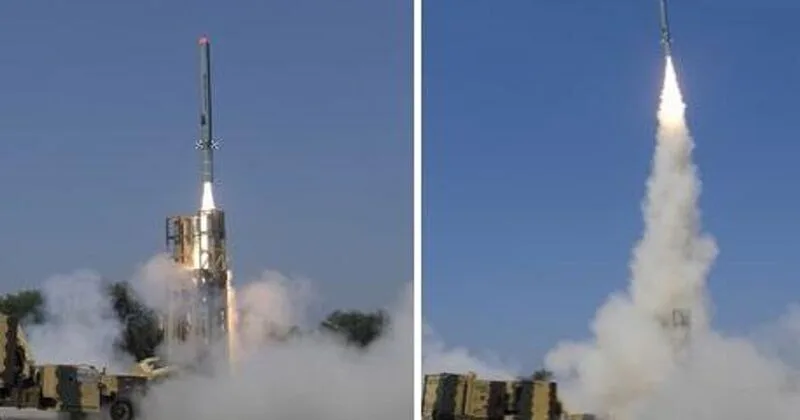
New Delhi: In a major boost to India’s defence capabilities, the Defence Research and Development Organisation (DRDO) on June 15 successfully conducted the flight test of the Long Range Land Attack Cruise Missile (LRLACM) from Dr APJ Abdul Kalam Island off the coast of Chandipur in Odisha.
–#India successfully tests LRLACM — "India's Tomahawk"!
-15 Jun 2026 Kalam Island, Odisha
-Successor to Nirbhay programme
-Range: 1000–1500 km
-Subsonic, terrain-hugging, sea-skimming cruise missile
-DRDO's Manik turbofan engine
-Weight: <20 tons, payload 1000 kg conventional… pic.twitter.com/Bou4EBCPo0— Insightful Geopolitics (@InsightGL) June 16, 2026
According to the Ministry of Defence, the missile successfully met all mission objectives and accurately struck its target at a range of 1,000 kilometres. Officials confirmed that issues encountered during previous developmental phases have been resolved.
The ministry stated that the LRLACM is a fully indigenous system, with its subsystems developed by various DRDO laboratories in collaboration with Indian industry partners. Bengaluru-based Aeronautical Development Establishment (ADE) serves as the nodal laboratory for the project.
The successful test marks a significant achievement following the challenges faced by the earlier Nirbhay cruise missile programme, which experienced multiple setbacks during flight trials between 2013 and 2020. The LRLACM builds upon the lessons learned from that programme and incorporates improvements in range, guidance, and overall performance.
Designed for launch from multiple platforms, the missile is expected to undergo two additional developmental trials and two user trials over the next two years before being inducted into the Indian Armed Forces.
The successful test comes amid evolving regional security challenges and highlights India’s efforts to strengthen its long-range strike capabilities. The LRLACM is designed to engage high-value targets deep inside enemy territory with high precision.
Flying at low altitudes, the missile is difficult to detect by enemy radar systems, enhancing its survivability. It can carry a 500-kilogram warhead and is capable of delivering significant destructive power against strategic targets.
Often compared to the United States’ Tomahawk cruise missile, the LRLACM can manoeuvre across varying altitudes and speeds, making it a versatile and potent addition to India’s military arsenal.