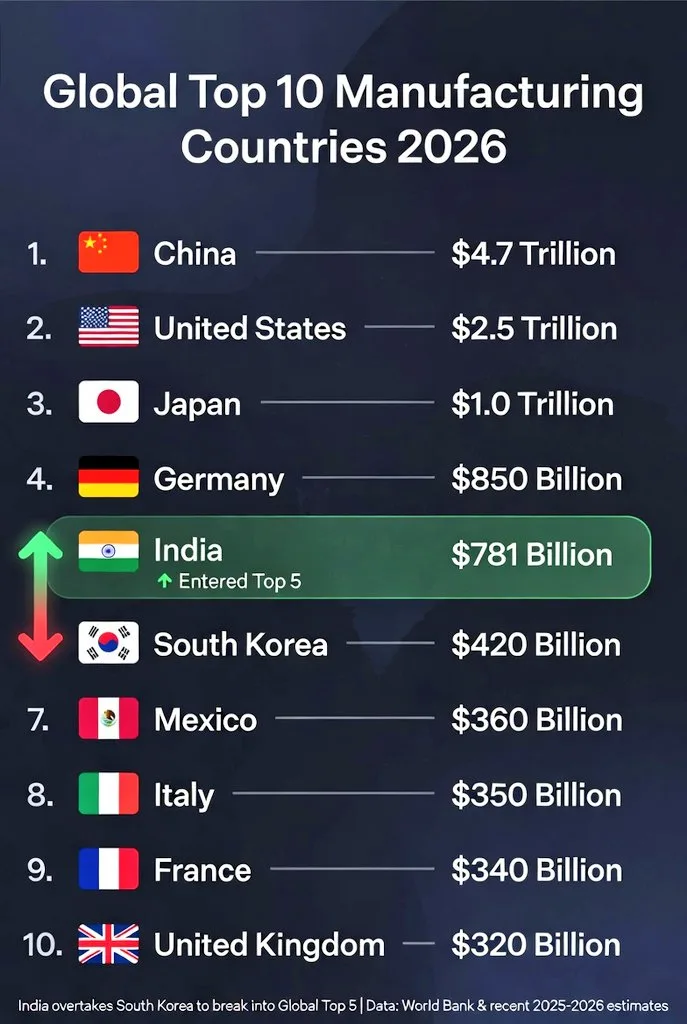
India has scripted another record in its path of harnessing the country as a global manufacturing powerhouse. As per the latest World Bank baseline data, India has emerged as the world’s fifth largest manufacturing economy surpassing South Korea. With this New Delhi has sealed its strong strategic footprint in the global supply chain, as the world’s fastest growing economy. With this, India is now a key stakeholder in the global manufacturing and supply chain, thus attracting global businesses, investment flow and state-of-the-art technology to the country.
Monumental manufacturing leap in a decade
Data testifies that in just a decade, India’s manufacturing story has accelerated by leaps and bounds compared to past decades. India has added more manufacturing capacity in the last ten years than the total manufacturing potential added over the past 70 years. For example, from 1960 to 2014, India’s manufacturing strength and output grew USD 3 billion to USD 328 billion. In stark contrast to this slow growth rate, from 2015 to 2025, India’s manufacturing output has grown from USD 328 billion to USD 781 billion.
Thus, in a span of just 10 years, India has added USD 453 billion to the manufacturing capabilities of the country. To summarise, in more than 70 years, USD 328 billion was added to manufacturing potential and in just 10 years USD 453 billion is added, signifying solid policy push, Production Linked Incentives(PLIs) and other strategic, financial mechanisms rendered by the government to catalyse the country as a global manufacturing hub. At this growth rate, it is anticipated that India will outperform Japan by 2029 and emerge as the world’s third largest manufacturing powerhouse with almost 1 trillion dollar production capacity.
Key contributing sectors & the vision of Make-in-India
As India rapidly expands its manufacturing potential, stretches its industrial base and seals its place in the global supply chain, there are key sectors who act as bulwarks of the country’s manufacturing growth story. Electronics, pharmaceuticals and automobiles are the key sectors that are major contributors to the success and rapid growth of India’s manufacturing saga. For example, electronics is one of the fastest growing export categories with USD 22.2 billion output. India is also the world’s fourth largest automobile market and third largest pharmaceutical market in terms of volume.
Thus India is adding immense value to the global supply chain. This growth story of India is weaved with visionary policies such as Make-in-India and Atmanirbharata that aims to seek self-reliance in the manufacturing sector by encouraging domestic production and home-grown state-of-the-art technology. In this direction, apart from traditional sectors, India is also swiftly emerging as a manufacturing hub for deeptech technologies such as semiconductors, space tech, defence tech, Artificial Intelligence(AI), advanced computing etc.
India emerges as manufacturing hub amid global headwinds & trade weaponisation
India rises to the top position in the global manufacturing powerhouses list at a very critical juncture across the geopolitical landscape. Tariff tussles are escalating, world-nations are weaponising trade to seek hegemonic ambitions, critical trade routes and maritime chokepoints are entangled in conflicts, energy security has hit a stalemate, global inflation rate is soaring and India has risen in the global manufacturing ladder at such a precarious scenarios.
Despite global headwinds and external shocks hindering the domestic manufacturing sector, India’s growth story has not halted. With strong strategic calculations such as economic diversification, multi-alignment etc. coupled with sound domestic policies, India’s manufacturing potential is racing. With this stellar potential, India presents itself as a credible partner to carve a resilient global supply chain devoid of creating bottlenecks and other weaponisation tactics. This solid manufacturing growth of India, also acts as a fertile ground to attract FDI, global partnerships and other strategic necessities that aids to further revolutionise the country as a manufacturing powerhouse.
From import dependent country to global manufacturing force
India’s success story in manufacturing is worth recalling. The country’s manufacturing potential was weak. It was an import dependent country with exports solely consisting of the service sector products. In such a scenario, India was highly vulnerable to the external shocks and was stuck in the global supply chain war escalated by the manufacturing bullwarks such as the USA and China. However, today the story has been completely changed.
India is reducing its dependency on global export giants and is debunking the label of being an import dependent country. Instead, it is gaining considerable stakes in the global supply chain thus acting as a cushion against trade weaponisation and other illicit tactics to secure nation’s economic security and also to ensure fairness and transparency in global trade. Today, manufacturing contributes to 13 per cent of India’s GDP.
This rapid pace of growth of the country’s manufacturing sector, exhibits the days ahead, where India is set to be the world’s third largest manufacturing hub, just next to USA and China, thus not just sealing national economic security, but also to ensure balance of power in the global economic paradigm against aggressive manufacturing and trade practices.