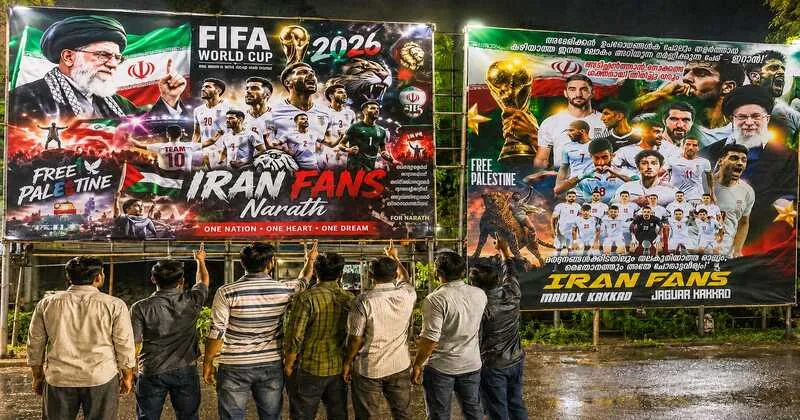
Iran-themed World Cup flexes in Narath, Kannur, featuring Ayatollah Khamenei and 'Free Palestine' messaging, have sparked debate over the intersection of football, religion and politics in Keralam
Every FIFA World Cup season witnesses an extraordinary outpouring of football passion across Keralam. Massive flex boards, cut-outs, social media campaigns and fan wars become common sights as supporters rally behind their favourite teams and players. Traditionally, the largest fan bases in Keralam belong to football giants such as Brazil and Argentina. They are followed by supporters of Portugal, Germany, France, England, Italy and Spain. The names of global superstars including Lionel Messi, Neymar and Cristiano Ronaldo dominate the football landscape, with giant flexes and cut-outs appearing across the state.
This time, however, a flex board that surfaced in Kannur district has attracted attention for reasons beyond football. The flex was put up by supporters of Iran, a team that has never enjoyed a significant fan base in Keralam. What has made the display particularly controversial is the inclusion of the image of Iran’s religious Leader, Ayatollah Ali Khamenei, along with the slogan “Free Palestine.” The development has triggered questions about whether football is being used as a platform to promote religious and political messaging rather than sporting enthusiasm. Observers point out that football fandom in Keralam has historically been centred on sporting excellence rather than ideological affiliations.
The controversy has gained further significance because the flex was erected in Narath, an area that had previously attracted national attention in connection with a major security case. On April 23, 2013, acting on information that secret weapons training was being conducted alongside yoga classes and sports training in a building owned by the Narath Charitable Trust, Keralam Police carried out a raid. During the operation, police seized lethal weapons and explosives and arrested 21 individuals linked to the banned Islamic terror group Popular Front of India (PFI) and SDPI.
Considering the seriousness of the allegations, the National Investigation Agency (NIA) subsequently took over the investigation. In January 2016, a special NIA court in Kochi found 21 accused guilty in the case and awarded punishment. Against this backdrop, questions are now being raised about who is behind the Iran-themed flex in the area. Intelligence agencies and the Police Special Branch are reportedly examining the matter.
Keralam has always had football supporters who admired teams and players for their achievements on the field. In recent years, however, social media has witnessed growing support for Iran among certain sections. From a purely footballing perspective, Iran has never enjoyed the same level of popularity as traditional World Cup powerhouses.
There are also few footballing reasons to explain such enthusiasm. Iran has never progressed beyond the group stage of the FIFA World Cup. In 18 World Cup matches, the country has recorded only three wins, four draws and eleven defeats.
That said, by Asian standards, Iran remains one of the continent’s stronger football nations. The country has produced several notable players, including Ali Daei, Sardar Azmoun and Mehdi Taremi, the Inter Milan star. Yet despite these achievements, Iran has never occupied a prominent place in Keralam’s football culture.
Many observers believe that Iran’s positions on West Asian issues and the Palestinian cause have contributed to the support it receives among certain sections of society. According to critics, this reflects the growing influence of political and religious narratives that differ from Keralam’s traditional football culture. The inclusion of Ayatollah Khamenei’s image on the Narath flex has further strengthened such concerns.
Interestingly, this year’s World Cup also features Gulf nations such as Qatar and Saudi Arabia. Both countries have successfully qualified for the tournament. For decades, these nations have played a major role in providing employment opportunities to Malayalis and have maintained close people-to-people ties with India and Keralam. Yet no comparable flex campaigns have emerged in support of these countries.
This is particularly noteworthy in the case of Qatar, which has a direct Malayali connection in its World Cup squad. Nineteen-year-old Tahseen Mohammad Jashid, whose family traces its roots to Kannur, has been selected in Qatar’s FIFA World Cup squad. His father, Jashid, is a native of Thalassery, while his mother, Shaima, hails from Valapattanam. Tahseen’s father was himself a footballer who represented Calicut University and was selected for the Indian Youth camp in 1992. Sarpreet Singh, who is part of the New Zealand World Cup team, is another player with Indian roots participating in the tournament.
The rapid development of football in Gulf countries has also benefited aspiring footballers from Keralam. Mohammed Razin from Malappuram district been selected by Al Nassr, one of Saudi Arabia’s biggest football clubs, while Keerthana from Idukki district has been selected by Al Hilal. Saudi Arabia’s growing football ambitions were highlighted when Al Nassr signed Cristiano Ronaldo, one of the biggest superstars in world football.
Despite these developments and the strong football links between Keralam and the Gulf, the unusual attraction towards Iran among certain sections has drawn attention. Critics argue that the phenomenon cannot be explained solely through football and point to the presence of specific political and religious messaging. The Police Special Branch is examining these concerns as part of its ongoing inquiry into the circumstances surrounding the controversial Narath flex.
