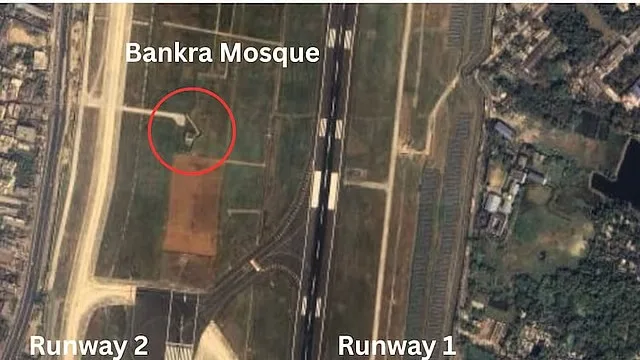
At Kolkata’s Netaji Subhas Chandra Bose International Airport, authorities have confirmed plans to relocate the Bankra Mosque, also known as the Gouripur Jame Masjid, from within the airport’s operational zone.
The mosque, believed to be more than 130 years old and older than the airport itself, is situated approximately 165 metres from the airport’s secondary runway. Aviation authorities have long argued that its location poses operational constraints and prevents critical infrastructure upgrades required to improve safety and efficiency.
Airport Director Vikram Singh recently confirmed that the old terminal building, which served Kolkata Airport before the commissioning of the new integrated terminal in 2013, will be demolished after the completion of this year’s Hajj operations. The mosque relocation is expected to be part of the broader redevelopment exercise.
Why authorities want the mosque relocated
According to airport officials, international aviation safety standards require a minimum clearance of approximately 240 metres from the runway for structures of this nature.
The Bankra Mosque currently stands around 165 metres from the secondary runway, creating what aviation authorities describe as a significant operational limitation.
Officials say the proximity of the structure has prevented the installation of advanced Instrument Landing Systems (ILS), technology crucial for safe aircraft operations during poor visibility conditions, particularly the dense winter fog that frequently affects eastern India.
The restrictions have also forced airport authorities to shorten touchdown points on the runway and have prevented wide-body international aircraft from fully utilising the strip.
Safety concerns and operational challenges
Officials have stated that the mosque’s location previously compelled authorities to shift the runway touchdown point southward by 88 metres to comply with mandatory Runway End Safety Area (RESA) norms prescribed by the Directorate General of Civil Aviation (DGCA) and the International Civil Aviation Organization (ICAO).
As a result, the secondary runway has not been able to achieve its full operational potential.
Airport authorities believe that relocation of the structure would allow the installation of advanced navigation systems, improve aircraft handling capabilities and significantly increase operational efficiency.
The move is expected to be particularly beneficial during adverse weather conditions when modern landing systems become critical for maintaining flight schedules and ensuring passenger safety.
136 YEAR OLD “BANKRA” MOSQUE WILL BE GONE. ENSURING SAFETY IS ALSO GOD’S WORK. FAITH HAD A VETO AND BENGAL HAS PAID LONG ENOUGH.
The Kolkata Airport Authority has confirmed plans to relocate the Bankra Mosque, located beside the runway! Airport Director Vikram Singh said the old… pic.twitter.com/jBpQjLRrOJ— Rahul Shivshankar (@RShivshankar) June 14, 2026
A politically sensitive issue for decades
The issue has remained politically sensitive for more than half a century.
During airport expansion exercises in the 1950s and 1960s, several surrounding villages were relocated. However, local accounts suggest that residents agreed to move only after assurances that the historic mosque would remain untouched.
As a result, successive governments avoided taking any decision regarding the structure.
Reports indicate that in 1995, the then Left Front government under Chief Minister Jyoti Basu declined a proposal to relocate the mosque.
Later, in 2003, authorities reportedly altered airport expansion plans and extended the runway from the opposite direction instead of addressing the mosque issue directly. That decision involved additional expenditure and infrastructure adjustments, including road diversions near Kaikhali.
For years, airport planners have cited the mosque as one of the principal obstacles to achieving optimal runway expansion.
The mosque currently lies within a high-security zone
At present, the mosque is located within the airport’s highly restricted airside zone under the supervision of the Central Industrial Security Force (CISF).
Worshippers seeking to offer prayers must undergo security screening before entering the area. They are then transported through airport premises using escorted shuttle services.
The unusual arrangement has often been cited as an example of the operational complexities created by the structure’s location inside an active airport zone.
Government proposes new mosque outside airport premises
According to officials, the relocation proposal does not involve eliminating the place of worship but shifting it to a more suitable location.
Sources indicate that authorities have proposed constructing a larger and modern mosque outside airport premises as part of the rehabilitation package.
Representatives of the mosque committee and several Muslim organisations have reportedly participated in discussions regarding the relocation plan.
Officials maintain that the objective is to balance aviation safety requirements, infrastructure development and religious sensitivities.
Airport authorities believe the redevelopment project could substantially increase Kolkata Airport’s future capacity.
According to estimates, annual passenger handling capacity could rise to nearly 40 million passengers once demolition of obsolete structures, runway improvements and related redevelopment projects are completed.
The ability to install advanced landing systems and optimise runway operations is expected to strengthen Kolkata’s position as one of eastern India’s most important aviation hubs.
Balancing heritage and infrastructure
The proposed relocation of the Bankra Mosque represents the culmination of a debate that has persisted for decades between heritage preservation, religious sensitivities and public infrastructure requirements.
While the mosque’s historical significance is widely acknowledged, aviation authorities argue that ensuring passenger safety and facilitating future airport expansion can no longer be postponed.
With discussions now moving toward implementation, the relocation is likely to mark one of the most significant infrastructure decisions taken at Kolkata Airport in recent decades.