

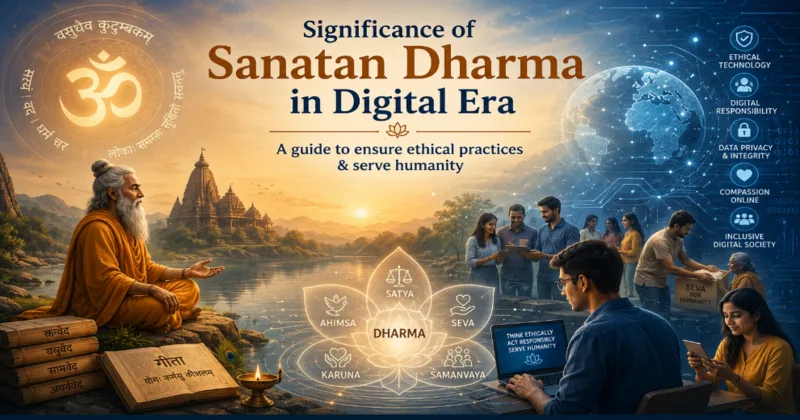
The significance of Sanatan Dharma in today’s digital era stems from its role as a framework for human consciousness, providing a much-needed balance to the algorithm-centric, mechanistic world we live in. In a time that emphasizes quickness, efficiency, and external connections, Sanatan Dharma presents a path for greater depth, insight and inner steadiness.
The emergence of digital technology and artificial intelligence and social media has sparked ethical debate over privacy and authenticity. Sanatan Dharma’s emphasis on truth and nonviolence gives an ethical foundation for addressing these issues. It encourages people to use technology responsibly, cultivating a digital culture founded on compassion and honesty.
Sanatan Dharma is a digital guide that delves into the profound teachings of Sanatan Dharma, with a concentration on the Veda, Upnishad and Bhagavad Gita. Unlike traditional AI models, which provide broad and generic information, Sanatan Dharma is especially designed to provide insights and advise based on Sanatan principles.
It is a blend of technology and tradition aimed at making the eternal knowledge of Sanatan scriptures available to a worldwide audience. Even though Sanatan Dharm in the digital age can be regarded from various angles, technology does not replace traditions; rather, it enhances them. It connects people to their roots while making practices available to those who may not have participated otherwise.
The significance of an ethical mindset during today’s cutting-edge AI revolution
The colonial era introduced printing technologies and modern academic publication, resulting in the documentation and translation of numerous Sanskrit and regional works. The present digital age has advanced this effort by allowing for large-scale preservation, indexing, and global distribution of spiritual and philosophical writings. Digital libraries, manuscript archives and open-access platforms now serve critical roles in safeguarding fragile knowledge traditions and making them available to scholars, students, and spiritual seekers around the world. In recent decades, there has been a notable revival of interest in traditional wisdom. Universities, cultural organisations, independent researchers and digital humanities initiatives have worked together to digitise manuscripts, produce critical editions and develop structured academic databases.
Several prominent initiatives have emerged as crucial pillars in the digital preservation and transmission of Dharmic knowledge. The only concern is that, during the colonial era, scholars such as Max Mueller manipulated and deceptively translated the Vedas and Upnishad in order to poison the mindset of Bharatiya and the rest of the world against great Bharatiya culture, traditions, deep knowledge of Vigyan, environment, psychology, consciousness and life management. The harmful impacts are still felt, particularly by young Bharatiya minds.In today’s world, the left ecosystem can use powerful AI characteristics to further distort the great Bharatiya knowledge, poisoning the brains of future generations against the concept of Bharat.
How digital technology helping to build digital platforms using Sanatan Dharma
Social media has established a worldwide platform for the growth of Sanatan Dharma. Various pages, groups, and influencers focusing on Vedic philosophy, yoga and Sanatan Dharma are bringing together individuals with similar interests from all over the globe. These online spaces are evolving into virtual satsangs, where timeless wisdom intertwines with contemporary curiosity. For numerous people, these platforms serve as an entry point, igniting interest in the expansive realm of Sanatan philosophy.
This illustrates how technology can enhance the accessibility and relevance of ancient teachings in the modern world. In the era of globalization, Sanatan Dharma has surpassed geographical limits. Hindu communities are present in almost every part of the world, notably in countries like the United States, the United Kingdom, Canada and Australia. This worldwide presence has enabled Sanatan Dharma to grow and prosper in various cultural environments.
Sanatan Dharma’s beauty comes from its willingness to evolve without losing its foundational essence. By integrating age-old wisdom with modern tools, it’s making its teachings accessible to a wider audience. Its emphasis on sound and vibration suggests that AI might be used to craft resonant soundscapes, chants, or mantras—AI-generated music or sound therapy based on sacred frequencies could support meditation, healing and spiritual work. The tradition’s close links with astrology and numerology also mean AI could refine and personalize Vedic-style charts and readings, delivering more precise predictions and perspectives on how planetary movements correspond to someone’s karmic journey.
Swami Vivekanand and AI
Vivekananda imagined a significant integration of Western empirical science and traditional Bharatiya Vigyan with the profound philosophical insights of Bharat’s Vedanta, resulting in a comprehensive perspective on reality. He explained that “the central focus of Vedanta philosophy is the quest for unity” and emphasized that “if the entire universe arises from a self-evolving cause, as both Vedanta and contemporary science assert, then this cause must encompass both material and spiritual elements, leading to a cohesive understanding of existence”.
On the other hand, in the era of AI, where objective truths about the world, the self, and existence are becoming more readily available—unfiltered by commercial search results or algorithmic biases—humanity will naturally be drawn to Sanatan Dharma. As AI enables deeper exploration of life’s complexities, from everyday ethics to the absurdities of the cosmos, the pluralistic and inclusive nature of Dharma will shine as a guiding light. This is not just a guess; it resonates with the essence of Dharma: a path that evolves to meet the seeker’s needs, encouraging a renaissance where technology enhances spiritual development.
Sanatan Dharma for ethical practices and orientation
Sanatan Dharma teaches dharma—the obligation to live righteously and follow moral laws. This concept has a parallel in ethical programming: AI practitioners must design systems that act ethically and avoid causing harm. Increasingly, efforts focus on building AI that complies with ethical guidelines to uphold fairness, justice and collective well-being, aligning in essence with dharma’s principles of proper conduct.
From this perspective, ethical duty in AI resembles a Yajna. Those who build and deploy AI bear the duty to ensure these technologies are developed with responsibility, transparency and service to humanity. As Yajna sustains cosmic balance, AI should be engineered to enhance the welfare of all and contribute positively to society. Nowadays, protecting data goes beyond technical defenses like firewalls and passwords—it’s fundamentally about values. In many ways, the ethos of contemporary cybersecurity reflects the teachings of Sanatan Dharma and the Bhagavad Gita.