India’s defence sector is undergoing a significant transformation, evolving from a model centred primarily on self-reliance to one increasingly focused on global outreach and strategic influence. What began as a push for “Defence Atmanirbharta” has expanded into an ambitious effort to establish India as a major player in the international arms market. Rising geopolitical tensions, growing demand for military equipment, and a series of policy reforms have accelerated this transition, enabling India to expand both its manufacturing capabilities and its defence exports.
The scale of this shift is reflected in the numbers. India’s defence exports have risen from Rs 686 crore in 2014 to Rs 38,400 crore in 2026, while domestically produced defence equipment now reaches nearly 100 countries. With defence production crossing Rs 1.5 lakh crore and new procurement and manufacturing policies taking effect, India is positioning itself to capture a larger share of the global defence market at a time when nations are actively seeking reliable alternative suppliers.
A defence manufacturing surge backed by policy reforms
India’s rise as a defence exporter has been underpinned by a substantial expansion of domestic manufacturing capacity. During the tenure of Prime Minister Narendra Modi, defence production has reached new levels, reflecting a strategic shift from import dependence towards indigenous manufacturing and export-oriented growth.
The government’s emphasis on self-reliance in defence production has been reinforced by policy measures designed to strengthen the domestic industry. The Production-Linked Incentive (PLI) scheme has been introduced to incentivise localisation in defence manufacturing by providing financial benefits to companies that increase domestic production output.
The regulatory environment has also been reshaped to support emerging technologies. The Drone Rules 2021 were introduced to reduce compliance burdens for industry participants and simplify operational and manufacturing procedures within the drone sector. These measures have become central to the development of India’s drone ecosystem, encouraging both domestic production and wider deployment across sectors.
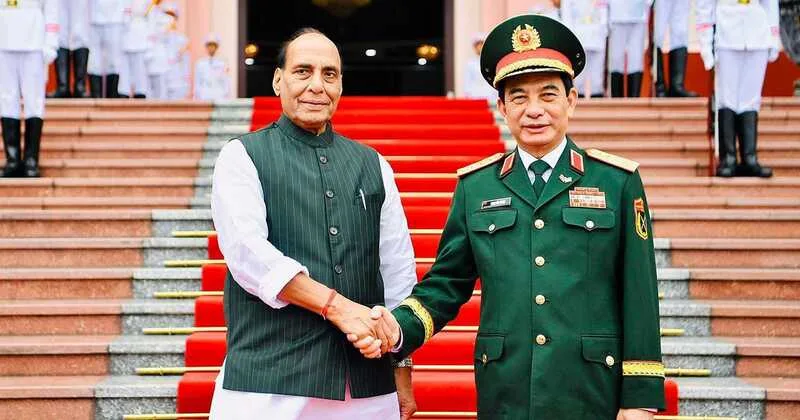
Held a productive bilateral meeting with Gen. Phan Van Giang, Defence Minister of Vietnam. We reviewed the growing India-Vietnam defence partnership and discussed ways to further deepen cooperation in maritime security, defence industry, training and regional stability. India… pic.twitter.com/4WruDhDCx6
— Rajnath Singh (@rajnathsingh) May 19, 2026
Further momentum has come from procurement reforms. Under the Defence Procurement and Financial Delegation System-2026, the procurement power of the Indian Armed Forces has been increased to Rs 1.25 lakh crore, providing greater autonomy and capacity to acquire defence equipment and services.
These reforms have strengthened India’s manufacturing base in defence equipment and components, enabling the country to respond to growing international demand. As geopolitical conflicts and supply chain concerns reshape defence procurement patterns worldwide, India’s established industrial capacity is increasingly viewed as a competitive advantage.
Global demand, drones and the export boom
The international security environment has created new opportunities for India’s defence industry. Heightened geopolitical frictions, including the Israel-Iran conflict, have led many countries to accelerate military acquisitions and diversify their supplier networks. Concerns over supply-chain disruptions and dependence on traditional defence exporters are prompting militaries to seek alternative sources of equipment.
India has emerged as one of the beneficiaries of this trend. Defence exports reached ₹38,400 crore in 2026, marking a dramatic rise from Rs 686 crore in 2014. Indian-made defence products are now exported to nearly 100 countries, reflecting growing confidence in the country’s manufacturing capabilities and technological expertise.
The export growth spans multiple sectors, including drones, missiles, aerospace and electronics, demonstrating India’s ability to serve diverse defence requirements across international markets.
The drone sector has become a particularly important component of this expansion. Government policies aimed at fostering drone manufacturing and adoption have helped improve the commercial viability of the technology. As global demand for unmanned systems rises, India is preparing to place a military drone order worth $2 billion, which would represent the country’s largest purchase of such equipment to date.
Industry observers see the country’s growing manufacturing ecosystem as well-positioned to benefit from rising defence spending worldwide. Companies such as Bharat Electronics Limited (BEL), Hindustan Aeronautics Limited (HAL), and Data Patterns have emerged among the top picks within India’s defence sector and are expected to benefit from the current surge in demand linked to geopolitical tensions.
Defence exports are also increasingly being viewed as an instrument of foreign policy. By supplying defence equipment to partner countries, India is seeking not only economic gains but also stronger diplomatic relationships and strategic partnerships. Defence Minister Rajnath Singh has expressed confidence that India’s defence exports will reach Rs 50,000 crore by 2030, signalling the government’s long-term ambitions for the sector.
BrahMos: The flagship of India’s global defence outreach
If one platform symbolises India’s emergence as a defence exporter, it is the BrahMos supersonic cruise missile. Jointly produced by India and Russia, the missile has become a key component of New Delhi’s efforts to expand its presence in international defence markets.
The BrahMos has attracted attention because of its speed, precision strike capability and versatility. It can be deployed from land, sea, air and submarine platforms, making it one of the most adaptable missile systems currently available. The missile travels at speeds ranging from Mach 2.8 to Mach 3, significantly faster than many conventional cruise missiles used by naval forces worldwide, and can strike targets located more than 400 kilometres away.
As India seeks to expand its influence in regions aligned with its geopolitical and strategic interests, the Global South has become an increasingly important focus. The BrahMos missile is playing a central role in this outreach, particularly in Southeast Asia, where maritime security concerns are driving demand for advanced defence systems.
India’s engagement with Southeast Asia has evolved considerably over time, and defence cooperation now represents a new dimension of those relationships. Countries facing security challenges in the South China Sea have shown growing interest in strengthening deterrence capabilities and enhancing anti-access/area denial (A2/AD) strategies. In this environment, the BrahMos has emerged as an attractive option.
Southeast Asia and India’s strategic missile diplomacy
The South China Sea remains one of the world’s most strategically contested maritime regions. China’s assertive naval posture in advancing its territorial claims has prompted several littoral states to strengthen their defensive capabilities. Enhancing A2/AD capacity has become one of the key approaches adopted by countries seeking to improve deterrence and maritime security.
The Philippines became the first international customer of the BrahMos missile when it received the first batch in 2024. India subsequently delivered the second batch in April 2025, demonstrating the operationalisation of one of the country’s most significant defence export agreements.
Indonesia is also emerging as a potential major customer. The country stands on the verge of what analysts describe as a significant A2/AD breakthrough, and its decision to procure the BrahMos missile from India could become one of Southeast Asia’s most consequential coastal-defence acquisitions.
🚨 India to Export BrahMos to Vietnam with 290 km Range Limit
India is preparing to export the BrahMos supersonic cruise missile to Vietnam, but the exported version will be limited to a 290 km range.
This follows the same arrangement as the deal with the Philippines, in line… pic.twitter.com/pBcdCt4Rf8— Defence Chronicle India ™ (@TheDCIndia) June 12, 2026
Vietnam represents another important opportunity. As a South China Sea littoral state and a longstanding strategic partner of India, Vietnam has shown interest in the BrahMos system. India and Vietnam discussed a potential BrahMos deal during the visit of Vietnam’s President To Lam to India from May 5 to May 7 this year. The discussions formed part of the broader India-Vietnam Comprehensive Strategic Partnership.
India’s efforts to deepen defence engagement in the region continue at the highest levels. Defence Minister Rajnath Singh is currently undertaking a two-nation visit to Vietnam and South Korea, where discussions are focused on expanding strategic military ties, defence industrial partnerships and maritime security cooperation aimed at supporting stability in the Indo-Pacific region.
Turkey’s unease reflects India’s expanding defence influence
Turkey’s growing unease over India’s defence engagements with Greece, Cyprus and Armenia reflects the widening reach of New Delhi’s strategic and military influence. As India expands its defence exports and deepens security partnerships across regions stretching from the Eastern Mediterranean to the Caucasus, reactions from Turkish media and strategic circles underscore how Indian-made military platforms are increasingly shaping geopolitical calculations far beyond South Asia. Some Turkish commentators accuse New Delhi of pursuing a “proxy war” against Turkey through arms exports to Ankara’s regional rivals. The criticism has intensified amid reports of potential BrahMos missile deals and expanding strategic cooperation between India and several countries that have longstanding disputes with Turkey.
The concern stems from a series of recent developments. India and Cyprus have adopted a defence cooperation roadmap for 2026-2031 that includes joint military exercises, naval port visits and discussions on defence acquisitions. Greece has expressed interest in the BrahMos supersonic cruise missile and other Indian military platforms, while Armenia has already emerged as one of India’s largest defence customers, receiving more than $2 billion worth of Indian equipment, including Pinaka multi-barrel rocket systems, Akash air defence missiles, ATAGS howitzers and radar systems that featured prominently in Armenian military parades in 2026.
JUST IN 🇮🇳🇨🇾🇬🇷
India is expanding its strategic footprint into the Eastern Mediterranean through deeper ties with Greece and Cyprus
Defence, maritime security, tech, energy, and infrastructure cooperation are strengthening under wider connectivity plans like IMEC
This also… pic.twitter.com/pbhy1hR0ud
— Brics Times (@Brics_Timesx) June 10, 2026
Turkish analysts have warned that such cooperation could alter military dynamics in both the Eastern Mediterranean and the Caucasus, raising concerns over Turkey’s strategic interests and its “Blue Homeland” maritime doctrine. However, Indian observers view these partnerships through a different lens. They argue that India’s defence engagements are legitimate sovereign agreements and reflect a natural convergence of strategic interests, particularly given Turkey’s longstanding military support to Pakistan, including the supply of drones.
From New Delhi’s perspective, defence exports are driven by commercial opportunities, strategic partnerships and the goal of strengthening regional stability. No official Indian position has described these agreements as being directed against Turkey. Instead, India’s expanding defence outreach underscores its emergence as a responsible arms supplier and a growing geopolitical actor capable of shaping security partnerships far beyond its immediate neighbourhood.
As India advances from the goal of self-reliance towards becoming a significant arms exporter, the BrahMos missile stands as a powerful symbol of that journey. Combined with expanding expertise in missile manufacturing, growing defence production, rising exports and deepening engagement with the Global South, it reflects a broader transformation underway in India’s strategic outlook. What began as a drive for Atmanirbharta is increasingly becoming a story of global reach, with India’s defence industry emerging as both an economic force and a key instrument of international influence.