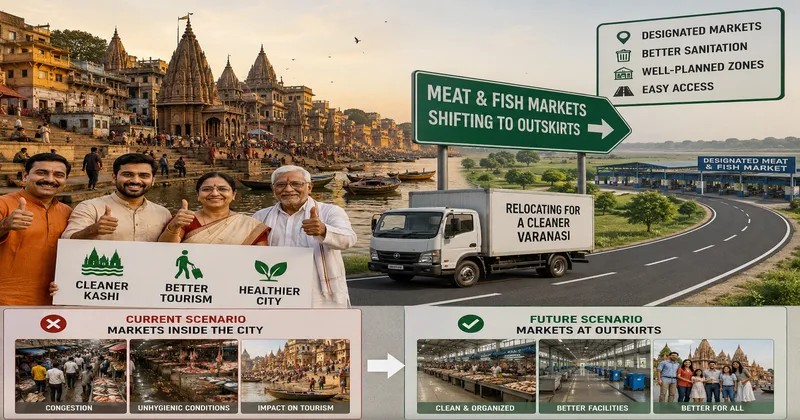
VARANASI: The Varanasi Municipal Corporation decision to relocate the city’s meat and fish shops to five designated sites on the outskirts is a long-overdue exercise in urban planning. It also aligns commercial activity with the needs of a heritage city that welcomes millions of pilgrims and tourists each year.
This agenda was approved during a governing body meeting at the Town Hall in Maidagin under the chairmanship of Mayor Ashok Kumar Tiwari, the resolution reflects an approach rather than creating any abrupt disruption. This is aimed at improving urban management, maintaining cleanliness and streamlining commercial activities. Municipal Commissioner Himanshu Nagpal outlined a clear roadmap, identifying five locations — Ramnagar, Sujabad, Ganeshpur, Avleshpur and Shivpur for the first phase, all shops will be shifted near the city outer limits to keep the transition smooth for traders and consumers alike.
The logic is to make Varanasi among the oldest continuously inhabited cities in the world. Its narrow, congested lanes were never designed to host open meat and fish markets serving a modern population.
Hotel owner of The Sashi Palace, Mayank Kumar Mishra said that “The decision aims to address issues such as sanitation, congestion and public health, aligning with the city objective to provide a more conducive environment for its residents and the large influx of pilgrims and tourists. Bringing these markets into properly designated zones is exactly the kind of planning that growing cities across the country are adopting.”
This is not a step to targets anyone livelihood. The state government has been emphatic on this point. Uttar Pradesh minister Sanjay Nishad defended the decision, saying the move was aimed at better organisation and public health safety rather than shutting businesses down. In his words “These shops are not being shut down but rather organised. It is better to ensure health safety. Establishing a proper system is the government responsibility. I thank the government for taking this step.”
The traders are not being asked to abandon their trade, they are being offered a chance to operate within a structured and hygienic system. The new markets on the outskirts are planned to be equipped with modern amenities, ensuring a better working environment. For shopkeepers long accustomed to operating in camped, makeshift spaces, the prospect of properly serviced premises with drainage, water and waste-management facilities represents a genuine upgrade.
The municipal corporation has also been careful to protect consumer interests. The civic body has clarified that the decision is intended to improve sanitation while ensuring that consumers are not denied access to food of their choice. The objective is not to restrict supply but to organise it to ensure that those who wish to buy meat and fish can do so from clean, well-regulated markets rather than from stalls competing for space on overcrowded streets.
Officials estimate that approximately 350 to 400 meat and fish shops are currently operating within the city limits and a six-month window allows traders time to adjust, the corporation time to ready the new sites and consumers time to adapt to the new locations.
The administration has been transparent about the legal standing of the existing arrangements as well. Mayor Ashok Kumar Tiwari, speaking on the proposal, said there are no shops that are legal that all of them are unauthorised. Seen in this light, the relocation is also a regularisation drive, bringing into formal order what has until now operated informally a step that ultimately benefits the traders themselves by granting them recognised, sanctioned premises.
As one local resident, Ram Janam Mishra living near the Vishwanath temple corridor put it: “Keeping the lanes near our temples and ghats clean isn’t about anyone’s faith it’s about the dignity of a city this old. A cleaner helps everyone who lives here and everyone who visits. On the occasion of Bakrid, the Goat meat market was sealed by government to maintain the dignity and thousands year old tradition. So, it should be implemented in all the area in Varanasi ”
The relocation reflects sound governance and people are supporting this, as a recognition that a world-renowned pilgrimage city deserves infrastructure to match its stature. By moving markets into planned, hygienic zones while safeguarding both trader livelihoods and consumer access, the Varanasi Municipal Corporation has charted a course that serves cleanliness, commerce and civic pride together. It is the kind of forward-looking planning that lays the foundation for a more organised and healthier Kashi.