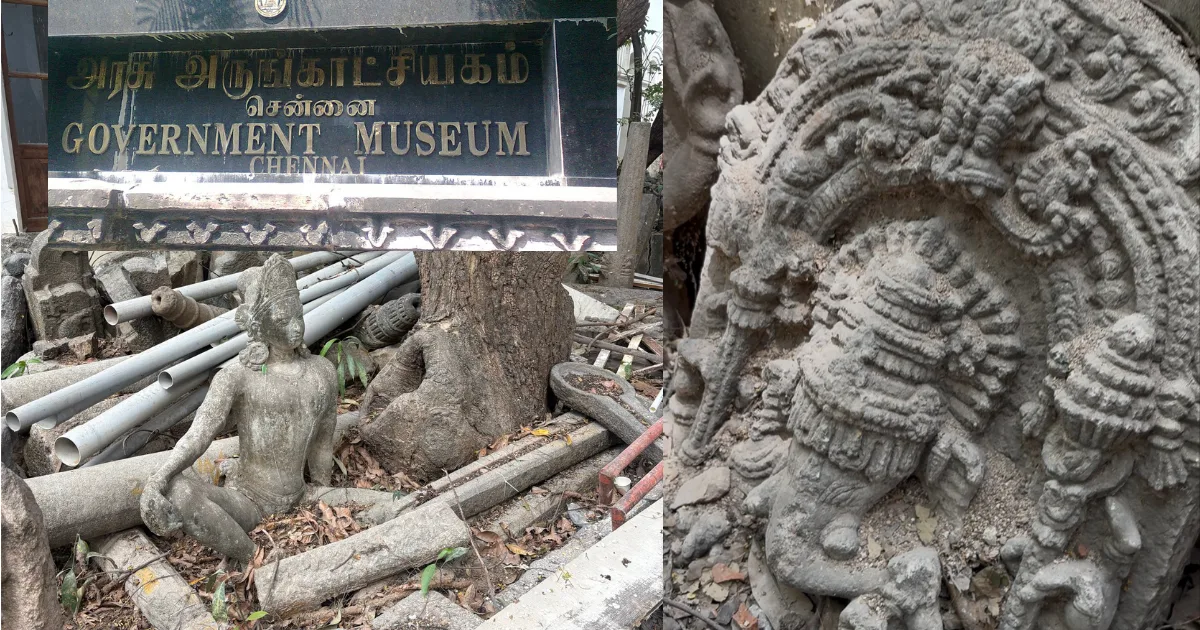
Once again, Chennai’s Government Museum in Egmore has come into public discourse after a video showing ancient idols and sculptures lying exposed in the open went viral on social media. The video has revived concerns over the condition of nearly 250 priceless artefacts dating from the Pallava and Vijayanagara periods, with heritage enthusiasts, archaeologists and art lovers questioning why the centuries-old treasures continue to remain vulnerable to rain, heat, moisture and pollution despite repeated appeals for their proper conservation.
About 250 ancient idols and sculptures dating back to the seventh century and excavated across Tamil Nadu are lying uncared for in a poor and pathetic condition due to official apathy and inadequate conservation measures at the Government Museum in Egmore.
As per reports, renovation works are ongoing at the museum heritage building on the premises. Officials at Egmore reportedly stated that the murthis belong to the Idol Wing department and that the museum has only provided the space, while the responsibility for their protection lies with the Tamil Nadu Idol Wing Police.
The museum is frequented by visitors and tourists from across the country as well as from foreign nations. Many who see these artefacts lying in the open yard have commented on their maintenance by the authorities concerned. It reflects poorly on both the officials and the government.
⚠️ DISASTER AT MADRAS MUSEUM! ⚠️
Priceless ancient artifacts dating back to the 3rd century & earlier are being treated like worthless junk. Rushed renovation work is happening directly on top of & around these irreplaceable treasures, leaving beautiful historical sculptures… pic.twitter.com/OXOwmSdXwn
— thirdmainroad (@thirdmainroad) June 8, 2026
It is noteworthy that at the museum, the colour and texture of a Pallava-era idol featuring an aesthetically designed female goddess had faded away as early as 2019 and no longer resembled its original form.
A fractured idol is placed alongside other vintage artefacts left to fend for themselves between rain and shine. The entire area presents a picture of total neglect.
Archaeology enthusiast R. Komagan, Chairman of the Gangaikonda Cholapuram Development Council, earlier told the media, “Artefacts kept in such conditions will get destroyed. Exposure to extreme sunshine, rain and pollution will have an adverse impact on them.”
The idols lying in the open date from the Pallava era of the 7th century to the Vijayanagara Empire of the 13th century.
These idols did not carry any description regarding their source, unlike those displayed inside the museum.
Officials had then stated that Rs 70 lakh had been allotted for creating a gallery to house these artefacts. This included creating natural creepers to provide cover for the figurines, along with improved lighting and better flooring.
These artefacts had been stolen from temples across the state and are valued for the priceless heritage of art and sculpture they embody in bronze, stone and wood.
However, several of them, seized by the Idol Wing police, continue to lie abandoned at the mercy of the elements.
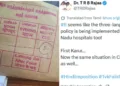
One visitor shared a message on social media stating: “Hi all, visited the Government Museum at Egmore today. I saw that there were a lot of stone sculptures and idols in a discarded state left out in the open outside the main building. Could see those by looking out of the windows (of the geology exhibit, I think). Many of them were marked idols with their code numbers and all, but just left in the open. Why is this happening, does anyone know? Shouldn’t the authorities store them at least in a locked storeroom?”
On the artefacts that are lying exposed, one observer aptly remarked: “What has been lived through and what has been lost or gained — through cracks, erosion and, in some cases, evolution in the weathered forms.” It is learnt that until last year (September), the condition remained unchanged.
The temple heritage of Tamil Nadu is renowned across the world for its rich cultural legacy, magnificent architecture and ancient murthies. However, successive governments have failed to adequately acknowledge and preserve this invaluable heritage.
Allowing such priceless artefacts to remain neglected and exposed amounts to a permanent abandonment of a significant part of the state’s cultural identity and glorious historical legacy.
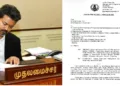
The issue of these neglected artefacts now serves as a test for the newly elected TVK government. Chief Minister C. Joseph Vijay’s administration faces a critical opportunity to demonstrate whether it will take meaningful steps to preserve and protect Tamil Nadu’s priceless heritage.
The earlier DMK government had openly declared its opposition to Sanatana Dharma, despite the fact that artefacts and history are inseparable from it. This was widely criticised as an anti-Hindu attitude.
DMK MLA Udhayanidhi Stalin reiterated anti-sanatana remarks in the Assembly. While the Chief Minister has neither endorsed nor condemned Udhayanidhi Stalin’s statement, the government’s response will be closely watched.
If the TVK government fails to act swiftly, it may be assumed that Joseph Vijay is following the same path in practice. Such silence could be perceived as a more dangerous strategy than the approach adopted by the previous regime.