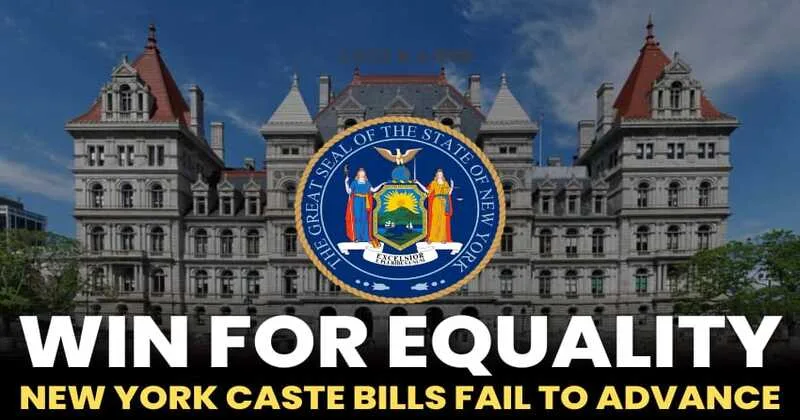
The controversial bill introduced in the New York legislative assembly which would have espoused discrimination & institutionalised bias against Hindus in the state has failed to advance. This is deemed as a major victory for the Hindu and Indian community in New York in the path of restoring equality. The two bills of New York aimed to specifically add caste as a protected category and was labelled as anti-discrimination law. However, this bill called as New York Senate Bill S.6531 and House Bill A.6920 would have categorically stereotyped Hindus and Indian-origin people living in the state.
The introduction of the loaded terms such as “caste” in the bill and coding caste as a protected category under New York’s Human Rights Law, would have systematically created inequality and would have institutionalised bias, specifically against Hindus and Indians in the state. Instead of advancing human rights and equality in the society these bills would have created systemic fragmentation in the society based on religion and ethnic classification. Thus, the bill would disproportionately single out Hindus as a separate entity.
A win for equality in New York!
The state legislative session has ended without movement on S.6531/A.6920 – bills that would have singled out and stereotyped Hindu and Indian Americans under the guise of social justice. As our press release explains, discrimination is already… pic.twitter.com/JiorLwVBMf
— CoHNA (Coalition of Hindus of North America) (@CoHNAOfficial) June 5, 2026
The impact of using terms such as “caste”, especially in laws & policies is humungous in American society. Even casual references to caste and talks surrounding the caste and ethnicity of a person or community creates fissure among the people and within the society. In such a scenario, if laws & people holding institutional power use the term “caste”, it has an intense negative consequence in the society. It leads to selective discrimination, targeting in New York. It will trigger strong statements against Hindus and Indian Americans in New York. On these lines, the Coalition of Hindus of North America(CoHNA) ran a fierce campaign against the bill for two years.
CoHNA urged the residents of New York to appeal to their respective Senators to vote against the bill that created discrimination in the society. CoHNA reiterated that caste is not a neutral term. It will trigger discrimination. Thus, instead of making caste as a “protected category”, the New York assembly and Senate should add terms such as “ancestry” in the Human Rights Law if it aspires to protect the rights of every community residing in the state. Instead, using the terms such as caste will only further complicate the issue by creating discrimination, and in-group, out-group attitude in the society, CoHNA explained.
CoHNS thus defined the defeat of the bill in the assembly as a “win for equality in New York”. “Bills would have singled out and stereotyped Hindu and Indian Americans under the guise of social justice. As our press release explains, discrimination is already prohibited under existing laws. There is no need for new religiously coded classifications that target any one group”, CoHNA wrote on its X social media platform. CoHNA highlighted how its grassroots volunteers, community members and Dalit Bahujan leaders, for two years, continuously strived to expose the flaws and fabricated claims in the bill.
“Importantly this includes the false allegations of caste-based discrimination at Hindu temples in the US!” the CoHNA statement further added. Sudha Jagannathan, Director of Government Relations at CoHNA said, “This is a win for advocacy and civil rights in the face of immense pressure from elite academics and activists with access to powerful media and political players. As a Bahujan Hindu myself, I have held many meetings with lawmakers in New York for the past two years to share my story and to educate. I find it offensive that New York State would try to weaponize my identity against my own culture and traditions that provide me solace and strength”.