Thiruvananthapuram: When the Mahamagha Kumbh Mela is about to take place in the land of Adi Shankara, how can we not talk about the economic and infrastructure growth engine that Kerala has missed out on?
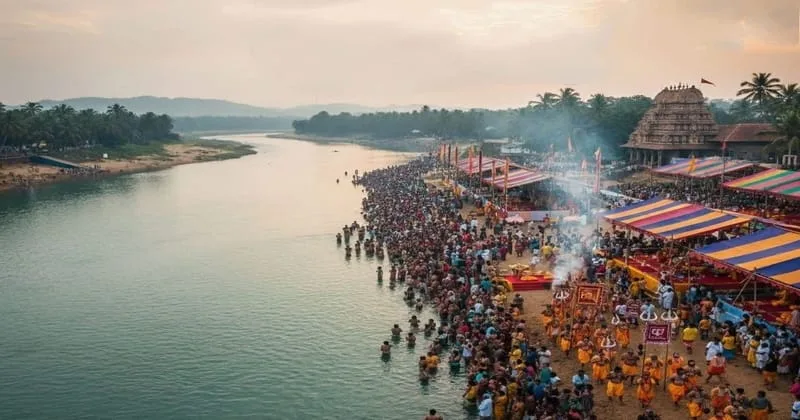
The Magha Kumbh, scheduled to be held from January 18 to February 3, 2026, on the holy banks of the Bharathapuzha in Thirunavaya, Malappuram District of Kerala, marks the beginning of a spiritual revolution in Kerala after 270 years. Kumbh Melas are symbols of India’s spiritual unity. The Mahamagha Kumbh Mela in Kerala is a great confluence that reconnects South India’s spiritual heritage with the national spiritual mainstream.
Kerala, the birthplace of Adi Shankaracharya, is the centre of the philosophical lineage that created the spiritual foundation of Kumbh Melas. Through the Dashanami Sanyasi tradition and the Amnaya Mathas, Shankara ensured the spiritual unity of India. For today’s Kerala, this gathering is a message of spiritual revival. The Kerala Mahamagha Kumbh Mela is not just a festival; it is a spiritual renaissance.
However, according to common logic, regarding the governing state government, this “Mahamagham” should have become an “anchor event” that simultaneously boosts the state’s tourism, infrastructure, employment, MSME trade, banking, real estate, and tax revenue alongside spiritual pilgrimage. But while a government lacking foresight lost this opportunity, the Uttar Pradesh government utilised it fully, and the Maharashtra government is already preparing for the Simhastha Kumbh Mela to be held in Nashik in 2027.
In reality, a combination of delayed permissions, stop-memos, administrative and legal hurdles, the alleged anti-Hindu stance of the CPIM-led government, and the silent non-cooperation of the Congress is causing Kerala to lose this historic opportunity. Ignoring the models right in front of our eyes is nothing short of an act against the people.
Rewinding Prayagraj Maha Kumbh Mela 2025
The Uttar Pradesh government built a Rs 2.8 lakh crore economy through one spiritual festival. The 2025 Prayagraj Maha Kumbh Mela in Uttar Pradesh became one of the largest human gatherings on the planet. Approximately 660 million (66 crore) pilgrims arrived from all over the world to take the holy dip.
The government investment for the 2025 Prayagraj Kumbh was Rs 7,500 crore. With this Rs 7,500 crore, they implemented roads, flyovers, underpasses, railway stations, airport upgrades, riverfronts, and lighting with precise planning.
Another Rs 1,500 crore provided by the Union Government was used for tent cities, sanitation, water, electricity, police, and health systems.
According to the Dun & Bradstreet report (Kumbhonomics 2025), here are some figures:
* Total: Rs 2.8 Lakh crore
* Direct Impact: Rs 90,000 crore
* Indirect Impact: Rs 80,000 crore
* Transaction Volume: Rs 1.1 lakh crore
For every Rs 1 invested by the Yogi government, Rs 35–Rs 40 returned to the UP economy as ROI (Return on Investment).
“Mahamagha”: The economic leap Kerala is losing (The Economic Ripple Effect)
For every Kumbh Mela, roads, riverfronts, sanitation, hotels, and transit hubs are built. For the next Kumbh, the same infrastructure is used at a lower cost to attract more pilgrims and provide facilities. Private investment, employment, taxes, and MSME trade grow as a multiplier of economic growth through each Kumbh Mela. This is the concept of Compounding Religious Tourism Assets and its ripple effect.
A comparison with Kerala’s main income source: Tourism
According to official statistics from the Kerala Tourism Department (average spending estimation):
* Total Tourist Spending in 2024 (Domestic + Foreign): Rs 45,053.61 crore
* Kerala’s GSDP (as per CAG report 2023–24 at current prices): Rs 11,46,108.67 crore
* Tourism contribution: 3.9 per cent of Kerala’s GSDP.
Sabarimala Pilgrimage — Kerala’s spiritual centre or the government’s money-minting machine
Sabarimala attracts millions of pilgrims globally every year and brings income to the state across all sectors. Taking the annual scale of Sabarimala pilgrims as a reference, let’s look at a projection of what would happen if the Kerala government properly organised the “Magha Kumbh Mela.”
Projection
(Note: This is not “audited revenue” released by the government; it is an economic projection based on average pilgrim spending + the tourism multiplier.)
The multiplier effect accounts for the ripple effect of accommodation, food, transport, trade, and services. Let’s first examine a conservative estimate based on Sabarimala.
Sabarimala Statistics
* Pilgrims: 4 crore
* Average Spending: Rs 3,000–Rs 5,000
* Total Economic Activity: Rs 30,000–Rs 50,000 crore
* This is nearly equal to (66 per cent) or exceeds (111 per cent) the total annual tourist spending in Kerala for 2024.
GSDP Impact
* An economic movement equivalent to 2.6 per cent to 4.36 per cent of the GSDP could be created in Kerala’s economy through one Magha festival.
* In other words, the economic benefit Kerala Tourism gains in an entire year could be achieved in just a few days.
Kerala Magha Kumbh Estimates (Projected Scenario)
* 1–2 crore Visitors
* Rs 2,500–Rs 5,000 Average Spending
* 2x Multiplier
* With 1 crore Visitors: Direct spending of Rs 25,000–Rs 50,000 crore results in an economic movement of Rs 50,000–Rs 1,00,000 Crore.
* With 2 crore Visitors: Direct spending of Rs 50,000–Rs 1,00,000 crore results in an economic movement of Rs 1,00,000–Rs 2,00,000 crore.
This means a single Mahamagha season could influence 4 per cent to 9 per cent of Kerala’s GSDP.
The Infrastructure Revolution Kerala Could Have Achieved
While it is understood that Kerala cannot match the scale of what CM Yogi Adityanath did in Prayagraj, even a scaled-down version would have brought an infrastructure revolution. At the very least, Kerala would have witnessed:
* 100+ km of roads, 10+ flyovers & underpasses.
* 2+ km of riverfronts and pilgrim ghats.
* 1000+ toilets, 50+ km of pipelines, STPs, and waste management.
* Tens of thousands of temporary tents and large hotel investments.
* CCTV, drones, field hospitals, and emergency services.
Associated Development Projects
* Establishment of a Thirunavaya–Ponnani–Kuttippuram–Tirur–Guruvayur Temple Corridor.
* A 4-lane Temple Corridor in Malappuram district (which PM Modi and Nitin Gadkari could have made possible).
* Parking and transit hubs.
* Bharathapuzha riverfront, ghats, walkways, and cruise rides.
* Permanent Thirunavaya tent cities/homestay networks and medical hubs.
These permanent facilities would remain in the region long after the Magha Mela concluded.
Tax and Fee Revenue
If economic activity worth approximately Rs 50,000 crore occurred:
* GST: Rs 4,000–Rs 6,000 crore.
* State Excise, Vehicle Tax, Tourism Cess, License Fees: Rs 2,000–Rs 3,000 crore would have reached the government treasury.
The money spent by the government on infrastructure development would be recovered through taxes within 2–3 years. Subsequent tolls or collections would be pure profit for the government.
Hotel and Homestay Boom
Demand for 10,000–20,000 beds would arise. Since 60–70 per cent of this follows the MSME homestay model, it would involve bank loans and investments. It is important to remember that this happens in the villages of Malabar, not in urban cities like Kochi or Thiruvananthapuram. Local bodies could have developed this into a total rural development model, if those in power were capable. The “stop memo” issued to a temporary bridge showed the true quality of local administration. This is a golden opportunity for young entrepreneurs, providing income for youth, jobs for women, and growth in bank loans and the construction sector.
Real Estate & Land Value Surge
The Bharathapuzha corridor, where the Kerala Kumbh Mela is held, would see a manifold increase in land prices, at least doubling. This would bring further revenue to the government through stamp duty and registration. Major hotels would bring branches to Malappuram.
Transportation and Logistics Income
Special trains, buses, boats, auto-rickshaws, taxis, and electric vehicles would be required. This would put Rs 1,000–Rs 2,000 crore into the pockets of local people in a single season.
Banking & Credit Boom
The demand for MSME loans for construction, homestays, hotels, and vehicles would create a new credit demand of Rs 10,000–Rs 20,000 crore in the Kerala financial market.
The Kerala Spiritual Brand
Alongside the “Beaches & Ayurveda” tag, Kerala would earn the title of “God’s Own Spiritual Capital.” Foreign tourists would spend more, and investments in wellness, yoga, and spiritual infrastructure would rise.
Political-Administrative Hurdles: Kerala’s perpetual curse
The spiritual apathy of the CPIM and the silent non-cooperation of the Congress are blocking Kerala’s Compounding Economic Engine. It is simply another version of scaring away investors by waving red flags. Ultimately, who loses? Only the Malayalis of Kerala!
Through excellent planning of the Prayagraj Kumbh Mela, Uttar Pradesh was able to build a Rs 2.8 lakh crore economy. Meanwhile, the Magha Kumbh in Kerala remains entangled in political and administrative knots. This is not just the loss of one festival; it is the loss of an economic future that could have flourished for decades, handed to us by the LDF-UDF politics of Kerala.