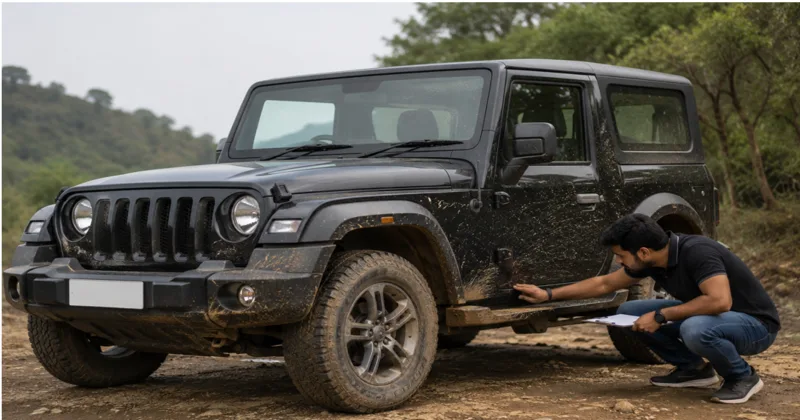
The Mahindra Thar is one of the most emotionally charged used car purchases you can make in India. The current generation, launched in late 2020, is a genuinely capable off-road vehicle wrapped in a lifestyle product’s clothing, and in the pre-owned market, it carries both the strongest resale premiums and the most context-dependent maintenance risks of almost any vehicle in its price band. How well it holds up in your hands depends enormously on how it was used in the hands of whoever owned it before you. If you are considering a used Mahindra Thar, the inspection process is more specific than for most second hand Mahindra cars because of what the 4×4 drivetrain can conceal from a casual look.
Let’s be clear about what the Thar is mechanically. The second-generation Thar uses a BorgWarner-sourced four-wheel-drive transfer case with a dedicated low-range mode, not a part-time traction system or an electronic torque-distribution system, but a proper mechanical 4Lo that multiplies torque for crawling over difficult terrain. The approach angle is 41.8 degrees, departure angle is 36.6 degrees, and the wading depth is rated at 650mm. These specifications are not marketing claims; they represent genuine engineering intent.
What Heavy Off-Road Use Does
And that’s exactly the issue. A Thar that’s been taken through riverbed crossings, loose shale, mud tracks, and sustained low-speed 4Lo operation has experienced stresses that a road-only vehicle simply hasn’t. The components most affected by serious off-road use are also the ones that are expensive to fix: the front and rear differentials, the transfer case, the wheel bearings, the CV joints, and the suspension arms and their bushings.
The Pre-Purchase Inspection Checklist
Since the manufacturer offers a wide range of SUVs, when inspecting second hand Mahindra cars like the Thar, start with the underbody. Get under the car and look for fresh scratches on the underbody protection plates, which, on a genuinely used off-roader, will have evidence of impact and scraping. That’s expected and not necessarily alarming. What is alarming is fresh welding on the frame, cracks in the underbody panels, or bent lower arms that suggest a hard impact. Any of these indicates the car has taken hits that go beyond normal off-road use.
Check the differential oil condition. If it smells burnt or the oil is dark and metallic, you can usually tell by pulling the differential fill plug and checking the drip, the diff has been run hard, possibly without timely oil changes. Differential oil on a Thar should be changed every 30,000 km or annually under normal use; off-road-intensive use warrants more frequent changes. If it hasn’t been done, the differential is wearing, and replacing a rear differential is not an inexpensive exercise.
The transfer case selector should move smoothly between 2H, 4H, and 4L. Any resistance, grinding, or failure to engage cleanly is a sign the transfer case needs attention. Similarly, the hub locks (on 4×4 variants) should engage and disengage cleanly, seized or reluctant hub locks are a common issue on units that have been used in wet conditions without periodic cycling.
Thar owners who used the vehicle primarily as a lifestyle vehicle, weekend drives, city use, occasional hill roads in 2H, will have a mechanically much cleaner example to sell than someone who has done actual trail riding. The visual cues of this difference are usually apparent: a trail-used Thar will show mud staining in the wheel wells and underbody, scuff marks on rock sliders if fitted, and wear on the soft-top hinges. None of these automatically mean the car is damaged, but they warrant the closer inspection described above.
Looking at a used Mahindra Thar on a certified platform gives you the advantage of an inspection that covers these specific points. Off-road vehicle inspections require familiarity with 4×4 systems, and not every generalist mechanic will check the transfer case engagement or the diff oil condition as standard.
Within the wider universe of second hand mahindra cars, the Thar commands the highest emotional premium and some of the strongest resale prices. A well-maintained, low-off-road-use example in the Rs 12-18 lakh used range can be excellent value. But buy in haste, particularly a particularly cheap one, and the cost of putting the running gear right can quickly erase any initial saving.
The tyres are another Thar-specific check. The factory fitment on most Thar variants is a Bridgestone Dueler or equivalent all-terrain tyre. If the car has been fitted with aggressive mud-terrain tyres as an aftermarket upgrade, ask where and when they were fitted and examine the tread wear pattern. Mismatched tyre wear across the axle indicates alignment issues that could be suspension-related. If the previous owner has fitted larger-than-OEM wheel and tyre combinations, verify that clearance hasn’t created rubbing against suspension components at full lock, which can cause accelerated wear on otherwise sound parts.
(Disclaimer: The views expressed by the author are personal and not of the publication)