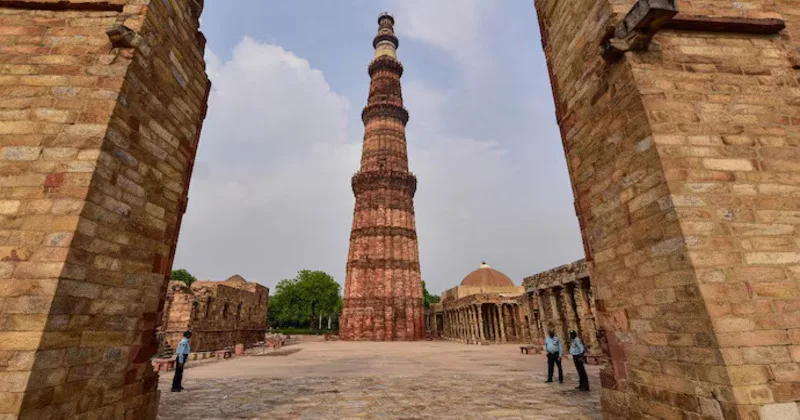
The Qutub complex in Delhi remains one of the most debated monuments in Indian history. While conventional history textbooks describe the Qutub Minar as a minaret begun by Qutb-ud-din Aibak in the late twelfth century and completed by his successors, an alternative interpretation has gained increasing attention in recent decades. According to several researchers, archaeologists and historians, the complex preserves unmistakable evidence of a pre-existing Hindu and Jain sacred landscape whose identity was transformed following the Islamic conquest of North India. The debate is not merely about architecture; it concerns memory, cultural continuity and the manner in which political power reshapes historical narratives.
Visitors walking through the Qutub complex immediately encounter architectural features that appear distinct from the conventions of early Islamic construction. The pillars lining the cloisters of the Quwwat-ul-Islam mosque are richly carved with floral motifs, bells, lotus designs, divine figures and ornamental patterns commonly associated with Hindu and Jain temples. These pillars do not resemble structures originally conceived for a mosque. Instead, they display the craftsmanship of temple builders whose artistic vocabulary had developed over centuries in the Indian subcontinent. Their presence has led many scholars to conclude that the earliest Islamic structures in the complex incorporated material taken from pre-existing temples.
One of the most frequently cited pieces of evidence comes from inscriptions associated with the Quwwat-ul-Islam mosque. Historical records and archaeological reports have referred to inscriptions indicating that material from numerous Hindu and Jain temples was used in the construction of the mosque. The Archaeological Survey of India and several historians have acknowledged the reuse of temple components within the complex. Even UNESCO’s description of the site notes that the mosque incorporated materials from earlier temples. Such admissions are significant because they demonstrate that the complex did not emerge upon an empty landscape but upon a space that already possessed religious and cultural importance.
The question that naturally follows is whether the builders merely reused abandoned materials or whether existing temples were dismantled during the process. This issue remains contentious. Some archaeologists and historians have argued that the evidence points toward the demolition of multiple Hindu and Jain temples and the incorporation of their remains into the newly established Islamic complex. Former ASI officials and archaeologists have publicly stated that temple remains are clearly visible throughout the site and that inscriptions refer to the use of materials obtained from numerous temples. The visible presence of sculpted deities, temple motifs, and fragments of sacred imagery strengthens the argument that the complex represents more than simple architectural recycling.
The Jain dimension of the debate is equally important. Several pillars and carvings within the complex exhibit characteristics associated with Jain artistic traditions. Images and motifs linked to Jain religious culture have been identified by researchers examining the site. This suggests that the area may once have accommodated both Hindu and Jain places of worship, reflecting the religious diversity of early medieval India. If this interpretation is accepted, the Qutub complex stands not merely upon the remains of a single shrine but upon a broader sacred precinct that served multiple communities.
The most striking symbol within the complex is the Iron Pillar. Predating the arrival of the Delhi Sultanate by many centuries, the pillar is generally associated with a Hindu context and is believed to have been erected during the Gupta period. Its survival within the complex serves as a reminder that the site possessed historical significance long before the establishment of Islamic rule in Delhi. For many observers, the presence of the Iron Pillar strengthens the argument that the area functioned as an important Hindu religious and cultural centre prior to the construction of the mosque and minar.
Supporters of the temple-origin theory also point to the broader historical context of the twelfth and thirteenth centuries. Across many regions conquered by invading armies, the construction of new political and religious monuments often involved the appropriation of earlier sacred spaces. Such actions were not unique to India; they occurred throughout the medieval world as conquering powers sought to establish legitimacy and visibly demonstrate their authority. The transformation of temples into mosques, visible in the Qutub complex appear consistent with a pattern of political conquest and symbolic domination.
The architectural evidence is difficult to ignore. Unlike structures designed from the ground up according to a unified plan, parts of the Qutub complex display an unusual combination of artistic traditions. Islamic arches and inscriptions coexist alongside pillars bearing unmistakably Indic iconography. The result is a monument that visually records a moment of transition in Indian history. Rather than erasing the earlier civilization completely, the builders incorporated elements of it into the new structure. Ironically, this act preserved evidence that continues to fuel historical inquiry centuries later.
However, caution is necessary when discussing the Qutub Minar itself. While the existence of reused temple material in the surrounding complex is widely acknowledged, historians continue to debate whether the Minar was originally conceived as a Hindu or Jain tower. The dominant academic position remains that the Minar was built under the Delhi Sultanate as a monumental tower associated with the Quwwat-ul-Islam mosque.
Nevertheless, the debate has encouraged renewed examination of India’s historical sources. For many years, discussions concerning temple destruction and the reuse of sacred architecture were often marginalized or treated as politically sensitive subjects. More recent scholarship has sought to investigate these questions directly through inscriptions, archaeology, and architectural analysis. Whether one ultimately agrees with the temple-origin theory or not, the physical remains at the site compel serious engagement with the historical realities of conquest, cultural interaction, and religious transformation.
The story of the Qutub complex therefore extends beyond a single monument. It reflects the layered nature of Indian civilization, where successive dynasties built upon the foundations of earlier eras. The carved pillars, fragmented idols, temple motifs, and ancient Iron Pillar all testify to a past that predates the Delhi Sultanate. At the same time, the mosque, inscriptions, and towering Minar speak to the arrival of a new political order.
What remains undeniable is that the site contains substantial evidence of earlier Hindu and Jain artistic and religious traditions. The incorporation of temple elements into the complex has been acknowledged by archaeological authorities and international heritage descriptions. These remnants challenge simplistic narratives and invite a more nuanced understanding of India’s past.
Whether viewed as a monument of conquest, adaptation, continuity or transformation, the Qutub complex stands today as one of the most important witnesses to the dramatic civilizational changes that unfolded in medieval India. Its stones preserve memories that neither time nor political controversy has been able to erase. The ongoing debate surrounding its origins is ultimately a reminder that history is not merely about monuments; it is about the identities, beliefs and cultural inheritances that those monuments continue to represent centuries after their creation.