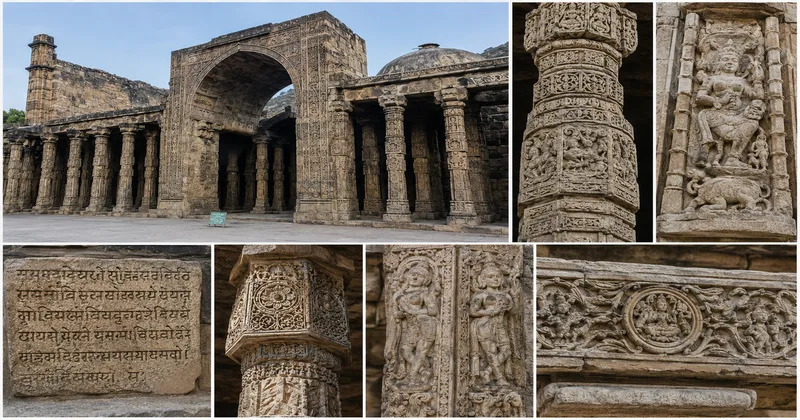
Among the many monuments that stand across India as mute witnesses to civilizational upheaval, few are as historically layered and symbolically significant as Adhai Din Ka Jhopra in Ajmer. Today, it is often introduced as one of the oldest surviving mosques in Rajasthan. Yet beneath its arches, carved pillars and weathered stone lies the unmistakable memory of a lost Hindu-Jain centre of learning — a Sanskrit college and temple complex that once embodied Ajmer’s intellectual and spiritual brilliance. Its story is not merely architectural; it is a chapter in India’s long history of cultural displacement, deliberate destruction, and contested memory.
The history of Adhai Din Ka Jhopra begins not with the Delhi Sultanate, but with the powerful Chauhan dynasty that ruled Ajmer in the 12th century. Historical and epigraphic evidence confirms that the site originally housed a Sanskrit educational institution commissioned by the Chauhan ruler Vigraharaja IV, also known as Visaladeva. Archaeological findings indicate that this was no ordinary structure. It functioned as a celebrated centre of learning where Sanskrit literature, philosophy, and sacred texts were studied. Attached to it stood a temple dedicated to Goddess Saraswati, the eternal symbol of wisdom and knowledge. The discovery of a Sanskrit inscription dated 1153 CE at the site strongly supports the existence of this scholastic complex long before Islamic occupation.
The significance of this institution becomes even clearer when examined through the findings of early archaeologists. Sir Alexander Cunningham, the founder of the Archaeological Survey of India, studied the monument extensively. In his reports, he concluded that the structure had unmistakably been built from the remains of demolished Hindu temples. He observed that the carved pillars contained iconography inconsistent with Islamic architecture, including depictions of Hindu deities and motifs associated with temple worship. Cunningham wrote that the mosque was “built of the spoils of many Hindu temples, thrown down by the bigotry of the conquerors”. This remains one of the most direct historical acknowledgements of the monument’s violent transformation.
The destruction came in the aftermath of one of medieval India’s most consequential defeats: the Second Battle of Tarain in 1192 CE, when Muhammad Ghori defeated Prithviraj Chauhan. Following this victory, Ajmer fell under Ghurid control. Historical records state that Qutb-ud-Din Aibak, acting under Ghori’s command, ordered the demolition or conversion of several existing Hindu structures. Adhai Din Ka Jhopra became one of the earliest and most prominent examples of this policy.
The site was repurposed into a mosque around 1199 CE and later embellished by Iltutmish in 1213 CE. The transformation was neither accidental nor merely adaptive reuse. It was a deliberate political act — one intended to assert conquest over both territory and civilizational memory. Across medieval conquest narratives, the conversion of temples into mosques served as a symbolic declaration of domination, replacing one sacred geography with another. Adhai Din Ka Jhopra exemplifies this historical pattern.
Even today, the monument’s architecture speaks louder than later historical labels. The surviving pillars, ornate corbels, lotus medallions, and sculptural fragments are unmistakably Indic in origin. The craftsmanship reflects temple aesthetics rather than Islamic design traditions. Experts note that many pillars were reused almost intact, preserving their original carvings despite attempts to adapt the structure for Islamic worship. The mosque façade, while bearing Quranic inscriptions added later, stands atop an older architectural grammar rooted in Hindu and Jain temple construction.
James Tod, the British historian who documented Rajasthan’s antiquities, described the structure as one of the finest examples of Hindu architectural genius. Though interpretations differ on whether the original structure was predominantly Jain or Hindu, there is broad scholarly agreement that it predated the mosque and functioned as a major scholastic-religious institution. This consensus is reinforced by inscriptions related to Sanskrit dramatic works such as Harikeli Nataka and Lalita Vigraharaja Nataka, both linked to the intellectual culture fostered under Vigraharaja IV.
The name “Adhai Din Ka Jhopra” itself carries layers of legend. Popular folklore claims the structure was converted into a mosque within two and a half days, hence the name. Historians regard this as unlikely, given the monument’s scale and complexity. Another explanation links the name to a later two-and-a-half-day fair held there during the Maratha period. Yet regardless of the origin of the name, what remains indisputable is the monument’s earlier identity as a centre of Sanskrit learning.
Why does this matter today? Because monuments are not merely stones; they are repositories of civilizational memory. Adhai Din Ka Jhopra forces India to confront uncomfortable historical truths about cultural destruction during medieval invasions. Acknowledging these truths is not about fostering present-day hostility. It is about historical honesty.
For centuries, India’s temple universities and pathshalas functioned as institutions where philosophy, astronomy, grammar, poetry and theology flourished. Their destruction represented not only religious aggression but an assault on knowledge systems. In this context, Adhai Din Ka Jhopra becomes more than a disputed monument — it becomes a symbol of interrupted intellectual continuity.
The monument today is preserved by the Archaeological Survey of India as a protected heritage structure. Visitors often admire its architectural beauty without being told the full story etched into its stones. Yet every surviving pillar whispers of a forgotten Sanskrit classroom, every carved motif recalls the shattered sanctum of Saraswati, and every weathered inscription reminds us of an India whose centres of learning were deliberately silenced.
Adhai Din Ka Jhopra belongs in any serious “Lost Temple” series because it represents the intersection of faith, scholarship, conquest, and memory. It reminds us that India’s civilizational wounds are often hidden in plain sight — not erased completely, but layered over, renamed and reframed.
To study Adhai Din Ka Jhopra is to look beyond the surface and listen carefully to history’s buried voice. And that voice tells us clearly: before it was a monument of conquest, it was a temple of knowledge.