The recent state assembly election results mark more than just another electoral milestone for the Bharatiya Janata Party. In West Bengal, the Bharatiya Janata Party won 207 of 294 seats, on a record voter turnout of nearly 93 per cent. In Assam, the BJP-led NDA secured a commanding majority, with the BJP alone taking 82 of 126. These were not mere electoral victories, but emphatic verdicts.
For political analysts, the numbers will fuel a thousand columns on caste arithmetic, alliance management and electoral strategy. Those readings have their place. But to grasp what actually happened in Bengal and Assam, one has to step back from the spreadsheet and look at the longer arc — the one that runs from a civilization that knew itself to one that is, at last, remembering itself.
For the BJP, West Bengal is not just a state victory; it is a civilizational homecoming. Bengal is the land of Bankim Chandra Chattopadhyay, Swami Vivekananda, Sri Aurobindo, Rabindranath Tagore and Dr. Syama Prasad Mookerjee. It is a land that has shaped India’s intellectual, spiritual and nationalist imagination. A BJP victory in West Bengal, therefore, carries a meaning far beyond electoral arithmetic. It is a historic moment in Bengal’s political landscape and a major expansion of the BJP’s national footprint.
Assam, on the other hand, demonstrates the power of continuity and governance. A third consecutive mandate is never accidental. It reflects public trust earned through delivery, political clarity, administrative resolve and cultural rootedness. Under the leadership of Himanta Biswa Sarma, Assam has become an important laboratory of decisive governance in the Northeast—combining welfare, infrastructure, identity, law and order, and regional integration. The BJP’s win there is a vote for stability, security and the promise of Viksit Assam within the larger mission of Viksit Bharat.
For the country, this consolidation matters because India is in the midst of a decisive transition. We are no longer debating whether India can rise; we are debating how quickly, how inclusively, and how confidently it can rise. A fragmented and short-term political imagination cannot build a $30+ trillion economy, secure borders, provide world-class infrastructure, foster cultural self-belief, and sustain social harmony at the same time. That requires continuity of vision, execution discipline, an organizing principle larger than transactional politics, and a political force capable of translating national aspirations into governance outcomes.
This is where the BJP’s distinctiveness lies. It is the only major national party in India that is explicitly anchored in ethos, ideals and culture. The BJP’s own articulation of its philosophy emphasizes a national approach, integral humanism, Antyodaya, Atmanirbharta, Sabka Saath Sabka Vikas, and the ‘dharma’ of “Nation First”.
The word “dharma” is important here—not in a narrow sectarian sense, but in its deeper Indic meaning: duty, order, responsibility, justice, balance, and national purpose. The BJP’s core political philosophy is that the nation comes first, and that governance must serve the people of Bharat. This is why its appeal extends beyond immediate schemes or electoral calculations. It offers voters a sense of participation in a larger national mission.
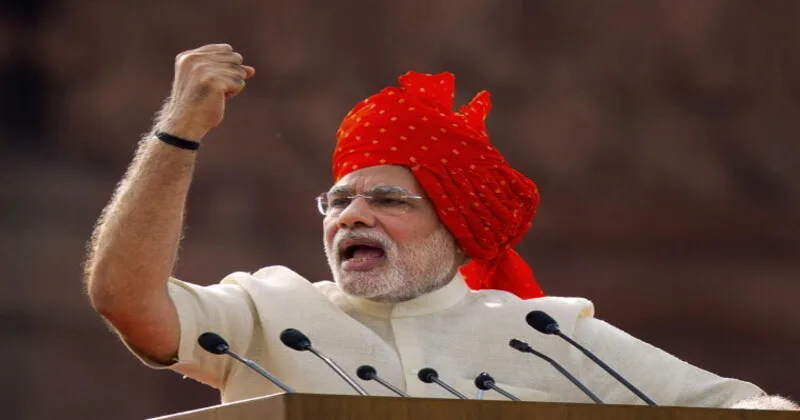
This is also why the BJP’s electoral success must be understood as more than a political wave. It is the expression of an ideological project: to harmonize development with dignity, welfare with empowerment, technology with tradition and nationalism with service. Under Prime Minister Narendra Modi, this philosophy has found contemporary expression through Jan Dhan, Ujjwala, Ayushman Bharat, PM Awas, Digital India, Make in India, Startup India, infrastructure expansion, national security, cultural rejuvenation and the overarching vision of Viksit Bharat.
Bharat has been here before, and the historical analogy is instructive. Bharat has seen great pan-Indian polities before, based on a clear ‘dharma’—the Mauryas, Guptas, Cholas, and Marathas among them. Their greatness did not rest merely on military power. The Mauryas built administrative scale and strategic unity. The Guptas presided over a period of knowledge, art, science and civilizational flourishing.
The Cholas combined maritime confidence, temple-based social organization, trade networks and cultural expansion. And then, when most of the subcontinent was under foreign sword, it was the Marathas under Chhatrapati Shivaji Maharaj who lit the lamp again. Hindavi Swarajya — self-rule rooted in dharma — was not a slogan. It was a constitutional principle.
The analogy is not that modern democratic India should replicate ancient kingdoms. The analogy is one of purpose. The great kingdoms of Bharat endured in memory because they were anchored in something larger than power. They saw governance as a duty; a belief that power exists to protect, maintain order, promote prosperity, uphold justice and preserve civilizational purpose. They built institutions, encouraged enterprise, protected sacred geography, expanded trade, strengthened administration and infused governance with meaning.
The BJP’s political consolidation, especially under Prime Minister Narendra Modi, must be understood in this broader frame. BJP under PM Modi has built an electoral machine, yes—but more importantly, it has built a political imagination. It has made development aspirational, nationalism mainstream, welfare delivery technologically precise and civilizational pride respectable again. It has created a bridge between the ancient and the modern, between Ram Mandir and Digital India, between Kashi Vishwanath Corridor and semiconductor missions, between Ujjwala cylinders and space missions, between border security and startup ambition.
What comes next for the BJP is crucial. The dharmic kingdoms of Bharat were not great because they were powerful; they were powerful because they were great. What lies ahead for the BJP is the harder work: converting electoral consolidation into civilizational consolidation to develop Bharat and benefit its people.
The party’s next phase must be about reinforcing that BJP governments deliver faster, cleaner, fairer and more future-ready governance. The BJP must also deepen its outreach to farmers, MSMEs, traders, startups, professionals, women entrepreneurs and youth. The opposition will interpret these results narrowly. Some will call it polarization; others will call it organizational dominance. But the voters seem to be quietly expressing something deeper.
They are voting for security, delivery, dignity, identity and aspiration. They are voting for a politics that does not apologize for Bharat. They are voting for a party that speaks the language of both heritage and highways, both temples and technology, both welfare and wealth creation. That is what makes the BJP different. Only the BJP has visibly and demonstrably presented an idea of India that is Indian. The task ahead is enormous. The responsibility is even greater. To build Viksit Bharat by 2047.