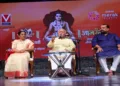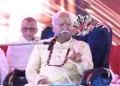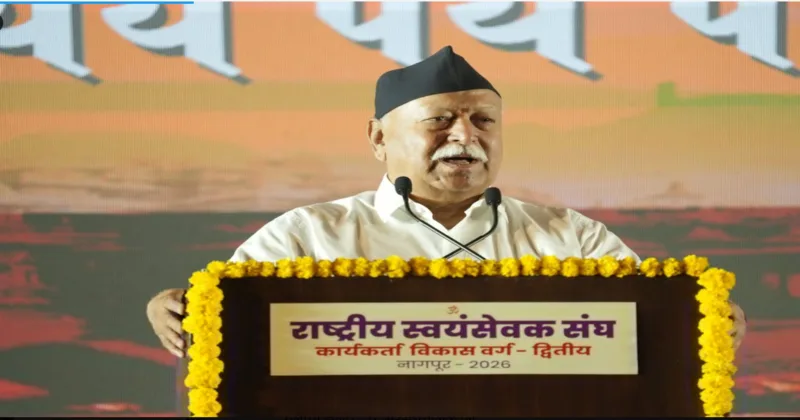
NAGPUR: “The time of Bharat has arrived, we need to expedite our preparation. The responsibility now lies with society to prepare itself and ensure that this opportunity is fully realised,” said Dr Mohan Bhagwat, Sarsanghchalak of the Rashtriya Swayamsevak Sangh (RSS), while addressing the valedictory function of Karyakarta Vikas Varg-Dwitiya at Reshimbagh, Nagpur, on June 4, 2026.
Referring to the significance of the RSS centenary year, Dr Bhagwat noted that the organisation has completed two-thirds of its year-long centenary programmes and that various activities will continue until Vijayadashami. He highlighted the extensive outreach campaign undertaken across the country during this period, through which Swayamsevaks engaged directly with people from different sections of society. According to him, these interactions have helped build stronger social connections and have generated a positive response among citizens.
He observed that one important sentiment is becoming increasingly visible across society today: a growing conviction that Bharat must move forward and that every citizen has a role to play in that journey. He said that this mindset, which was once limited to smaller sections of society, is now spreading more widely among ordinary people. The desire to contribute to national progress and participate in the country’s development is becoming stronger, and the effects of this change are beginning to manifest in different spheres of public life.
Discussing the broader social atmosphere, Dr Bhagwat remarked that the awakening of Hindu society is becoming increasingly visible. He stated that the Hindu society, which bears the responsibility of safeguarding and advancing Bharat’s civilisational ethos, is becoming more conscious of its duties. This awakening, he argued, is not confined to any single region or sector but is producing visible outcomes in multiple areas of national life.
At the same time, he cautioned that Bharat is operating in a complex global environment. He pointed out that many countries today are affected by developments far beyond their borders. Conflicts occurring in one part of the world have economic consequences elsewhere. “We see that powerful countries often act as they wish. They may take over a country, bomb it, or even stop the world’s oil supply. Let the idea about Bharat be that, even when it becomes powerful, it will not do such things; rather, it will carry everyone together and move ahead,” he said.
Dr Bhagwat observed that people often focus primarily on difficulties because human nature tends to notice negative developments more readily than positive ones. He argued that nations that successfully navigate periods of uncertainty are those that maintain confidence in their own capabilities and continue preparing for the future despite immediate obstacles.
He stressed that preparedness is the key to overcoming adverse circumstances. Those who remain focused on their long-term objectives rather than becoming overwhelmed by temporary difficulties are best positioned to shape the future.
Turning to the larger civilisational role of Bharat, Dr Bhagwat argued that the world today faces several intellectual and moral dilemmas for which it has yet to find satisfactory answers. He explained that contemporary models often create conflict between individual freedom and collective welfare. Excessive emphasis on individual rights can weaken social cohesion, while excessive emphasis on collective interests can suppress individual liberty. Similarly, rapid material development may come at the expense of environmental sustainability, while strict environmental restrictions may impede economic growth.
According to Dr Bhagwat, Bharatiya civilisational thought offers a framework capable of harmonising these apparently conflicting goals. He stated that Bharatiya philosophy seeks balance rather than exclusivity. It does not view the individual, society, nature, and spirituality as competing domains but as interconnected dimensions of life. The ability to maintain harmony among these dimensions, he suggested, represents one of Bharat’s most important contributions to global thought.
He further observed that Bharatiya tradition has long recognised the legitimacy of material prosperity and human aspirations while simultaneously emphasising higher moral and spiritual goals. The challenge lies not in choosing one dimension over another but in ensuring that all dimensions develop in a balanced manner.
Dr Bhagwat recalled that Bharat was once among the world’s foremost centres of knowledge, prosperity, science, philosophy, and culture. He noted that many streams of intellectual and scientific thought that later spread across the world had deep roots in the Bharatiya civilisational tradition. Disciplines such as mathematics, Ayurveda, philosophy, and various branches of knowledge flourished in Bharat and contributed significantly to global civilisation.
He then posed a critical question: if Bharat possessed such strengths, how did it endure centuries of foreign domination? According to him, the answer lies not in the superiority of those who ruled over Bharat but in the gradual weakening of society’s preparedness and collective consciousness. External forces succeeded because internal strength diminished. Therefore, the most important task before contemporary Bharat is to rebuild that preparedness and restore social confidence.
Dr Bhagwat emphasised that efforts towards the awakening of Hindu society have been underway for many generations. He acknowledged the contributions of sants, reformers, thinkers, and national leaders who worked to revive cultural confidence and social cohesion long before the establishment of the RSS. The Sangh, he said, developed a practical method through which people belonging to different linguistic, regional, social, and sectarian backgrounds could come together while preserving their distinct identities.
He stressed that unity does not require uniformity. Bharat’s diversity is a source of strength, but that diversity must be bound together by a shared sense of belonging and responsibility. Individuals should develop a deep conviction that the nation, society, culture, and civilisation are their own and that they have a duty to contribute to their preservation and advancement.
Dr Bhagwat stated that every individual’s achievements are made possible by the contributions of society, culture, nature, and previous generations. Therefore, people have an obligation to give back rather than merely consume the benefits provided by others.
He explained that Bharatiya tradition teaches human beings to view themselves as part of a larger whole rather than as isolated individuals. This perspective fosters respect for nature, society, and all forms of life. The reverence shown towards rivers, plants, animals, and natural resources reflects a broader worldview rooted in gratitude and interconnectedness. Such values, he suggested, have enabled Bharatiya civilisation to sustain itself through centuries of change.
Addressing the role of the RSS, Dr Bhagwat explained that the organisation’s primary objective has always been the development of dedicated individuals capable of serving society selflessly. He stated that national transformation ultimately depends on human beings who possess discipline, integrity, commitment, and a clear understanding of their responsibilities. Building such individuals is a long-term process requiring patience, training, and continuous effort. It was this understanding, he said, that inspired RSS founder Dr KB Hedgewar to establish the organisation.
Dr Bhagwat noted that Dr Hedgewar had actively participated in numerous social and national movements before arriving at the conclusion that society required a continuous process of character-building. While many organisations worked in specific fields, there remained a need for an institution dedicated to developing individuals who could contribute effectively in every sphere of national life. The RSS emerged from this insight.
He remarked that the work of preparing dedicated karyakartas is inherently gradual. Significant time must be invested in each individual, and results often become visible only after years of effort. Nevertheless, he argued that such work remains indispensable because the strength of society ultimately depends upon the quality of its people.
Dr Bhagwat further clarified that the RSS does not seek recognition or credit for itself. The objective, he said, is not organisational expansion for its own sake but the strengthening of society. If society becomes capable, united, and self-confident, the larger purpose is fulfilled regardless of whether the organisation receives public recognition.
He described Dharma as the principle that harmonises different aspects of life. “A country becomes truly great when the world starts needing it. India is a dharma-centric nation, and it will rise to greatness to guide the world in matters of dharma,” he said.
While ideals and values are important, he observed that the world often pays attention only to those who possess the capability to act. Nations lacking strength frequently find themselves vulnerable to external pressures, while powerful nations are able to shape international developments. Therefore, Bharat must become both prosperous and powerful. The purpose of national strength, he said, is not to impose one’s will on others but to contribute positively to the welfare of humanity. A strong Bharat should become a source of stability, cooperation, and guidance rather than coercion.
Dr Bhagwat argued that Bharat has an opportunity to demonstrate how modern development can coexist with civilisational values, social harmony, and environmental responsibility. By successfully building itself according to its own principles, Bharat can offer a meaningful example to the world.
He connected this vision to the ideal of Vasudhaiva Kutumbakam. “Let the whole world see that the foundation on which Bharat has been built rests on the ideals of “Vishwa Bandhutva” (global brotherhood) and “Vasudhaiva Kutumbakam” – the belief that the whole world is one family. Only then will nations shape themselves in harmony with their own nature, building relationships based on mutual friendship and respect,” he exhorted.
Dr Bhagwat observed that Bharatiyas are already excelling across diverse fields both within the country and abroad. The challenge, therefore, is not a lack of talent but the need to channel that talent towards larger national and civilisational objectives. Although the activities conducted in such camps may appear simple to outside observers, their purpose is to foster discipline, teamwork, selflessness, and a sense of responsibility. Their true significance, he said, can only be understood through direct experience. “Other supply chains can be rectified but this supply chain of quality human beings should not break,” he expressed.
Calling upon citizens to participate actively in nation-building, Dr Bhagwat urged people not to remain passive observers, “Dont be a mute spectator, be part of the Sangh.” He encouraged them to understand the Sangh’s work, contribute to social service activities, and engage constructively in efforts that strengthen society.
Concluding his address, Dr Bhagwat expressed confidence that Bharat possesses the capacity to fulfil its historic mission. If society develops a clear understanding of its identity, transcends divisions, and works collectively for national and global welfare, he said, the vision articulated by Swami Vivekananda that Bharat would once again rise to a position of moral and spiritual leadership, offering peace, confidence, and guidance to humanity, can become a reality.
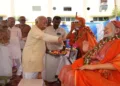
Kumar Mangalam Birla graced the event as the Chief Guest. Maharaja Gaj Singh of the erstwhile Marwar Royal Family, Jodhpur; Pujya Shri Yogi Bhavnath Ji Maharaj, Mahant of Ravinath Kunj Ashram, Jaipur, Nath Sampradaya; Padma Shri Bharat Bhushan Tyagi, renowned farmer; Shri Gopalbhai Gorasiya, businessman; Advocate Divyam Tyagi; and Shri Bhagwanbhai from Gujarat and many other eminent dignitaries attended the programme.