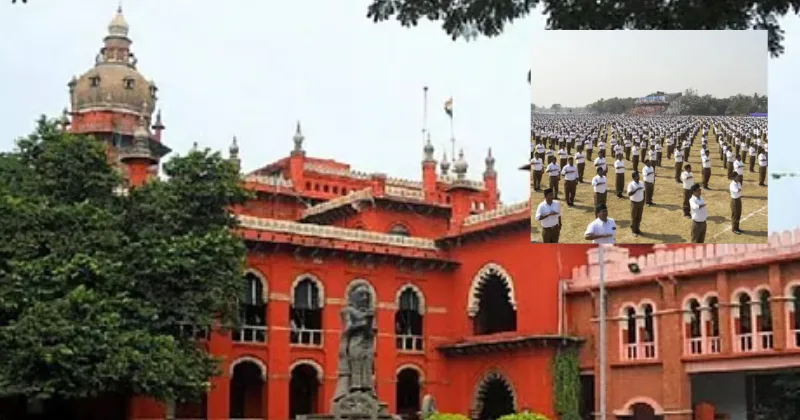
The Madras High Court has quashed criminal proceedings against 15 RSS members who were booked for allegedly conducting a Vijayadasami and RSS centenary celebration without prior permission in Ambur town of Tirupattur district, observing that the prosecution had failed to show that the gathering caused any real disturbance to the public.
Justice M. Nirmal Kumar passed the order while allowing a petition filed by RSS members led by V. Jayapal and others, who had sought to quash the proceedings pending before the Additional District Munsif-cum-Judicial Magistrate Court, Ambur.
The petitioners were represented by advocate D. Vijaya Babu, while the State was represented by Additional Public Prosecutor Leonard Arul Joseph Selvam.
Case Details:
According to the police, on October 2, 2025, RSS members gathered in Ambur carrying RSS flags to celebrate Vijayadasami and the organisation’s 100th year celebrations. The complaint alleged that the event was held without permission and caused inconvenience to the public and disruption to traffic.
The complaint was lodged by M. Dinakaran, the Village Administrative Officer (VAO), following which Ambur Town Police registered a case under various provisions of the Bharatiya Nyaya Sanhita (BNS).
Counsel for the RSS members argued that the case was based entirely on official witnesses and lacked support from any independent member of the public. The prosecution had listed only four witnesses:
The Village Administrative Officer (complainant)
Two Village Assistants
The Investigating Officer
The petitioners contended that no independent eyewitnesses had been examined and that there was no material to show that any member of the public had been affected by the gathering.
Arguments of the case:
The petitioners further pointed out that the final report was filed on October 9, 2025, merely nine days after the complaint was registered.
According to them, this indicated that the investigation had been completed in haste without proper inquiry.
They also submitted that there was nothing on record to show that any prohibitory order was in force on the date of the event or that such an order had been communicated in the prescribed manner.
In the order, dated on April 28, 2026, the Justice Nirmal Kumar further observed that merely gathering in a group cannot automatically be treated as a criminal offence. The prosecution had not produced material showing that any prohibitory order was in force, that it had been communicated to the public, or that the accused had wilfully disobeyed it.
The Court further observed that the allegations in the final report were general in nature and that no specific allegations had been made against the petitioners to attract the provisions under which they had been charged. The judge remarked that unlawful assembly by itself would not amount to the commission of an offence.
Justice Nirmal Kumar also noted that the occurrence was alleged to have taken place in a public place and in public view. However, no public or independent witness had been examined by the prosecution.
The Court said this raised serious doubts regarding the veracity of the complaint. The order further recorded that there was no material to show that any prohibitory order had been promulgated and communicated to the public or that the petitioners had disobeyed such an order.
Referring to the earlier Jeevanandham judgment of the Madras High Court, the judge reiterated that the right to protest and assemble peacefully is a democratic right that must be protected. He noted that police authorities had failed to follow the guidelines laid down in that landmark ruling while registering and investigating the case.
The Court also found no evidence that the gathering had led to any law-and-order problem, traffic disruption, or public disorder as claimed by the prosecution.
Holding that the continuation of the trial under Sections 189(3), 223, 126(2) and 293 of the Bharatiya Nyaya Sanhita, 2023, was wholly unsustainable and amounted to an abuse of the process of law, the High Court quashed the proceedings against all the petitioners and closed the connected petitions.
The Ambur case is not an isolated one. For the last several decades, RSS programmes in Tamil Nadu, particularly Vijayadasami route marches and public gatherings, have frequently been the subject of litigation. RSS was compelled to move the Madras High Court repeatedly after permissions were denied or restricted on law-and-order grounds by parties like DMK in power and its eco-system.
The courts subsequently granted permission in numerous cases, often imposing safeguards and conditions, while observing that constitutional rights of assembly and expression could not be curtailed on the basis of general apprehensions.
Critics argue that such repeated police action creates a perception among the public that association with the RSS may lead to legal complications, thereby discouraging engagement with the Sangh’s ideology and activities.