Women are traditionally associated with nurturing, giving life and protection. It is for this very reason that nations use female allegories to represent the country as a mother figure. A mother figure who nurtures and protects its people.
In Greek mythology, Athena was considered as the goddess of wisdom and strategy. She was considered the patron goddess of Athens, the city to which she gave her name. Apart from Athena, the Greek goddess Nike, the goddess of victory also found a prominent place in Greek history and mythology. Alexander used Nike as a symbol of state power and military success on his coins. Her image continues to inspire modern symbols of achievement, including the design of the original FIFA World Cup trophy and the design of the Olympic medals even today.
Apart from ancient Greece, the French Republic has Marianne, a female figure representing liberty and reason. Britannia has long been the national personification of Great Britain. In the United States, the Statue of Liberty is a female colossus symbolizing freedom and democracy. Lady Justice representing the moral authority of judicial system is derived from figures like the Greek goddess Themis and the Roman goddess Justitia.
Allegorical figures help invoke emotional connection and patriotism among citizens by personifying the nation’s values and identity through familiar imagery. In many languages and cultures, countries are referred to using feminine pronouns. This is most probably because personification of countries based on a female figure appears to be more natural and organic.
In India after the uprising of 1857, the notion of India as a ‘single nation state’ rather than a collection of states emerged. It is subsequent to this that the idea of Bharat Mata as an icon of the Indian nation state arose. The first time we hear of a ‘National Mother’ is in a Bengali play written by Kiran Chandra Banerjee in 1873 wherein he mentioned ‘Bharat Mata’ in his play ‘Bharat Janani’, which further popularized this idea.
The play dealt with the Bengal famine in the 18th Century and showed how people were motivated by a goddess to rise in rebellion against the East India Company. In 1882, the theme of the sanyasi rebellion against the British emerges once again in the novel Anandamath by Bankim Chandra Chattopadhyay. He introduces the concept of Vande Mataram or salutation to the Mother. The Mother is personification of the nation, however, the nation in this depiction is Bengal, not Bharat.
Though Raja Ravi Varma created a painting of India as a mother goddess in 1898 prior to Abanindranath Tagore’s iconic version of Bharat Mata encapsulating both the deity of India and the imperial power of Britannia, it is the version of Abanindranath Tagore, Rabindranath Tagore’s nephew, of Bharat Mata in 1905 that remains popular. Over the years many artists have unleashed their powers of imagination to showcase their own versions of Bharat Mata.
Amritha Shergill’s depiction of Bharat Mata is as a poor rural Indian woman with an infant son on her lap and a young daughter by her side, gazing directly at the viewer. Around the late 1920s or early 1930s, Roop Kishore Kapoor rendered his take on Bharat Mata. Published in 1931 as a lithograph, it depicts Bharat Mata arising from a partially visible map of India, including British Burma.
In his work, Kapoor transforms India into a prosperous, industrious landscape-farmers working the land, boats plying the coasts, a train traversing the east, lofty mansions and temples dotting the terrain. With her body seamlessly merging into the mapped geography, the four-armed Bharat Mata figuratively emerges from the land, towering over the busy landscapes.
Post independence, M. L. Sharma painted his rendition of Bharat Mata in which she appears as a young woman in an ornamental bodice, her hair blowing against a background halo suggesting the dawning sun. She boldly rides a chariot pulled by two fierce lions, the newly authorized Indian flag fluttering above within the glowing aura. The entire ensemble sits atop a purple globe outlined with the map of India. Scripted across the map in Devanagari is the Swadeshi movement slogan “Vande Mataram”.
Sardar Sobha Singh’s Bharat Mata depicts the mother figure with a divine halo, wearing a sari draped in Roman fashion. The picture shows Bharat Mata stroking the mane of a fierce lion as it snarls at an overturned British Crown. In the backdrop, the Ashoka Pillar can be seen rising.
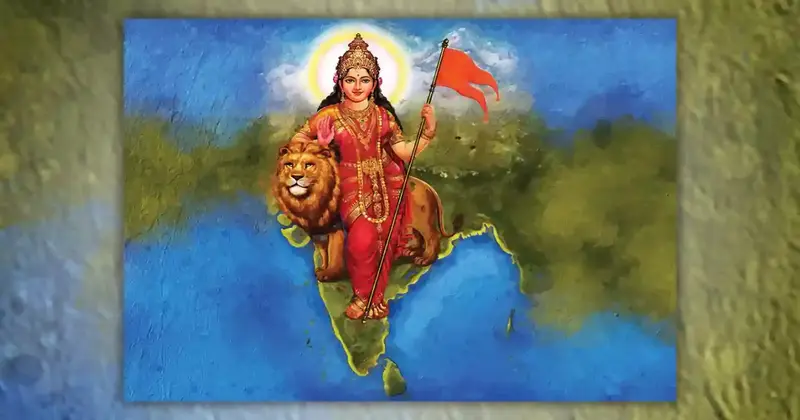
The acclaimed artist and painter Jivaji Bhikaji Dixit ‘s allegorical representation of Bharat Mata embodied the nation’s spiritual ethos. Dixit depicted Bharat Mata as a four-armed Goddess occupying the map of India. On her left stands a lion, an emblem of power.
In 2005, a century after Abanindranath Tagore first painted Bharat Mata in his new “wash” style in 1905, M.F. Husain rendered his own provocative modernist nude version. The painting depicts the sun rising over the serrated Himalayas and a svelte woman’s torso and limbs whimsically outline India’s map. The spokes of the national flag’s wheel mark the heartland.
Her body was inscribed in English important cities and places: Cochin, Chennai, Bangalore, Goa, Hyderabad, Goa, Kolkata, Mumbai, Jaipur, Varanasi, Delhi and Srinagar. Two other names appear, Gujarat and Bhopal. The woman is painted in deep red and saffron shades. Over the Bay of Bengal, an outline of a man is shown meditating and on the Arabian Sea, a ship is seen sailing.
The iconic personification of India as Bharat Mata has been reimagined by artists across the decades to channel the spirit of the times. From Abanindranath Tagore’s graceful Bengal school style to Amrita Shergill’s emotion-laden peasant mother, the visualizations have evolved with India’s self-perception. In a 1962 print, the broken column of the lion capital is surrounded by a pack of guardian lions of the goddess protecting the border in a nation at war with China. Sumathi Ramaswamy, in her book, The Goddess and the Nation: Mapping Mother India, talks about this powerful blending of the “scientific-geographic” and the “anthropomorphic-sacred” in the visualisation of the country.
Despite each artist having imprinted their unique vision onto the allegorical mother figure, we find that certain motifs persist-the ubiquitous presence of saffron evoking spirituality, the map integrating nationhood, and the lion symbolizing strength and sovereignty.
As India underwent pivotal milestones from the Swadeshi movement to Independence to becoming a Republic, artists responded by portraying Bharat Mata as increasingly powerful yet always nurturing. This remarkable lineage of paintings demonstrates how creative minds mutually reinforce both art and nationhood.
Apart from the allegoric representation, the slogan “Bharat Mata Ki Jai” also became popular during the freedom struggle. Azimullah Khan, one of the main architects of the Revolt of 1857, coined the slogan ‘Madre Watan, Bharat Ki Jai’ (Mother of the nation, victory to India), which later came to be known as ‘Bharat Mata Ki Jai’.
In terms of calendar art, one of the most well-known renditions of Bharat Mata in pre-independence India became one in which freedom fighter, Bhagat Singh, was shown to be offering his head to the personified nationalistic goddess. The first calendar image of Singh with Bharat Mata was printed in 1931 after which, his popularity among the Indian masses made the print mainstream.
From a reading of the various literature on the topic, it is clear that the idea of India as “Bharat Mata” was a central and formative concept in the philosophy of modern Indian nationalism and the concept of patriotism was reinforced during freedom struggle through all artistic forms including poetry, songs, essays as well as visual art representation of Bharat Mata.
A close look at the origin and subsequent evolution therefore shows that the picture of Bharat Mata reflects a cultural metaphor that emerged during India’s anti-colonial struggle and has persisted as a symbolic representation of the Indian nation.
One of the reasons Bharat Mata remains relevant is that its interpretation has evolved. Artists, activists and communities have adapted the image to reflect changing political and social contexts. Modern depictions sometimes place Bharat Mata amidst representations of farmers, soldiers, scientists or children, emphasizing collective progress. Others depict her alongside maps, landscapes or cultural motifs from across India showcasing it as a flexible cultural symbol capable of absorbing new meanings.
For India, secularism has never meant the exclusion of cultural symbolism. Instead, it stands for equal respect for diverse faiths and freedom of interpretation. Cultural metaphors, patriotic songs or artistic idioms are not inherently anti-secular unless enforced as mandatory expressions of religious loyalty.
The picture of Bharat Mata, when viewed as a representation of the nation, aligns with this inclusive understanding. It does not compel worship or prescribe a religious ritual. Rather, it offers an artistic embodiment of national identity.
Critics sometimes argue that the saffron colour or the feminine divinity-like form associates the image with one particular religious tradition. Yet these elements have broader cultural meanings in India. Saffron has historically symbolized renunciation, courage and sacrifice across various communities. Similarly, the mother metaphor—’Dharti Maa’/ ‘Janmabhoomi’—appears in many Indian languages and cultures, independent of specific religious iconography.
Therefore, interpreting Bharat Mata exclusively through a narrow religious lens overlooks the layered and diverse ways in which Indian culture uses metaphor and symbolism.
While the allegorical representation of Bharat Mata was a powerful symbol during the freedom struggle, the question is – what is the relevance of the allegory of Bharat Mata in post-independence era? Though there was no official adoption of Bharat Mata as an allegorical figure when India became a republic, an analysis of the Constituent Assembly debates show that the sentiment behind “Bharat Mata” was evident during the debates regarding Article 1 of the Constitution, which deals with the name of the country.
Several members advocated for the name “Bharat” instead of “India” (or along with it) on the grounds that it was deeply rooted in India’s ancient history and culture. Members like Seth Govind Das expressed pleasure at the inclusion of “Bharat” and specifically mentioned the freedom struggle slogan: “Bharat Mata Ki Jai”, linking the name directly to the emotional and patriotic fervour the allegory inspired.
Post-independence, therefore, though there is no official adoption of Bharat Mata as an official allegorical figure, neither is there a constitutional or statutory bar on displaying such culturally significant symbols. The State Emblem of India (Prohibition of Improper Use) Act, 2005; governs the misuse of the national emblem but does not prohibit symbolic or poetic representations of the nation.
The principle of secularism, as enshrined in the Indian Constitution, mandates the State to maintain neutrality in matters of religion and to ensure that no citizen is discriminated against on religious grounds. In S.R. Bommai v. Union of India, the Supreme Court held that secularism is a positive concept of equal treatment of all religions and not mere ‘non-involvement’. The Court further observed that “religion and culture are not mutually exclusive in the Indian context” and that the State can recognize and support cultural expressions that strengthen national integration.
Similarly, in M. Ismail Faruqui v. Union of India, the Court clarified that secularism in India does not require the state to be anti-religious or to erase the nation’s civilisational identity. In fact, the Court emphasized that cultural heritage is not inconsistent with secularism and that the state may recognize symbols and practices rooted in Indian civilisational identity.
Further, in Bijoe Emmanuel v. State of Kerala, the Supreme Court upheld the right of individuals to express their reverence for the nation in forms consistent with their conscience, reinforcing the idea that patriotic expression need not conform to a single, state-prescribed format. Symbols like Bharat Mata transcend any single faith and represent the emotional and spiritual unity of the people. It therefore falls within the domain of cultural nationalism, not religious partisanship.
Even historically, the Indian tradition has recognised this plural and inclusive view of governance. As Justice Rama Jois famously articulated, “Secularism in Bharat, in the sense of equal treatment for all, was part of Rajadharma, our ancient constitutional law”.
Bharat Mata is not a religious figure. She is a metaphor, a poetic embodiment of the land and its soul—shared by Hindus, Muslims, Christians and all communities. Faith may be personal, but reverence for the motherland transcends sectarian lines. Her invocation is not an act of exclusion, but a reaffirmation of belongingness and in revering her, we are revering the emotional and constitutional architecture of the Republic itself.
A most alarming aspect of the world today is the fact that people are quick to ‘brand’ others. There is a growing tendency to reject all things that are historically significant and culturally revered for fear of being branded. There is a growing feeling that it is essential to reject all culturally relevant things to be treated as ‘progressive’. However using secularism as a weapon to dismantle civilizational memory is not in the best interest of the nation. We cannot be victims of selective cultural amnesia. Most importantly one must be able to assert the right to cultural expression without fear of labels.
In this context it is heartening to note the steps taken by the Ministry of Home Affairs establishing a first- ever protocol for rendition of the national song Vande Mataram. It was directed that all six stanzas of Vande Mataram must be rendered in full, if played along with the National Anthem Jana Gana Mana, Vande Matram must be played first and the audience must stand in attention when it is rendered (except when it is played as part of a film/newsreel) It was very heart-warming to see the directive being followed at the Kerala Cabinet swearing in ceremony.
It is also interesting to note that even this protocol of singing the National Song was challenged before the Apex Court. During the course of arguments, Solicitor General Tushar Mehta had to intervene to emphasise that respect for the National Song was organic and ideally, even an advisory was not necessary.
Though the Apex Court dismissed the matter terming it as ‘premature’, it is circumstances like these that make one wonder if Article 51A of the Constitution should have specifically incorporated as a fundamental duty respect for all national symbols and signs rather than limiting it to the National Flag and the National Anthem. But then, no one would have even remotely guessed that a time would come when even nationalism would have to be insisted on.
Coming back to the discussion on Bharat Mata, one wonders how this quintessential national personification will continue to transform. Will she take on a more global or humanitarian avatar? Or retreat into traditional iconography?
Ideally, a mature, pluralistic democracy should strive, not to remove such potent unifying symbols but to reaffirm their original, inclusive meaning. As long as artists draw on inventiveness and insight to shape their renditions, Bharat Mata will remain a compelling symbol, her visual evolution reflecting the progress of the nation itself. Bharat Mata belongs to the map of India. She is not the mother of a faith, but the mother of the land that is home to all faiths. Honouring her is only a reaffirmation of the nation’s shared identity and collective commitment to the nation she so powerfully embodies. And despite everything, like the soul of India, Bharat Mata too is timeless, inclusive and indivisible.