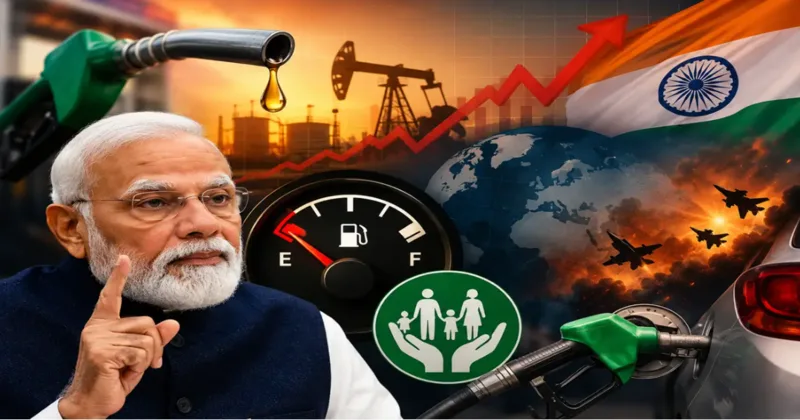
Prime Minister Narendra Modi has appealed to the Indian population to be frugal. He could not have made his appeal at a better time. The region of West Asia is on fire, and the effects of this crisis are starting to affect every household and fuel pump across India. Logistics are strained, the market is jittery, and the price levels are steadily creeping up, affecting even the common man’s pocket.
PM Modi did not soften any blows while making this appeal. In a straightforward manner, the Prime Minister informed the nation that there is a need for some degree of restraint, and the upcoming months will require a lot from each citizen. Governments around the globe are having to make some adjustments because of the crisis in West Asia and the Russia-Ukraine war, which have made all nations reevaluate their expenditure and imports. India is no exception, but India has a Prime Minister who is not afraid to state the obvious.
Conservation is Key: Saving Fuel
The Modi Government’s message is not abstract or metaphysical. It calls for tangible action that would make the lives of Indians change. Citizens are encouraged to use public transport, carpool wherever possible, or opt for electric mobility. Those with the choice can choose to telecommute and save on fuel. One might give pause before making plans for foreign trips and destination weddings abroad. Purchasing gold, which puts strain on the foreign currency reserve, can be delayed. Indians must purchase locally produced goods rather than importing them. Even in their kitchens, the instructions are clear – use less oil while slowly moving toward organic farming that requires fewer expensive chemical fertilizers. Individually, these seem like minor modifications. Collectively, however, when millions of Indians make some of these changes, they could have a significant effect on India’s economy.
India depends on imports for nearly 87 per cent of its crude oil requirement, and that simple fact says it all. Whenever there is any trouble in West Asia or the price of oil goes up globally, its effects are not restricted to these places alone. They make their way to the gas pump within days, and gradually begin raising the price of everything that needs transportation. The Government has tried to mitigate this problem by importing oil from more than forty different nations and through alternate sources. However, these are solutions for the distant future and will have no immediate effect on calming down the volatile oil market. Till then, the only recourse available to the nation is somewhere else.
While it will make no difference if one household refuses to buy foreign cooking oil, the import cost balance sheet will get affected if ten million families refuse to do so. While one individual leaving his vehicle behind and travelling by metro will create little ripples, a similar action taken by a city will create waves. That is precisely what the Prime Minister is banking upon, and really speaking, there is nothing wrong about making such an expectation either. After all, Indians are not unaware of collective discipline. They have observed it during wartime; they practiced it during the pandemic period as well without any coercion from anyone. The only difference now is that the enemy remains invisible in nature. It could be in the form of an oil price somewhere in some distant land, delays in shipment across the Red Sea, or wars being fought thousands of kilometers away. However, its effects will directly affect their shopping experience at the local grocer’s, petrol stations, and electricity bills.
Learning From the Pandemic
Not long ago, COVID-19 lockdown and the subsequent period impacted the lifestyle decisions made by the people of India. For many, this change became permanent. Working and communicating through a hybrid model are being maintained in organisations and Government offices even now. The citizens were concerned about their health and thus started prioritising well-being in terms of both investment of time and money. This led to an inclination towards being rational and thoughtful while making spending decisions to maneuver in an uncertain world.
Governments worldwide have deployed national austerity measures ranging from voluntary conservation appeals to mandatory rationing to conserve foreign exchange and energy. Since transportation is heavily dependent on petroleum, countries have implemented direct limits on private and Government vehicle use. In Sri Lanka, a QR based rationing system has been implemented that caps the weekly fuel allotment for private motor vehicles. Myanmar and South Korea are following the odd even scheme for allowing cars on roads. Egypt has sliced fuel allotment for Government and public vehicles by 30 per cent.
Some nations have implemented the COVID era work arrangements to conserve fuel by cutting down on daily commuting. India, Philippines and Indonesia have implemented a remote work model for their Government officials while Sri Lanka is maintaining a four day short week. To ease the strain on national power grids, Governments are actively curbing non essential power use.
Similar limits have also been imposed in Sri Lanka, Malaysia and Thailand. Jordan has altogether banned air conditioning in public offices. Countries are also opting to restrict non essential imports and curb government spending.
In addition to implementing policy mandates, Governments are also encouraging citizens directly to modify their behaviour. Australia’s Every Little Bit Helps campaign and Singapore’s Let’s Save Energy Together programme both promote voluntary reductions in energy use.
Austerity is not restricted to being a fiscal policy. It is also a cultural measure that transforms societal values, institutions and the shared mindset. Appeals like these promote solidarity amongst citizens who not only re-evaluate their lifestyle to align it with the economic necessities of times but also come forward to support the vulnerable groups of the society who often bear the maximum brunt of such measures. Tough times have never broken India. They have only reminded Indians of what they have in common.
In challenging times of the past, Indian leaders have often reached out to citizens through direct calls. Former Prime Minister Lal Bahadur Shastri appealed to the Indian public to skip one meal every week to conserve food during the severe 1965 food shortage and war with Pakistan. This collective fasting famously came to be known as the Shastri Vrat. These initiatives encouraged both citizens and Government bodies to conserve resources and her administration became well known for enforcing strict statutory austerity measures.
The pandemic years are not so far behind us. People still remember the janta curfew, the banging of plates and ringing of bells, the lighting of diyas on a Sunday night. At the time many questioned the logic of these gestures. But they worked. Not because people were ordered to do them but because they felt part of something larger than themselves. That is the nature of such appeals. They are not policy directives. They are invitations to belong to a shared national moment. And Indians have consistently shown that when that invitation feels genuine they accept it. The current call for economic restraint carries the same spirit. It is asking citizens not just to save fuel or skip a foreign holiday but to see themselves as active participants in protecting the country from an external economic shock. That sense of shared purpose is perhaps the most powerful tool any Government has and right now it is being put to use.
Traditionally, the Indian lifestyle is deep rooted in mindful living, self discipline and austerity which encourages a balanced low impact lifestyle rejecting the excess of modern materialism. Indian households are accustomed to minimalistic living when earnings in the family are disrupted or when resources are stretched. In developing economies people often grow up learning to repair, reuse and conserve what they have. Responsible consumption is naturally blended in the Indian way of living. Unlike societies characterised by excessive consumption Indian families tend to focus on long term saving, minimising food wastage and maintaining financial discipline.
India has never needed to be taught frugality. It has lived it. Every generation of this country has faced a moment where it was asked to do more with less and every generation has found a way. That instinct does not disappear in times of plenty. It simply waits. What the Prime Minister has done is remind a nation of something it already knows. Sacrifice is not foreign to India. Neither is solidarity. And when the two come together as they have before this country has a habit of coming out stronger than anyone expected.