

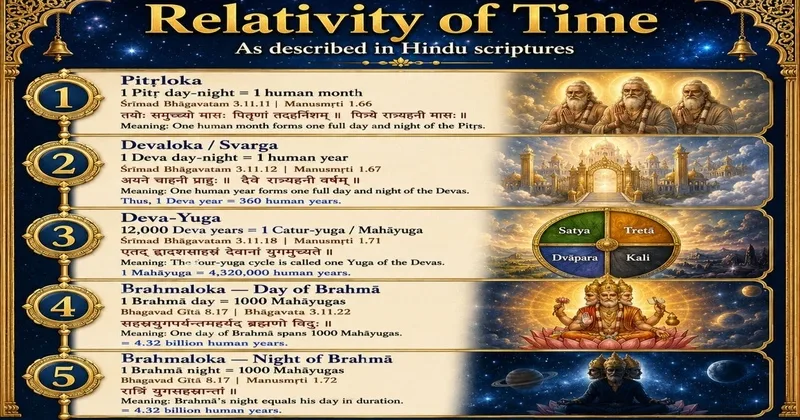
Modern science, especially after Albert Einstein, introduced the idea that time is not absolute. According to relativity, time can move differently depending on gravity, speed, and the curvature of space-time. What appears to be a few moments to one observer may be years to another.
🚨 Modern science calls it “Theory of relativity of time” (Einstein’s)
But Hindu scriptures described differences of time across Lokas (Realms) thousands of years ago.
It is clearly mentioned that in three realms: ie. Pitṛloka, Devaloka (Heaven), Brahmaloka — time does NOT… pic.twitter.com/iwBtLTF48E
— Sarfarosh 🚩🕉️ (@Sarfarosh_IND) May 25, 2026
Remarkably, Hindu scriptures described a layered and non-uniform understanding of time thousands of years ago. The Puraṇas, Bhagavad Gita, Manusmṛti and Śrimad Bhagavatam repeatedly explain that time flows differently across various Lokas (realms of existence). Earthly time is not considered the universal standard. Instead, Kala (Time) is presented as cosmic, divine and relative to the realm in which one exists.
From Pitṛloka to Devaloka and finally Brahmaloka, the scale of time expands enormously. Hindu cosmology presents existence as a hierarchy of dimensions in which higher realms experience vastly different durations than those on Earth.
Time in Pitrloka: Realm of the Ancestors
The first level of scriptural time relativity appears in Pitṛloka, the realm of the Pitṛs, or ancestral beings. The Śrimad Bhagavatam states:
“तयोः समुच्चयो मासः पितॄणां तदहर्निशम्।”
The verse explains that two fortnights of human beings, one full month, become one complete day and night for the Pitrs.
Similarly, Manusmṛti 1.66 declares:
“पित्र्ये रात्र्यहनी मासः…”
Meaning that one human month forms the day and night of beings residing in Pitṛloka.
Thus: 1 Pitṛ day-night = 1 human month. This is the earliest indication that Hindu scriptures viewed time as relative rather than fixed.
Devaloka and Svarga: The Time Scale of the Devas
The next higher realm is Devaloka or Svarga, the celestial world of the Devas.
Bhagavatam 3.11.12 states:
“अयने चाहनी प्राहुर्वत्सरो द्वादश स्मृतः।”
The scripture explains that Uttarayaṇa and Dakṣiṇayana, the two solar movements, together form one day and night of the Devas. For humans, this equals one full year.
Manusmṛti 1.67 also confirms:
“दैवे रात्र्यहनी वर्षं…”
Meaning:
1 human year = 1 Deva day-night. The six months of Uttarāyaṇa are considered the daytime of the Devas, while Dakṣiṇāyana forms their night.
From this calculation:
1 Deva year = 360 human years. Here, the concept of cosmic time expands dramatically. What humans experience as centuries become only a few years in Devaloka.
The Concept of Mahāyuga and Divine Time
Hindu cosmology further develops this idea through the doctrine of the four Yugas, Satya, Treta, Dvapara and Kali.
Śrīmad Bhāgavatam 3.11.18 describes the complete cycle:
“कृतं त्रेता द्वापरं च कलिश्चेति चतुर्युगम्।”
The four yugas together form one Catur-yuga or Mahāyuga.
Manusmṛti 1.71 adds:
“एतद् द्वादशसाहस्रं देवानां युगमुच्यते।”
Meaning that 12,000 divine years constitute one complete Yuga cycle. Since one divine year equals 360 human years, the total becomes:
1 Mahāyuga = 4,320,000 human years. This immense scale demonstrates how Hindu scriptures viewed cosmic existence over millions of years rather than merely human historical timelines.
Brahmaloka and the Day of Brahma
The most astonishing scale of scriptural time appears in relation to Brahma and Brahmaloka.
In the Bhagavad Gita 8.17, Krishna declares:
“सहस्रयुगपर्यन्तमहर्यद् ब्रह्मणो विदुः।”
Meaning:
One day of Brahmā lasts for 1000 Mahayugas. Srimad Bhagavatam 3.11.22 similarly states that 1000 cycles of four yugas make one daytime of Brahmā. The calculation becomes extraordinary:
1 Brahma day = 4.32 billion human years
1 Brahma night = another 4.32 billion years
Thus, a complete day-night cycle of Brahmā equals 8.64 billion human years. Interestingly, modern cosmology also deals with timescales of billions of years regarding planetary and cosmic evolution. Though the approaches are entirely different, the sheer magnitude of time envisioned in Hindu cosmology remains remarkable.
Kakudmi and Revati: A Human Experience of Time Dilation
One of the clearest narrative examples of time relativity in Hindu scriptures is the story of King Kakudmi and his daughter Revati. According to Srimad Bhagavatam 9.3.29–32, King Kakudmi travelled to Brahmaloka with Revatī to seek advice from Brahma regarding her marriage. While they waited briefly as celestial music was being performed, time passed differently on Earth.
Brahmā informed the king:
“कालोऽभियातस्त्रिणवचतुर्युगविकल्पितः।”
Meaning that 27 Catur-yugas had already passed on Earth during their short stay in Brahmaloka.
When Kakudmi returned, his entire civilisation had vanished. Countless generations had disappeared, and humanity itself had changed. The story closely resembles the modern scientific idea where time moves differently for observers situated in different frames of existence.
King Indradyumna and the Lost Kingdom
Another powerful example appears in the Skanda Puraṇa, particularly in the Puruṣottama-kṣetra-mahatmya. King Indradyumna travelled to Brahmaloka seeking divine blessings connected with the worship of Jagannath. However, by the time he returned to Earth, ages had passed. The scripture states:
“गीतगानावसरतो भूयान् कालो गतस्तव।”
Meaning:
During the period of celestial singing in Brahmaloka, a vast amount of earthly time elapsed. His kingdom, dynasty and subjects had all disappeared. Only Jagannath and the sacred site remained. The narrative reinforces the recurring Purāṇic principle that time expands and contracts according to the realm one inhabits.
King Muchukunda and the Power of Time
The story of King Muchukunda in Śrimad Bhagavatam 10.51 also demonstrates this doctrine. Muchukunda aided the Devas in heavenly battles for an extended duration. After he finally returned, the Devas informed him that everyone he once knew had long vanished. The Bhagavatam says:
“ज्ञातयोऽमात्यमन्त्रिणः… नाधुना सन्ति कालिताः।”
Meaning:
His relatives, ministers, friends and subjects no longer existed because Time had consumed them all.
The Devas then declared:
“कालो बलीयान् बलिनाम्।”
Meaning:
Time is stronger than the strongest. This episode highlights not only the relativity of time but also the Hindu philosophical understanding that Kāla ultimately governs all beings, kingdoms and civilisations.
Hindu Cosmology and the Nature of Time
Unlike modern mechanical views of time as a universal clock, Hindu philosophy presents time as:
-Cosmic rather than local
-Layered rather than uniform
-Realm-dependent rather than absolute
-Cyclical rather than linear
The higher the loka, the greater the scale of time. Human perception becomes only one small layer within a vast cosmic framework. In Hindu thought, Kāla itself is often treated as a manifestation of the Divine. Time creates, sustains and destroys worlds. Entire universes emerge and dissolve within cosmic cycles measured through Yugas, Kalpas and the lifespan of Brahmā.
Comparison with Modern Scientific Relativity
It is important to note that Hindu scriptural descriptions and Einstein’s scientific theory arise from entirely different foundations. Modern relativity is based on mathematics, physics, gravity and measurable space-time effects. Hindu cosmology, on the other hand, emerges from metaphysical and spiritual frameworks.
Yet the philosophical similarity is striking:
-Time is not experienced equally everywhere
-Different realms experience different temporal flow
-A short stay in one dimension may equal ages in another
These scriptural ideas demonstrate the extraordinary depth and imagination of ancient Indian cosmology.
Hindu scriptures present one of the most sophisticated ancient visions of cosmic time found anywhere in world civilisation. From Pitṛloka to Brahmaloka, the Puraṇas and allied texts repeatedly emphasise that time is relative to consciousness, loka and cosmic position.
The stories of Kakudmi, Indradyumna and Muchukunda are not merely mythological narratives; they are philosophical illustrations of a universe where time is fluid, layered and vast beyond ordinary human comprehension. Long before modern discussions of time dilation and cosmic timescales, Hindu thinkers were already contemplating realities where millions or even billions of years could pass differently across dimensions of existence. In this vision, Earth time is only one small rhythm within the immeasurable cosmic dance of Kala.