





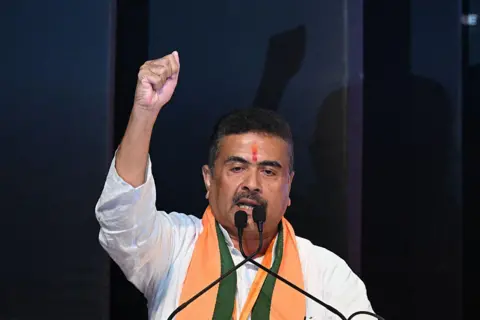
West Bengal is preparing for what could be its most ambitious industrial policy overhaul in years, with Chief Minister Suvendu Adhikari leading a series of consultations with economists, industry leaders, policy experts and senior bureaucrats to formulate a roadmap for economic revival.
According to government sources in media, the discussions are centred on identifying the structural challenges that have discouraged investment in the state over the past two decades and developing long-term solutions to revive Bengal’s industrial ecosystem.
Officials involved in the process say the proposed framework is expected to address key concerns including land availability, industrial infrastructure, logistics connectivity, power subsidies, labour flexibility, ease of doing business and faster approval mechanisms.
A senior bureaucrat familiar with the discussions said the government wants to move beyond headline-grabbing investment announcements and create a sustainable industrial strategy capable of generating long-term growth and employment.
“There is increasing emphasis on building a credible industrial roadmap rather than relying solely on investment summit declarations. The government is examining why industries gradually moved away from Bengal and how the state can prevent further capital flight,” the official said.
Centre and NITI Aayog likely to play key role
The revival strategy is also expected to involve significant coordination with the Union government and policy institutions.
Reports indicate that discussions have intensified following meetings between Chief Minister Suvendu Adhikari and economist Ashok Lahiri, a former BJP MLA from West Bengal who now occupies a prominent position within the national policy establishment.
Officials believe that closer coordination with NITI Aayog and central ministries could help Bengal access expertise and policy support required to accelerate industrial growth.
A source familiar with the deliberations said the state’s revised industrial policy could be announced in the near future after consultations are completed.
From investment summits to ground reality
For years, the Mamata Banerjee-led government projected West Bengal as an emerging investment destination through successive editions of the Bengal Global Business Summit (BGBS), where investment proposals worth thousands of crores were announced and numerous Memoranda of Understanding (MoUs) were signed.
However, industry observers and business groups have repeatedly pointed to a gap between announcements and actual implementation.
Within corporate circles, concerns have often been raised regarding delays in land allocation, administrative bottlenecks, slow approvals, infrastructure constraints, uncertainty surrounding project execution and allegations of local-level interference.
While neighbouring states such as Gujarat, Maharashtra, Tamil Nadu, Karnataka and Uttar Pradesh expanded manufacturing clusters and developed ready industrial parks with plug-and-play infrastructure, Bengal struggled to convert investment intentions into operational projects.
The long shadow of Singur
Any discussion on Bengal’s industrial future inevitably returns to Singur.
The 2006 Singur land acquisition controversy, which led to the exit of Tata Motors’ Nano project from West Bengal, became a defining moment in the state’s politics. While the movement significantly altered the state’s political landscape, many economists believe it also contributed to a prolonged hesitation within the administrative system regarding large-scale industrial projects.
Nearly twenty years later, policymakers are still grappling with the consequences.
Government officials say the new administration is exploring alternative models for industrial land acquisition that minimise conflict while ensuring that industries have access to adequate land.
A senior officer said discussions have focused on frameworks based on voluntary consent, fair compensation, land pooling arrangements, leasing mechanisms and negotiated settlements rather than compulsory acquisition.
The objective, officials say, is to create a predictable and transparent system that balances industrial development with the interests of landowners.
Review of existing industrial parks and unused land
As part of the restructuring exercise, the government has reportedly initiated a review of existing industrial estates, industrial parks and infrastructure projects across the state.
The exercise is expected to identify:
1. Unused industrial land
2. Stalled projects
3. Underperforming industrial zones
4. Delayed infrastructure developments
5. Land parcels that can be quickly made available to investors
Officials believe that optimising existing resources may be faster and less contentious than acquiring entirely new land for industrial projects.
Old MoUs under fresh scrutiny
The government is also examining investment proposals announced during previous Bengal Global Business Summit editions.
A significant number of projects announced over the years either progressed slowly or failed to materialise on the ground despite initial commitments.
This has triggered discussions on creating stronger project-monitoring systems and establishing accountability mechanisms within departments responsible for industrial clearances.
Policymakers are reportedly considering new tracking systems that would regularly monitor project implementation and identify administrative delays before they become major obstacles.
Beyond Subsidies: Restoring investor confidence
Officials involved in the policy exercise acknowledge that financial incentives alone will not be enough to revive industrial growth.
While power subsidies, infrastructure support, logistics improvements and land availability are expected to form key components of the new policy, investors today increasingly prioritise policy stability, predictable governance and administrative efficiency.
Reports note that Bengal possesses several natural advantages, including a large labour force, strategic access to eastern and northeastern India, major ports, rail connectivity and proximity to neighbouring countries. Yet these advantages have not translated into sustained industrial expansion in recent years.
The challenge before the new government, therefore, extends beyond attracting investment proposals. It involves restoring confidence among businesses that projects can be executed without uncertainty, delays or policy reversals.
A bid to restore Bengal’s industrial credibility
Government sources quoted in media say the upcoming industrial restructuring is ultimately aimed at repairing Bengal’s reputation as an investment destination.
Officials believe the state’s industrial decline was not caused by a lack of interest from investors but by a gradual erosion of confidence resulting from policy uncertainty, stalled projects and implementation challenges.
The proposed reforms seek to address these structural issues by creating a more transparent, predictable and investor-friendly environment.









