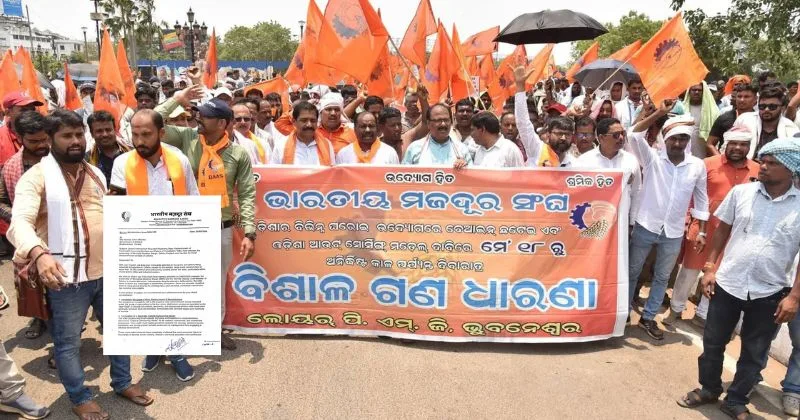
Bhubaneswar: The indefinite protest launched by the Bharatiya Mazdoor Sangh (BMS) in front of the Odisha Assembly against the large-scale retrenchment of contract and outsourcing workers entered its 11th day on May 27.
Despite the intense summer heat and scorching weather conditions, BMS activists and workers have continued their agitation, demanding the protection of labour rights and the dignity of workers across the state. BMS officials stated that more than 15,000 contract and outsourced employees have been removed from service in recent months, creating widespread unrest among labourers and their families.
“Bureaucracy still carries the mindset of the previous BJD regime.”
Addressing the media during the protest, BMS Odisha president Badal Maharana alleged that several senior bureaucrats in different government departments were still functioning with the “mindset and working style of the previous BJD government.” He claimed that such an administrative approach was adversely affecting the transparency and efficiency of the present BJP-led government and damaging its public image.
The labour union also expressed grief and anger over the suicide of worker Tanmay Sen from Balasore, claiming that he took the extreme step due to financial distress and mental pressure caused by retrenchment and job insecurity.
Declaring Tanmay Sen a “martyr of the labour rights movement,” BMS accused the state Labour Department of remaining silent despite the worsening condition of workers. The organisation termed the government’s response “irresponsible” and demanded immediate intervention.
BMS placed several key demands before the state government, including immediate bilateral or tripartite talks involving the Labour Department, industrial managements, and union representatives to resolve the crisis.
The union further demanded an immediate halt to what it described as “illegal and large-scale retrenchment” of workers and sought financial assistance for affected families. It also called for the introduction of a transparent labour policy, keeping in view Odisha’s growing industrialisation.
Among other demands, BMS urged the government to monitor all employment-related activities through a dedicated labour portal, including wage payments, EPF, and ESI benefits. It also demanded that 70 per cent of jobs in industries operating in Odisha should be reserved for local youth.
The organisation additionally sought the abolition of private recruitment agencies and the implementation of a direct recruitment mechanism through the labour portal, based on the Haryana model.
Meanwhile, BMS’s national general secretary, Surendra Kumar Pandey, has written a detailed letter to Odisha Chief Minister Mohan Charan Majhi, seeking his immediate intervention in the matter.
In the letter, Pandey warned that the “absolute apathy” of employers and the failure of official talks had triggered deep resentment among workers. He stated that the ongoing satyagraha agitation, which began on May 18 in front of the Odisha Legislative Assembly, was rapidly intensifying and could lead to widespread industrial and social unrest if left unresolved.
“We draw your immediate attention to the grave and deteriorating industrial atmosphere in Odisha caused by the sudden, large-scale retrenchment of more than 15,000 contract and outsourcing workers across the state, particularly within crucial public utility and industrial sectors,” the letter stated.
The BMS leadership informed the Chief Minister that a high-level meeting held on May 24 between union representatives and Odisha’s Deputy Chief Minister-cum-Power Minister failed to reach any satisfactory conclusion, resulting in a complete deadlock.
The organisation specifically alleged that the retrenchment drive was being carried out in the name of cost-cutting by the four power distribution companies operated under Tata Power in Odisha. BMS demanded the immediate reinstatement of all removed contract, temporary and outsourced workers, with full back wages and continuity of service.
BMS also urged the state government to formulate a separate “Odisha Outsourcing Model” that would legally guarantee job security, standard service conditions, and protection against arbitrary termination by private contractors or management authorities.
Highlighting the larger socio-economic impact, BMS stated that the mass retrenchment had devastated thousands of families across Odisha, pushing many workers into financial distress, poverty, and mental trauma. The organisation warned that the removal of experienced technical manpower was already affecting maintenance and emergency restoration work in the power sector.
According to BMS, a shortage of technical workers could result in prolonged and frequent power outages in both rural and urban areas, severely impacting the general public, agricultural operations, and small industries during peak seasons.
BMS has urged the Chief Minister to convene an immediate high-level tripartite meeting under his chairmanship and issue strict directives to stop the alleged illegal retrenchments before the situation escalates further.